Current graduate students
Speaker: Heather Hoff
Abstract: Software is a key asset of any new business. How do you protect the results of weeks or months of hard labour? Who owns the software and how do I mange its development to ensure its inherent value is maintained? Should I use Open Source, or even contribute to Open Source? What are the benefits and how does this measure up against the risks?
Speaker: Jeffrey Wong
Abstract: Is your work new, and is it useful? Who else knows about it, and how? These are fundamental questions to whether or not a patent can be obtained. Is your idea abstract or tangible? Can software be patented, and if so how? This lecture will cover the criteria for patentability, the process for obtaining a patent and the timeline, and the costs and strategies involved in developing a patent portfolio.
Back by popular demand, CryptoWorks21 will once again launch the Intellectual Property (IP) Management Lunch and Learn Lecture Series! Our knowledgeable speakers will provide more in-depth presentation built from the previous sessions.
The lectures are designed for researchers working in areas related to information technology, including cryptography and quantum technology.
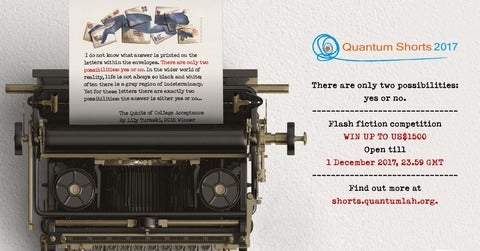
The Institute for Quantum Computing is pleased to announce a call for entries to the Quantum Shorts flash fiction competition. The competition is open to stories up to 1000 words long that take inspiration from quantum physics and include the phrase “There are only two possibilities: yes or no”. The competition is free to enter, offering prizes of up to US $1500.
Neil Julien Ross, Dalhousie University
As we approach the development of a quantum computer with tens of
well-controlled qubits, it is natural to ask what can be done with
such a device. Specifically, we would like to construct an example of
a practical problem that is beyond the reach of classical computers,
but that requires the fewest possible resources to solve on a quantum
computer. We address this problem by considering quantum simulation of
spin systems, a task that could be applied to understand phenomena in
Jiawei Mei - Southern University of Science and Technology, China
The toric code is a topological quantum error correcting code, and an example of a stabilizer code, defined on a two-dimensional spin lattice. It also represents the simplest example of topological order -- Z2 topological order that was first studied in the context of Z2 spin liquid. I will talk about our recent progress in the search for a toric code topological order in the kagome antiferromagnetic spin system.
Colloquium: Mohammad Hafezi, University of Maryland/Joint Quantum Institute
There are tremendous efforts underway to better understand systems with topological order --- global properties that are not discernible locally. The best-known examples are quantum Hall effects in electronic systems, where insensitivity to local properties manifests itself as conductance through edge states which are insensitive to defects and disorder.
Producing Polarization Entangled States Using a Bright Single Photon Source