Waterloo PhD student talks research with Nobel Laureates
Jean-Philippe MacLean is in Germany discussing quantum science at the prestigious 66th Lindau Nobel Laureate Meeting.

Recent developments in quantum computers have spurred renewed interest in quantum-safe solutions for information security [1]. It is now widely accepted that the current public key infrastructures, which are the foundation of cyber security, will not withstand the arrival of the quantum computer [2], [3], and that this arrival will occur with high probability within the next ten to fifteen years. New solutions are called for, and these solutions should at least be partly based on quantum technologies.
Friction is the ubiquitous mechanical process of sticking and energy dissipation at the interface between objects. Despite its technological and economic significance, friction remains poorly understood, being a non-linear, out-of-equilibrium, many-body process. According to the widely known empirical laws of friction, it is proportional to the load on the interface and independent of velocity.
Using a two-color laser field and tungsten nanotips, we showed that multicolor quantum channels led to a twofold increase in quantum efficiency. By gating quantum efficiency with pulse delay, optical control of electron photoemission was attained for fields with modest intensity. In this talk, I will discuss the observed effect and potential applications for nanowire-based photonics transistors and ultrafast spin-polarized electron sources.
On February 11, 2016 it was announced that gravitational waves have been detected affecting an instrument on earth. In addition to the realization of a 100 year old prediction the astounding sensitivity of the detector demanded the approaching and overcoming of seemingly fundamental quantum limits on measuring the motion of 25Kg masses. Quantum mechanics is usually thought of applying only to the very small (zeptogrammes and nanometers).
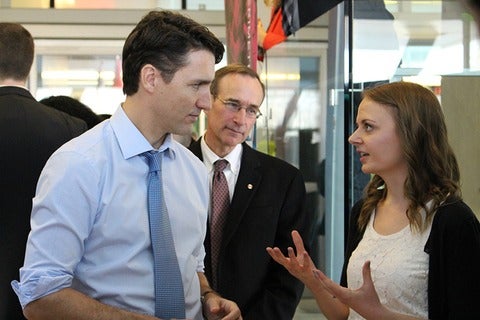
Institute for Quantum Computing (IQC) Executive Director Raymond Laflamme talked quantum computing with Prime Minister Justin Trudeau during a tour of Perimeter Institute for Theoretical Physics (PI) on Friday, April 15, 2016. Their conversation went on to seed a social media sensation that garnered headlines around the world.
The tensor rank of a symmetric tensor is equal to the polynomial rank of some homogeneous polynomial. I will introduce the isomorphism between symmetric states and homogeneous polynomials.
How can we find operational notions of local agents within a global theory? In this talk, I will present an operational way to model the effective state spaces of individual agents, as well as the range of their actions. I will then address the aspects of locality relevant to derive independence and non-signalling conditions between agents. This approach establishes an operational connection between local action and local observations, and gives a global interpretation to concepts like discarding a subsystem or composing local functions.
Imagine a movie showing particles in a gas moving and colliding with each other. Then when you play the movie backwards the velocity of the particles will be opposite, but their motion is still governed by the same laws of physics – we could just as well call the backwards film “forward” – there is no fundamental way to distinguish the arrow of time. This is called time-reversal symmetry.
Yuval Sanders of the Department of Physics and Astronomy will be defending his thesis:
Characterizing Errors in Quantum Information Processors
Yuval is supervised by Professors Raymond Laflamme and Frank Wilhelm-Mauch.