Faculty

Monday, November 19, 2018 2:30 pm - 2:30 pm EST (GMT -05:00)

Quantum proof systems for iterated exponential time, and beyond

Henry Yuen, University of Toronto

An outstanding open question in quantum information theory concerns the computational complexity of nonlocal games. in a nonlocal game, a classical verifier interacts with multiple players that cannot communicate, but are allowed to share entanglement. In a recent breakthrough result, Slofstra showed that the following problem is undecidable: given a nonlocal game, is there a quantum strategy for the players to win with probability 1?
Thursday, November 15, 2018 7:00 pm - 7:00 pm EST (GMT -05:00)

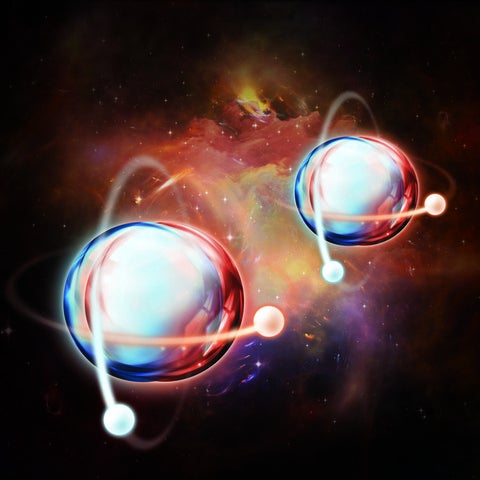
Entangled: The series

QUANTUM + Pop Culture

“Quantum physics” has taken its position with “rocket science” in pop culture as a shorthand for frighteningly complicated science. Quantum physics has also taken on a sort of magical connotation in fiction, with features like entanglement, superposition, and tunneling spurring imagination. But where does the science draw the line? How much is joyful speculation, and how much is disregard for reality? And if it’s always seen as either magical or scary, how does that affect the perception of quantum science?

Thursday, November 1, 2018 7:30 pm - 7:30 pm EDT (GMT -04:00)

Quantum + Beer

Quantum + Beer

Thursday, November 1
7:30 pm
Patent Social - 17 Erb Street East, Waterloo

Experience the unique combination of quantum physics and craft beer and learn how they are anecdotally intertwined.

A step further for secure quantum communication and scalable quantum computing

A team of researchers at the Institute for Quantum Computing (IQC) generated three-photon entanglement on a superconducting chip using a new, scalable technique.

The experiment, published in Physical Review Applied, could lead to advances in quantum communication protocols like secret sharing and in quantum computing power.

Friday, November 2, 2018 11:45 am - 11:45 am EDT (GMT -04:00)

RAC1 Journal Club/Seminar Series

Topological cavity states in two-dimensional photonic/phononic chips

Jian-Hua Jiang, School of Physical Science and Technology, Soochow University

Topological insulators are electronic systems with an insulating bulk and topologically protected boundary states. Conventional 2D topological insulators induce 1D edge states. Recent studies indicate that lower-dimensional topological states are also possible in electronic systems, which, however, has been confirmed only in Bismuth in experiments [1].

Friday, October 19, 2018 12:30 pm - 12:30 pm EDT (GMT -04:00)

RAC1 Journal Club/Seminar Series

The study of high-efficiency magnetization reversal using spin-orbit coupling

Dongseuk Kim, Quantum Technology Institute, KRISS, South Korea

In recent years, the magnetic random-access memory (MRAM) have been attracting attention as a next generation memory device due to their fast switching speed and non-volatility characteristics. The biggest challenge for the switching device using a magnetic material is an easy magnetization reversal.

Monday, October 29, 2018 2:30 pm - 2:30 pm EDT (GMT -04:00)

Trapped Ion Experiments at Sandia National Laboratories

Susan Clark, Sandia National Laboratories

Sandia National Laboratories is a multidisciplinary National Laboratory in the United States dedicated to developing advanced technologies. Here, I will explain the ongoing work in quantum information science using trapped ions. In particular, I will describe requirements of surface ion traps fabricated at Sandia’s MESA facility. Additionally, I will discuss results obtained using these traps relevant to building a quantum information platform, including ion shuttling, electric field control, and high-fidelity quantum operations.