RAC1 Journal Club/Seminar Series
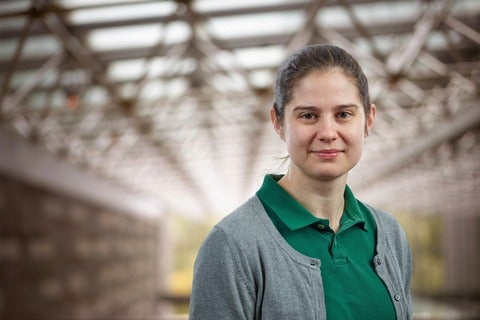
Crystal Senko: Ion traps and multi-level quantum systems
I give an overview of trapped ion quantum information experiments and discuss prospects for implementing multi-valued quantum logic using trapped ions.

Whenever one is tempted to employ a quantum system for any kind of applications, the focus usually lies on two properties setting it apart from a system described by a classical theory, namely the coherent superposition of different quantum states and entanglement between two ore more constituents forming the system.
Candidate: Hyeran Kong
David R. Cheriton School of Computer Science
We give a dissipative quantum search algorithm that is based on a novel dissipative query model. If there are $N$ items and $M$ of them are marked, this algorithm performs a fixed-point quantum search using $O(\sqrt{N/M}\log(1/\epsilon))$ queries with error bounded by $\epsilon$. In addition, we present a continuous-time version of this algorithm in terms of Lindblad evolution.
David R. Cheriton School of Computer Science
We present a quantum algorithm for simulating the dynamics of Hamiltonians that are not necessarily sparse. Our algorithm is based on the assumption that the entries of the Hamiltonian are stored in a data structure that allows for the efficient preparation of states that encode the rows of the Hamiltonian. We use a linear combination of quantum walks to achieve a poly-logarithmic dependence on the precision.
Metal halide perovskites (MHPs) are revolutionizing the solar cell research field - the record power conversion efficiency of MHPs based solar cells has reached 22.7%, which rivals that of silicon solar cells. What is particularly exciting about MHPs is that they can be manufactured into solar cell devices at low-costing using low temperature solution processing. Based on these attributes, MHPs have been called the “next big thing in photovoltaics” and worldwide research efforts have grown explosively.
Entangled photons offer an exquisite probe to correlated dynamics within a material system. In my talk I shall discuss some recent experiments and our theoretical investigations into developing an input/output scattering theory approach that connects an incoming photon Fock state to an outgoing Fock state, treating both the internal (material) and photon dynamics on a consistent footing. As proof of concept, we show how entangled photons can probe the inner workings of a model system undergoing spontaneous symmetry breaking.
April 12, 2018 – Ottawa, Ont. – National Defence/Canadian Armed Forces
Stealth aircraft in the Canadian arctic will be no match for a new quantum radar system.
Researchers at the University of Waterloo are developing a new technology that promises to help radar operators cut through heavy background noise and isolate objects —including stealth aircraft and missiles— with unparalleled accuracy.