PPLN-based photon pair sources toward biphoton quantum frequency
PhD Thesis Presentation
Candidate: Aimee Gunther

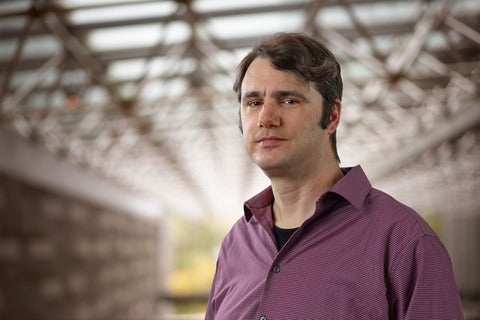
Chris Ferrie will take you through a historical journey of his own coming of age with digital software and what that experience has granted him. The lesson to be learned is that children will take advantage of the opportunities they are given, but only if their parents and teachers show genuine interest in the activities giving rise to those opportunities. 20 years from now, there will be a Quantum Technology equivalent of Bill Gates. That future leader is only a young child today.
Candidate: Theerapat Tansuwannont
Supervisor: Debbie Leung
Candidate: Dusan SarenacSupervisor: David Cory
On deposit in the Science graduate office, PHY 2013.
Oral defence Monday, June 4, 1:30 p.m., RAC 2009.
A brief history and overview of the requirements to guide the research and development for high-coherence superconducting quantum circuits will be given. The main focus will be on materials development at NIST. Topics will include identifying and mitigating loss due to amorphous two-level systems at interfaces and how to scale the fabrication of small aluminum-oxide tunnel junctions. The junctions were studied with atom probe microscopy to get an understanding of where the oxidation occurs.
Candidate: Thomas McConkey
Supervisors, Matteo Mariantoni, Amir H. Majedi. On display in the Engineering graduate studies office, DWE 3520C. Oral defence Friday, June 1, 10:00 a.m., EIT 3142.
In recent years, circuit quantum electrodynamics (QED) has seen considerable efforts towards protecting quantum information from unwanted sources of decoherence through quantum error correction. Independent of the implementation, this is based on encoding a logical qubit into a stable manifold within a larger Hilbert space, whose symmetries restrict the number of independent errors and make them detectable and correctable.
Jon Yard, IQCAbstract: Quantum-mechanical amplitudes and unitaries are typically expressed over the complex numbers. Because there is a continuum of complex numbers, classical computations of quantum systems generally utilize finite-precision approximations by rational numbers.
The resource theory of quantum coherence studies the off-diagonal elements of a density matrix in a distinguished basis, whereas the resource theory of purity studies all deviations from the maximally mixed state. We establish a direct connection between the two resource theories, by identifying purity as the maximal coherence, which is achievable by unitary operations. The states that saturate this maximum identify a universal family of maximally coherent mixed states.
The Natural Sciences and Engineering Research Council of Canada (NSERC) reappointed Kevin Resch, interim director of IQC, as Canada Research Chair (CRC) in Optical Quantum Technologies. The five-year Tier II appointment, will allow Resch and his team to bring three streams of optics research together in order accelerate the development of quantum technologies.