Staff

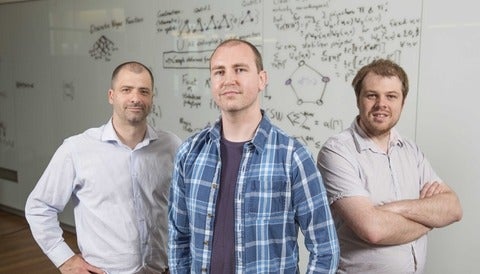
A form of quantum weirdness is a key ingredient for building quantum computers according to new research from a team at the University of Waterloo’s Institute for Quantum Computing (IQC).

In a new study published in the journal Nature today researchers have shown that a weird aspect of quantum theory called contextuality is a necessary resource to achieve the so-called magic required for universal quantum computation.
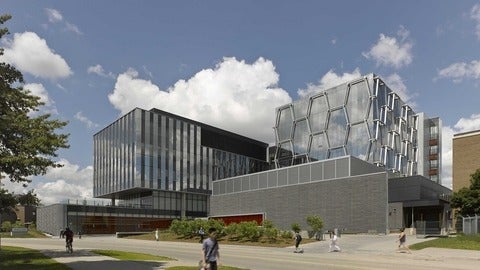
WATERLOO, Ont. (Thursday, May 1, 2014) – The Province of Ontario renewed its investment in world leading quantum technology research today allotting $25 million to the Institute for Quantum Computing at the University of Waterloo over five years.

“We are extremely grateful that the Province of Ontario continues to create the conditions for Ontario, and Canada, to lead the world in quantum information research," said Feridun Hamdullahpur, president and vice-chancellor of Waterloo.

Thursday, April 17, 2014 12:00 pm - 1:00 pm EDT (GMT -04:00)

Kothari: Exponential improvement in precision for simulating sparse Hamiltonians

Robin Kothari

We provide a quantum algorithm for simulating the
dynamics of sparse Hamiltonians with complexity sublogarithmic in
the inverse error, an exponential improvement over previous methods.
Unlike previous approaches based on product formulas, the query
complexity is independent of the number of qubits acted on, and for
time-varying Hamiltonians, the gate complexity is logarithmic in the
norm of the derivative of the Hamiltonian. Our algorithm is based on
a significantly improved simulation of the continuous- and

Monday, April 21, 2014 1:00 pm - 1:00 pm EDT (GMT -04:00)

Imai: NMR as a low energy probe of condensed matter

Takashi Imai, McMaster University

NMR (Nuclear Magnetic Resonance) is a versatile probe of condensed matter, and has a broad range of applications in chemistry, medicine (MRI), oil industry, etc. NMR has become so popular outside the conventional realm of physics that the crucial role NMR has been playing in condensed matter physics is sometimes overlooked. I will explain how condensed matter physicists use NMR as a powerful low energy probe of solids, drawing examples from modern research into statistical physics, magnetism, and superconductivity.

Tuesday, April 8, 2014 11:00 am - 11:00 am EDT (GMT -04:00)

Fan: Quantum receivers beyond the stand quantum limit of coherent optical communications

Jingyun Fan, National Institute of Standards and Technology

Measurements based on the quantum properties of physical system have enabled many tasks which are not possible by any classical means. In this talk, I introduce two quantum receivers that discriminate nonorthogonal optical coherent states unconditionally surpassing the standard quantum limit, with mean photon numbers ranging from single photon level to many photons, thus bridging the gap between quantum information technology and state-of-the art coherent communications.

Tuesday, January 24, 2012 12:00 pm - 1:00 pm EST (GMT -05:00)

Leonardo Neves: Measurement of spatially encoded photonic qudits

Leonardo Neves

Abstract

In this seminar we will address some measurement strategies for extracting information carried by single photons transmitted through a multi-slit array, the so-called spatial qudits. The focus will be on the methods to implement projective-like measurements and positive operator valued measurements. Applications in quantum state tomography and quantum state discrimination will be discussed.

Thursday, July 14, 2011 6:30 pm - Friday, July 15, 2011 8:30 pm EDT (GMT -04:00)

The Quantum Physics of Harry Potter

Post for The Quantum Physics of Harry Potter From invisibility cloaks to teleportation, Harry Potter’s world is filled with mystery and wonder. Yet this magical world is not so different from the world we inhabit. Just beneath the surface of our ordinary lives is a strange quantum reality.