Remembering Stephen Hawking

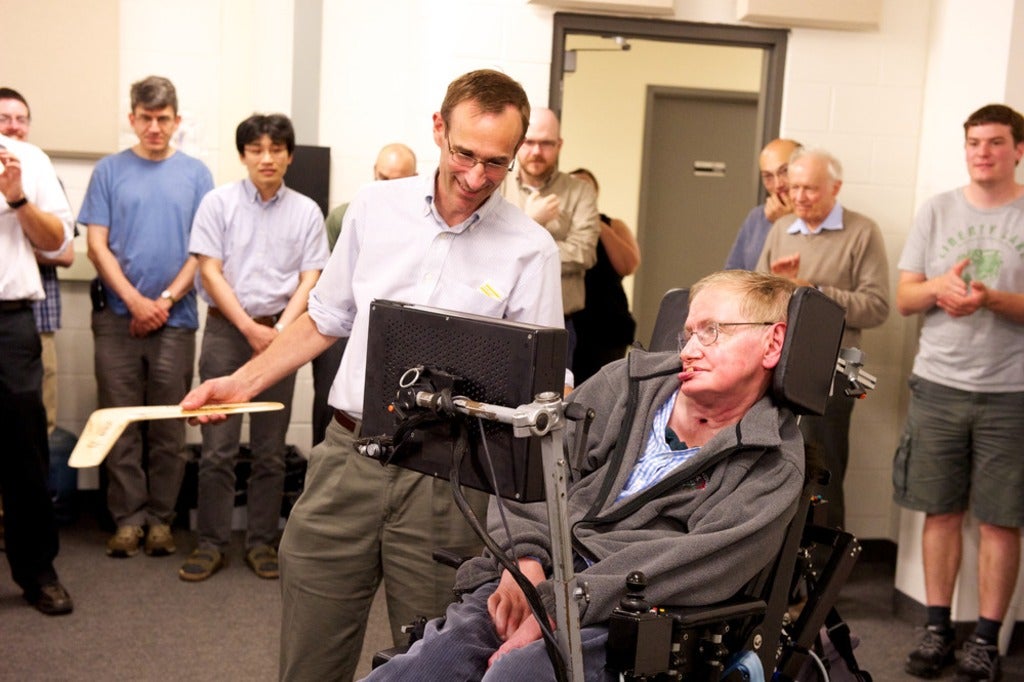
The scientific community, and the world, is deeply saddened by the news of Professor Stephen Hawking’s passing.
The scientific community, and the world, is deeply saddened by the news of Professor Stephen Hawking’s passing.

Researchers at the Institute for Quantum Computing (IQC), in collaboration with researchers from the National Institute of Standards and Technology (NIST) and the National Institute of Health (NIH), have developed a neutron interferometry technique that is more powerful, robust and practical than existing techniques, paving the way for advances in imaging, materials science, and fundamental physics and quantum research.
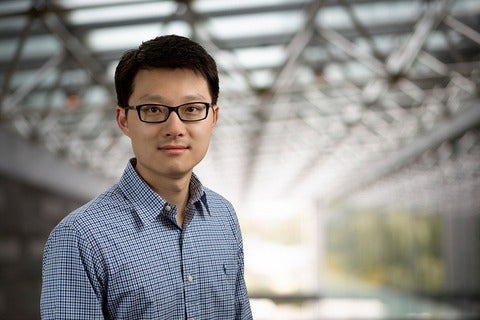
Wei Tsen, assistant professor at the Institute for Quantum Computing (IQC) and the Department of Chemistry, is one of eleven University of Waterloo researchers receiving an Early Researcher Award, the Government of Ontario announced.
The Royal Bank of Canada (RBC) is opening a cyber security lab and investing $1.78 million into research at the University of Waterloo to develop advanced cybersecurity and privacy tools, announced today.

The Canadian Space Agency (CSA) is awarding $1.5 million to the Institute for Quantum Computing (IQC) to lead the science of a mission called the Quantum Encryption and Science Satellite (QEYSSat), which will protect the communications and data of Canadians on Earth and in space.
Christine Muschik joins the Institute for Quantum Computing (IQC) as an Assistant Professor in the Department of Physics and Astronomy at the University of Waterloo.
A team of researchers at the Institute for Quantum Computing (IQC) demonstrated a new type of on-demand single photon generator that can shape photons to increase their efficiency when used in a quantum network.
Next-generation communication networks will rely on the transmission of quantum information. Single photons, as carriers of quantum information, will play an integral role in building these future networks.
Faculty member Norbert Lütkenhaus has been named a Fellow of the American Physical Society. He is recognized for his “pioneering theoretical contributions to the fields of quantum secure communications and optical quantum information processing.”
A light emitting diode (LED)-based spectrophotometer designed and implemented by Institute for Quantum Computing (IQC) researchers is the first demonstration of characterizing optical coatings using a simple, automated device.
Quantum machine learning and artificial intelligence, quantum-safe cryptography, and simulation of quantum systems all rely on the power of quantum computing.
A team of researchers at the Institute for Quantum Computing (IQC) have taken a step closer to realizing the powerful possibilities of a universal quantum computer. The Laboratory for Digital Quantum Matter, led by faculty member Matteo Mariantoni, is developing technologies for extensible quantum computing architectures based on superconducting quantum devices.