The Knowledge Integration¹ program at the University of Waterloo is one of a kind. By the end of their degree, Knowledge Integration students are equipped with a broad set of highly transferable skills and a very unique and important type of expertise.² But what does this expertise actually look like? What does it mean to be a knowledge integrator? Read on to find out.
Important notes:
¹ To make it easier for readers to distinguish between the Knowledge Integration program at the University of Waterloo versus the broader idea of the knowledge integration process and knowledge integrators as a type of individual, any mention of the Knowledge Integration program has been written in italics.
² The term “expertise” usually implies that one has achieved mastery in a particular field. I use the term “expertise” more loosely to refer to the general knowledge and skills that knowledge integrators have. Some knowledge integrators might have expertise at the level of mastery if they go on to pursue this area at the graduate level, but others (such as students in the Knowledge Integration program at the University of Waterloo) might still be developing this area of expertise. Importantly, this is not unique to students in the Knowledge Integration program: no undergraduate students become full-fledged experts in a topic by the end of their degree. Further education is always necessary to become an expert.
Jump To:
The two-page overview of this webpage is available to download.
Key Takeaways
- What is knowledge integration?
Knowledge integration is the process of combining ideas and methods from different disciplines, perspectives, and ways of knowing to create a new, more holistic understanding of a problem or topic. - Why is knowledge integration important?
Today’s complex problems, such as climate change, food insecurity, and health inequality, have too many interconnected components to be tackled from just one perspective. We need to engage in knowledge integration to solve these problems. Many disciplines and stakeholders need to work together, integrating their unique perspectives to generate effective and holistic solutions. - What are knowledge integrators and why are they important?
Knowledge integrators are individuals who have the expertise to make knowledge integration happen. Specialists don’t usually get this type of training so we need knowledge integrators to facilitate integration processes. - What unique expertise do knowledge integrators have?
Knowledge integrators have expertise in four core areas that can be summarized as “The Four Cs”: Cross-disciplinary thinking, Collaboration, Communication, and Complex problem-solving. - What mindsets and characteristics are necessary to do knowledge integration work?
Knowledge integrators need to value diverse perspectives, and they need to be curious, open-minded, flexible, creative, willing to take risks, comfortable with uncertainty, perseverant, and patient. - What are the different types of knowledge integrators?
Knowledge integrators can be described as T-Shaped, Pi-Shaped, or Comb-Shaped depending on how many additional disciplines they choose to specialize in. - Where do knowledge integrators work?
Knowledge integrators work in a variety of fields and sectors!
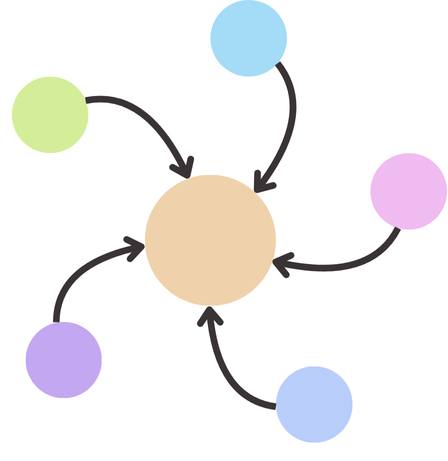
Knowledge Integration:
The process of combining ideas and/or methods from different disciplines, perspectives, and ways of knowing to create a new, more holistic understanding of a problem or topic.
Key Features of Knowledge Integration
Knowledge integration is the foundation of interdisciplinary and transdisciplinary work.
The terms “multidisciplinary”, “interdisciplinary”, and “transdisciplinary” are often used interchangeably but they actually mean different things; they describe different levels of integration work. Read more about the differences between these terms here.

Knowledge integration can be done individually or in teams.
Knowledge integration is usually a collaborative activity where individuals from different backgrounds come together to combine their expertises together. However, it can also be carried out individually. For example, in the 1860s, Austrian biologist Gregor Mendel combined his knowledge of biology with ideas from statistics to create a new understanding of how genetic traits get passed down.
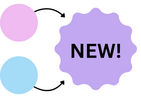
Knowledge integration is an academically rigorous activity because it creates new knowledge!
The process of combining ideas or methods from different fields of knowledge generates a new understanding of something.
Why is Knowledge Integration Important?
Today’s complex problems cannot be solved by single disciplines or fields alone. Problems such as climate change, food insecurity, and health inequality have too many interconnected components to be tackled from just one perspective. We need to engage in knowledge integration to solve these problems. Many disciplines and stakeholders need to work together, integrating their unique perspectives to generate effective and holistic solutions.
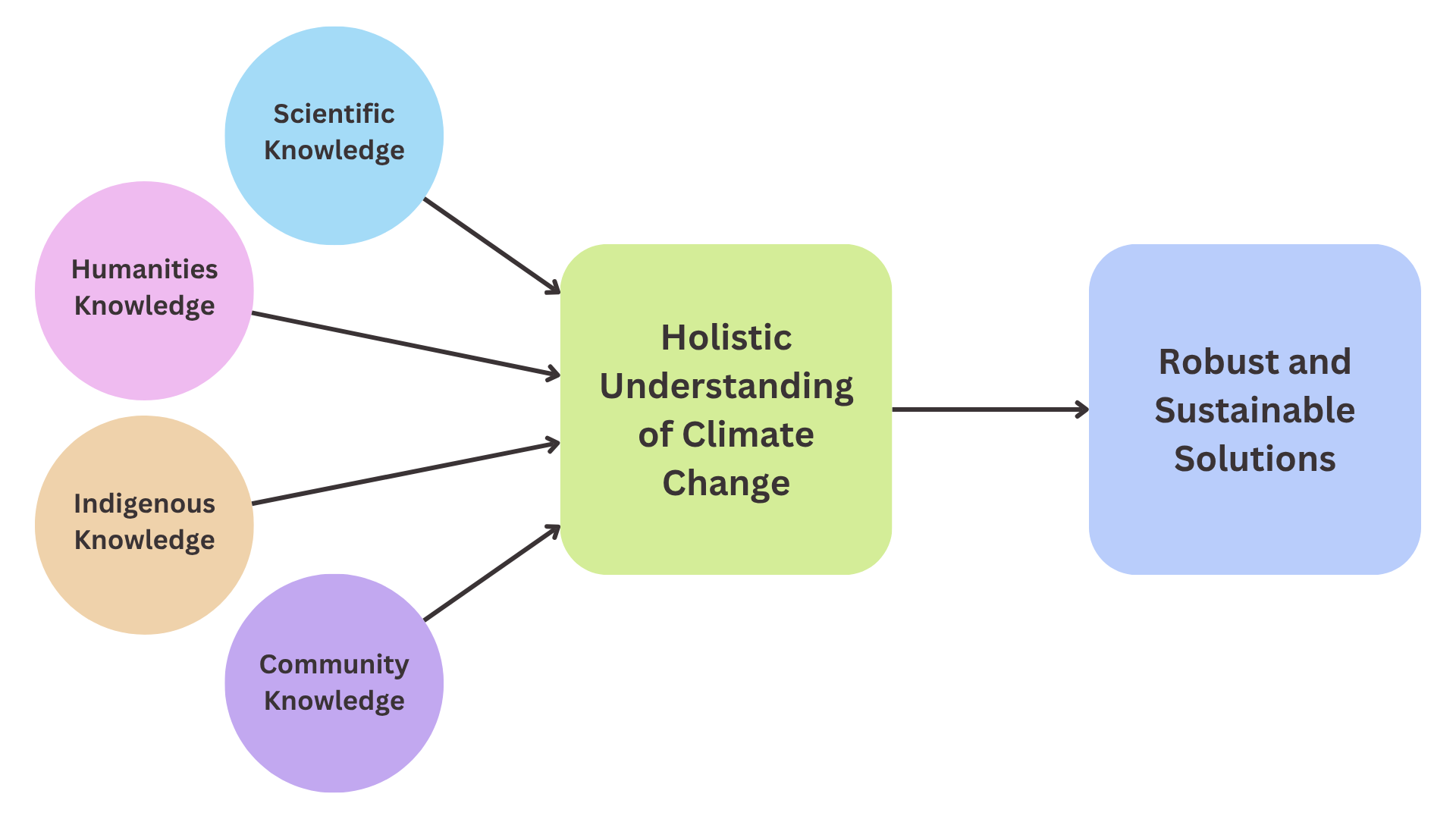
For example, to address climate change, we need to consider the interconnections between environmental, social, and economic factors. To do this we need to combine the expertise of scientists from multiple scientific disciplines, the expertise of people working in humanities fields, the knowledge of Indigenous peoples who have been caring for the land for a long time, and the knowledge of impacted communities. This will enable us to create a holistic understanding of climate change and find solutions that are robust and sustainable.
Why Does the World Need Knowledge Integrators?
Our world likes to put knowledge into boxes. This is reflected in the way our universities are designed. Universities are made up of departments that each focus on a particular branch of knowledge, often called a discipline. Examples of disciplines include ecology, economics, and engineering. These disciplines each have their own framework to understand and investigate the world. This framework is called a paradigm. It includes the discipline’s set of assumptions, questions, theories, and vocabulary to talk about the world. It also includes the discipline’s beliefs about what problems should be addressed and the particular methods they use to generate new knowledge. When individuals specialize in a discipline, they will learn its paradigm and use it to guide the work they do.
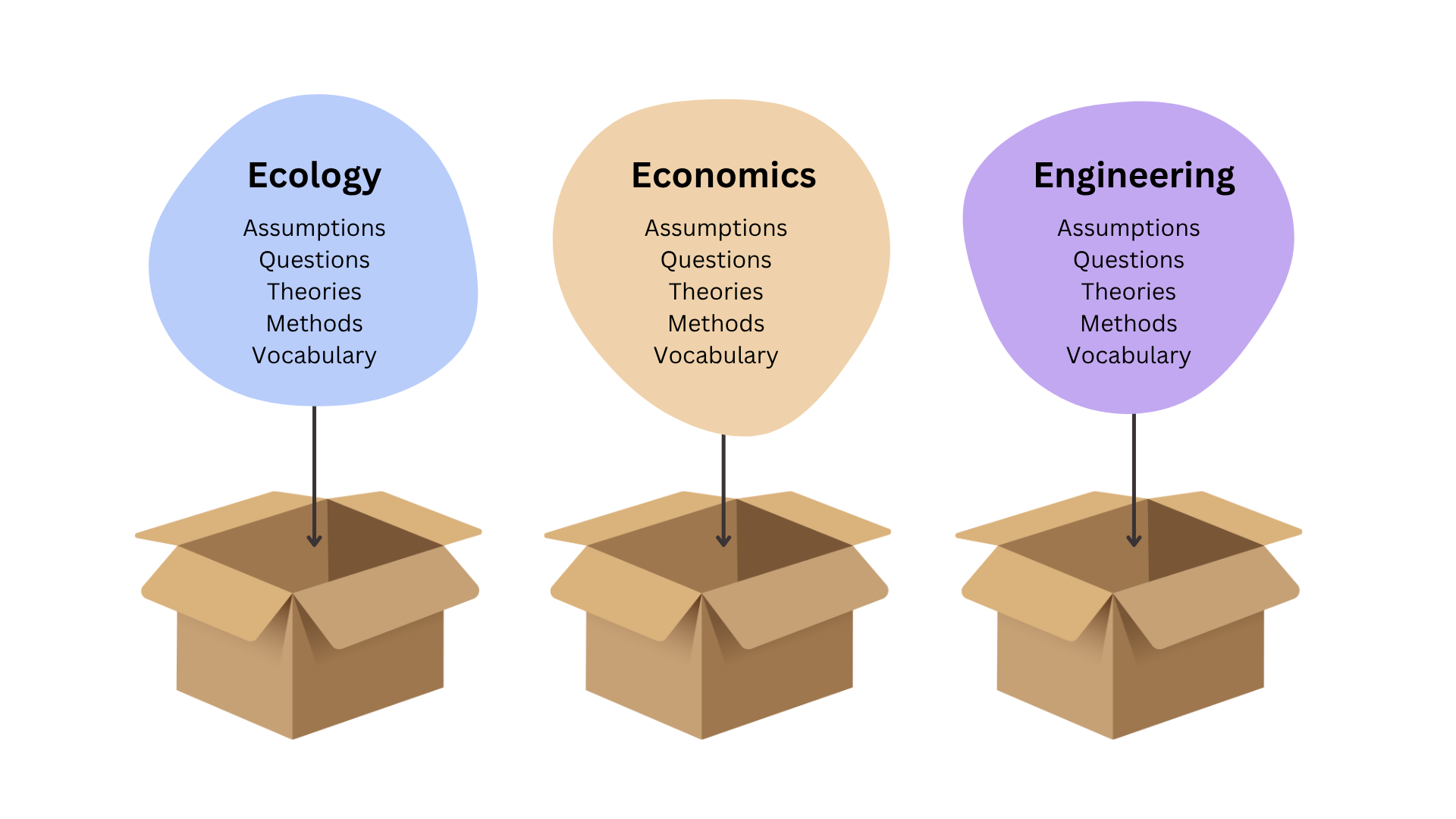
The presence of different disciplinary paradigms makes it challenging to do knowledge integration work. This is because different disciplines struggle to understand and communicate effectively with each other. For example, to address climate change, experts from disciplines such as ecology, economics, and engineering need to collaborate to develop robust solutions. However, it is challenging for them to share their knowledge and work with one another because they each work within a different disciplinary paradigm.
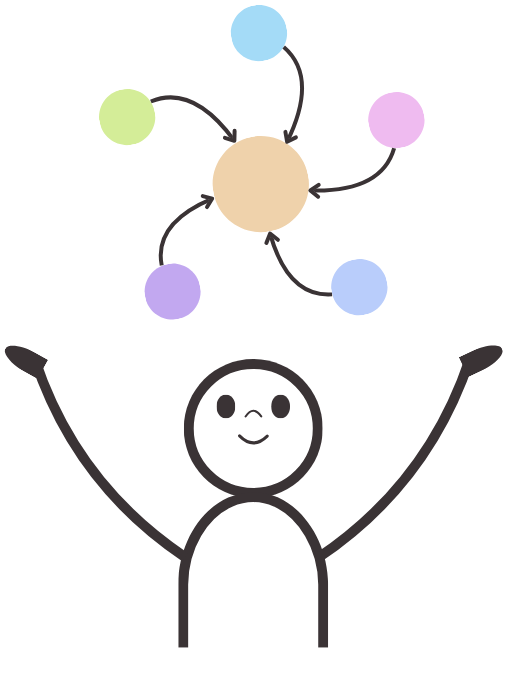
It takes a special kind of expertise to fully understand what paradigms are and how to work between them to make knowledge integration happen. Individuals who are trained in one specialized discipline are not usually taught how to work between paradigms but knowledge integrators are. Knowledge integrators have the expertise that is needed to connect people and knowledge from diverse fields to solve complex problems. Let’s break this expertise down.
Knowledge Integrators:
Individuals who have expertise in connecting people and knowledge from diverse fields, often to solve complex problems.
What Does Knowledge Integrator Expertise Look Like?
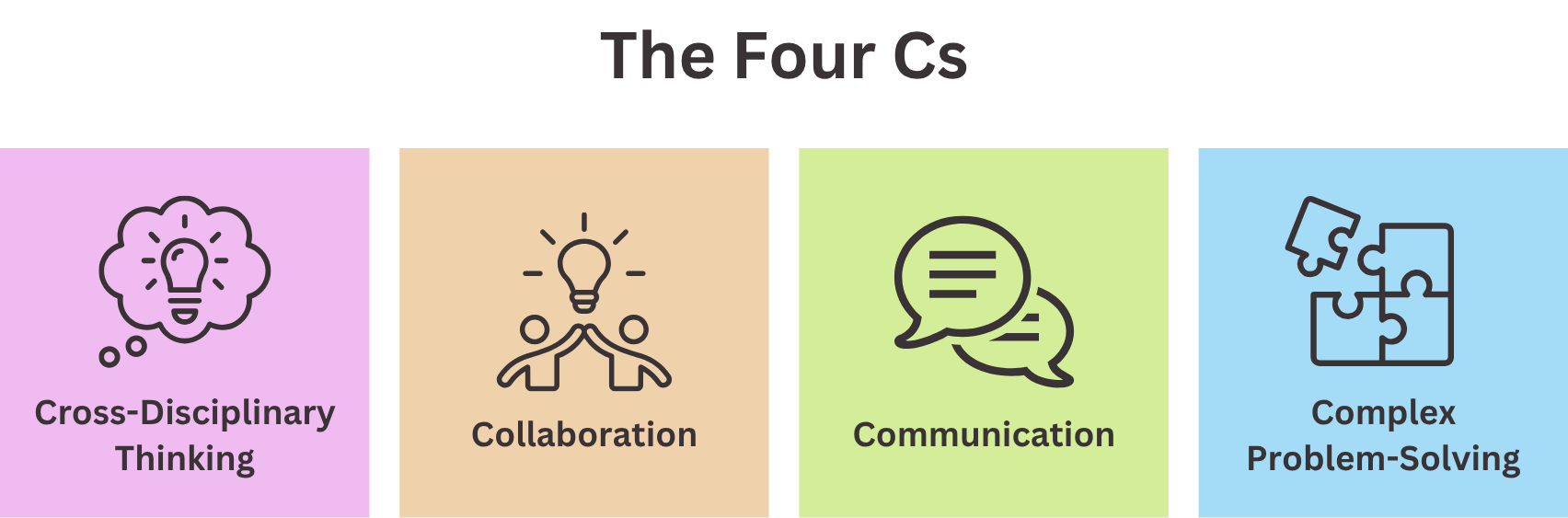
Knowledge integrators have expertise in four key areas to make knowledge integration happen. These can be summarized as “The Four Cs”. They include: Cross-disciplinary thinking, Collaboration, Communication, and Complex-problem solving. Importantly, these four areas also align with the top attributes that employers look for in recent graduates.
Cross-disciplinary Thinking
Knowledge integration is all about combining ideas and methods from different disciplines and fields. Knowledge integrators have a breadth of knowledge across various disciplines which makes them able to find common ground and make connections between disciplines that might look very different on the surface.
Key Skills
- Understanding different ways of knowing
Knowledge integrators are able to understand how different disciplines or fields think about a problem or topic. They are able to learn the language, theories, and methods of other disciplines with enough depth to make connections between them. - Finding commonalities
Knowledge integrators are able to see past disciplinary differences to find common ground. - Applying and repurposing knowledge
Knowledge integrators are skilled at applying knowledge in new contexts.
Collaboration
Knowledge integration often happens in cross-disciplinary teams where collaboration is an essential activity. Cross-disciplinary collaboration is a type of work that needs to be learned and practiced, just like any other type of work. Disciplinary experts rarely get this training in their specialized programs, though knowledge integrators do.
Key Skills
- Relationship building
Knowledge integrators know that strong relationships are critical for effective collaboration. They have tools to help group members connect with one another and build a strong team culture. - Creating team processes
Groups need to have effective team processes to make collaboration work. Knowledge integrators have the skills to help groups create and maintain these processes. - Conflict management
Conflict is an inevitable part of team work. In fact, healthy conflict is a good thing. It helps teams find strong, creative solutions to problems. However, conflict can become detrimental to a team if it is not managed well. Knowledge integrators have the skills to help teams work productively through conflict.
Communication
Knowledge integrators are skilled at communicating with individuals from different backgrounds. This is essential for engaging in knowledge integration work. Whether knowledge integrators are directly involved in integrating their own knowledge with the knowledge of others on a collaborative team, or they are working as the translator between people from different disciplines, knowledge integrators need to communicate with people from diverse fields. This requires a specific set of skills.
Key Skills
- Asking good questions
Knowledge integrators are able to ask questions to uncover how different disciplines and fields understand something. - Communicating in different modalities
Knowledge integrators are skilled writers, speakers, and visual communicators. - Translating knowledge
Knowledge integrators are able to take complex information and translate it into language that can be easily understood by others. This skill is very important because disciplines often use a lot of complicated jargon. Some knowledge integrators engage in a specific type of translation work called knowledge brokering. Knowledge brokering is the process of translating academic research into a format that can be used in the real-world.
Complex Problem-Solving
Knowledge integrators are often doing work that aims to tackle complex, real-world problems. This means they often have expertise in specific problem-solving skills and techniques.
Key skills:
- Understanding problems
Knowledge integrators are able to think systemically and holistically. They can see how different perspectives and disciplines relate to the same complex problem. - Brainstorming solutions
Knowledge integrators know many techniques to brainstorm creative ideas. They also know techniques to pick the most feasible and fitting solutions. - Problem-solving methods
Knowledge integrators are able to use specific problem-solving methodologies to tackle complex problems.
Value diverse perspectives
Knowledge integrators understand that diversity in teams enhances creativity and leads to more robust solutions. This mindset is crucial to effectively engage in cross-disciplinary collaboration because knowledge integrators see the value in drawing on many different perspectives to solve a problem. They can also share the importance of this mindset with others on the team.
Curious, open-minded, and flexible
Knowledge integrators are eager to learn and open-minded to new ideas. They know their perspective is limited and they are willing to change it in light of new information. These characteristics are critical to engaging in cross-disciplinary thinking, collaboration, and complex-problem solving.
Creative
Knowledge integrators are imaginative, abstract thinkers. They can look outside the box to make new connections. Creativity allows knowledge integrators to engage in cross-disciplinary thinking, communicate complex ideas in new ways, and brainstorm new ideas to solve complex-problems.
Willing to take risks
Knowledge integrators are willing to challenge the status quo and work outside of traditional academic disciplines. This characteristic is crucial when engaging in knowledge integration work, which is seeking to break down the boundaries of traditional disciplines.
Comfortable with uncertainty
The processes of integrating knowledge and solving complex problems rarely follow a linear path. Being comfortable with uncertainty means that knowledge integrators are able to work on non-linear projects and trust that everything will work out in the end.
Perseverant and patient
Knowledge integrators have the perseverance and patience to work through the challenges that knowledge integration work presents, such as team conflicts and facing roadblocks during complex problem-solving processes.
What are the Different Types of Knowledge Integrators?
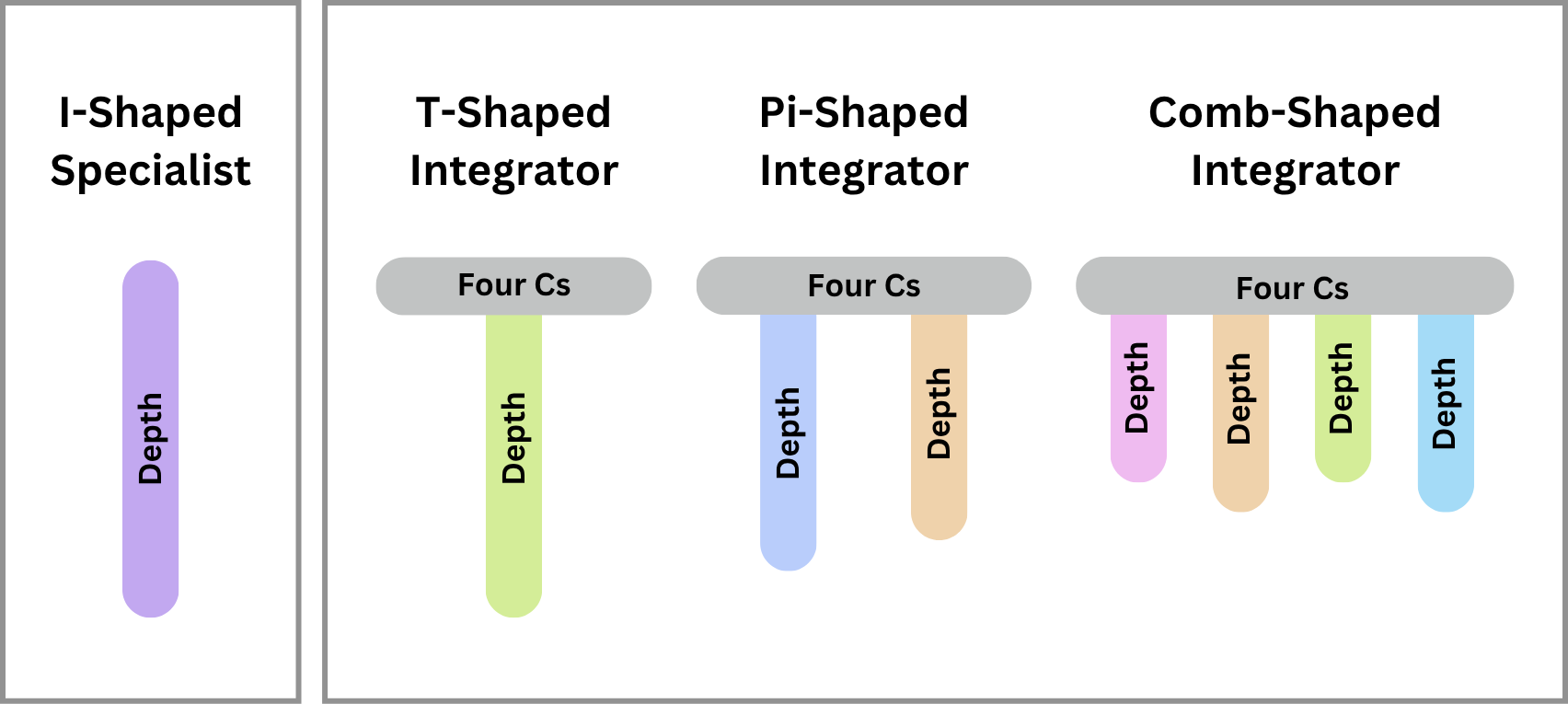
Knowledge integrators tend to gain a depth of knowledge in one or more academic disciplines in addition to their knowledge integrator expertise in cross-disciplinary thinking, collaboration, communication, and complex problem-solving. We can see this among the different shapes of integrators: T-Shaped Integrators, Pi-Shaped Integrators, and Comb-Shaped Integrators (in contrast to I-Shaped Specialists).
T-Shaped Integrators
T-Shaped Integrators are individuals who have a depth of knowledge in ONE academic discipline (the vertical trunk of the “T”) in addition to their knowledge integration expertise (the horizontal bar of the “T”). Although they do specialize in one main area, their knowledge integration expertise helps them engage with people from other disciplines. This means that they typically integrate knowledge by collaborating with people who have expertise in disciplines or fields that are different than their own.
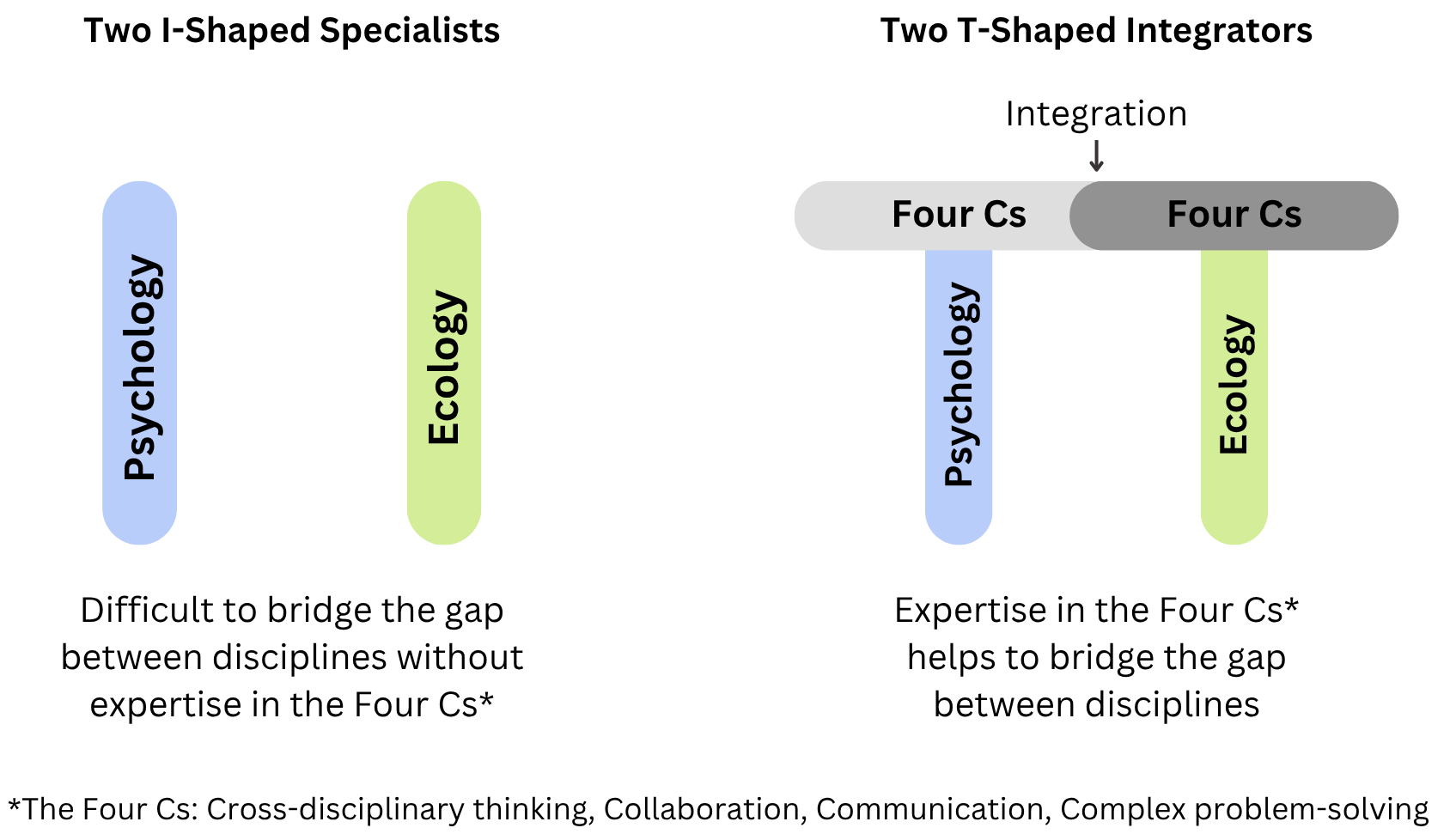
T-Shaped integrators can be contrasted with I-Shaped Specialists who also have depth in one academic discipline but lack knowledge integration expertise. This makes it difficult for I-Shaped Specialists to engage in cross-disciplinary collaboration. For example, two T-Shaped Integrators, one with a depth of expertise in psychology and the other in ecology, would be better equipped to engage in knowledge integration than two I-Shaped Specialists with expertise in these fields. This is because the T-Shaped Integrators would be better equipped to bridge the gap between their different disciplines than the I-Shaped Specialists; they would be better able to communicate with each other about their disciplines and collaborate on a project that aims to solve a mutual problem.
Pi- and Comb-Shaped Integrators
Pi-Shaped Integrators:
- These are individuals with knowledge integrator expertise (the horizontal bar of the Pi symbol) and a depth of knowledge in TWO academic disciplines (the two vertical legs of the Pi symbol).
Comb-Shaped Integrators:
- These are individuals with knowledge integrator expertise (the horizontal bar of the comb) and a depth of knowledge in THREE or MORE areas (the vertical lines of the comb).
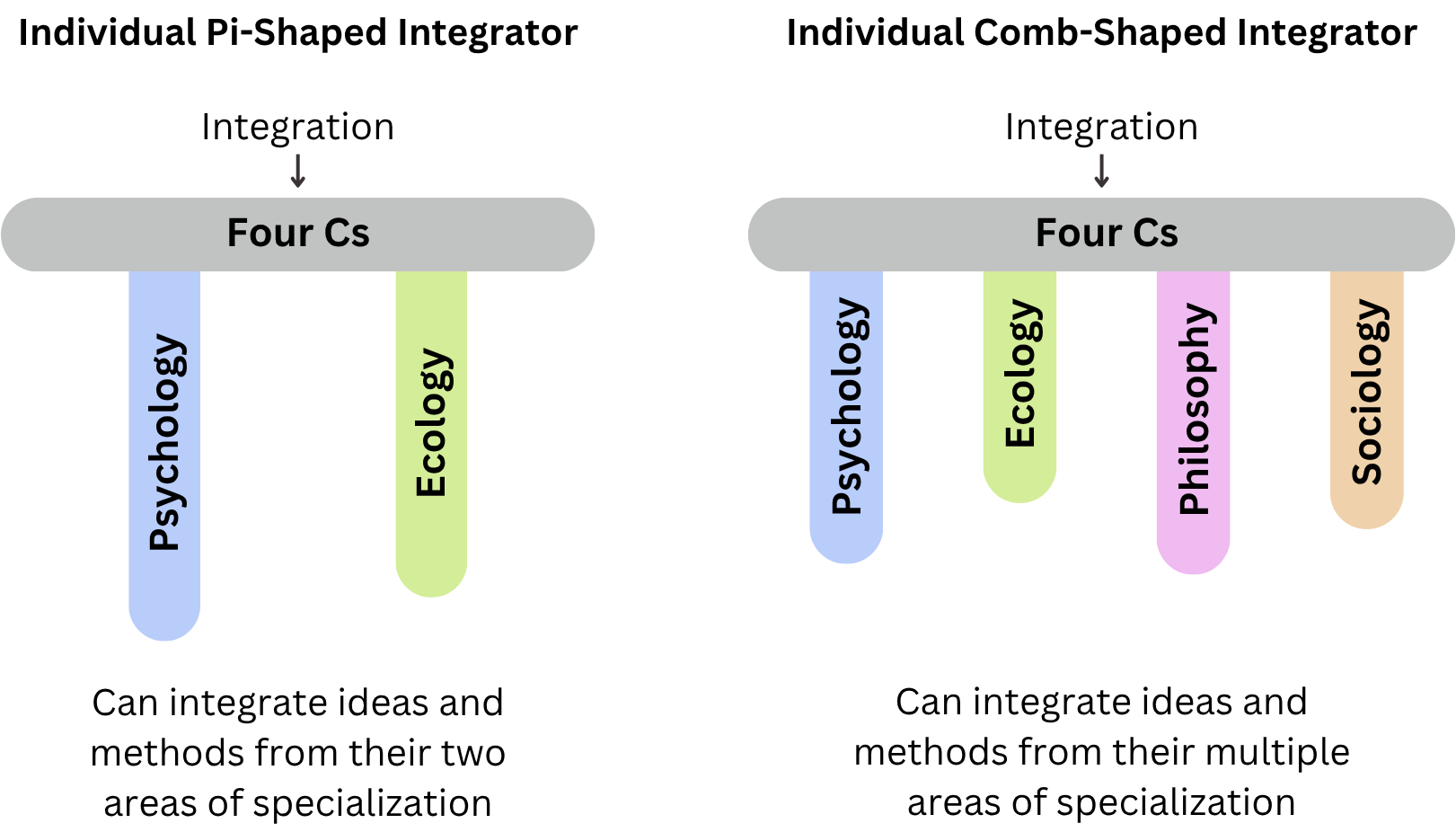
Pi- and Comb-Shaped Integrators differ from T-Shaped integrators because they can integrate knowledge at the individual level. They can do this by blending together ideas, theories, and methods from their various areas of expertise. For example, a Pi-Shaped knowledge integrator with expertise in both psychology and ecology could combine their knowledge of these different fields to better understand interactions between humans and the environment. This ability to integrate knowledge at the individual level makes Pi- and Comb-Shaped integrators very well equipped to then integrate knowledge at the team level.
It is also important to note that as the number of specialization areas increase, the depth of specialization in each area will decrease. This is because someone specializing in multiple areas is not able to spend as much time learning about each area as someone specializing in one or two areas. To represent this idea, the Comb-Shaped Integrator diagram has the shortest “legs”, the Pi-Shaped Integrator has medium length legs, and the T-Shaped Integrator has the longest leg. The varying length of legs within each shape represents the idea that someone might not have equal depth in each area they choose to specialize in.
A Special Note on Depth Integration
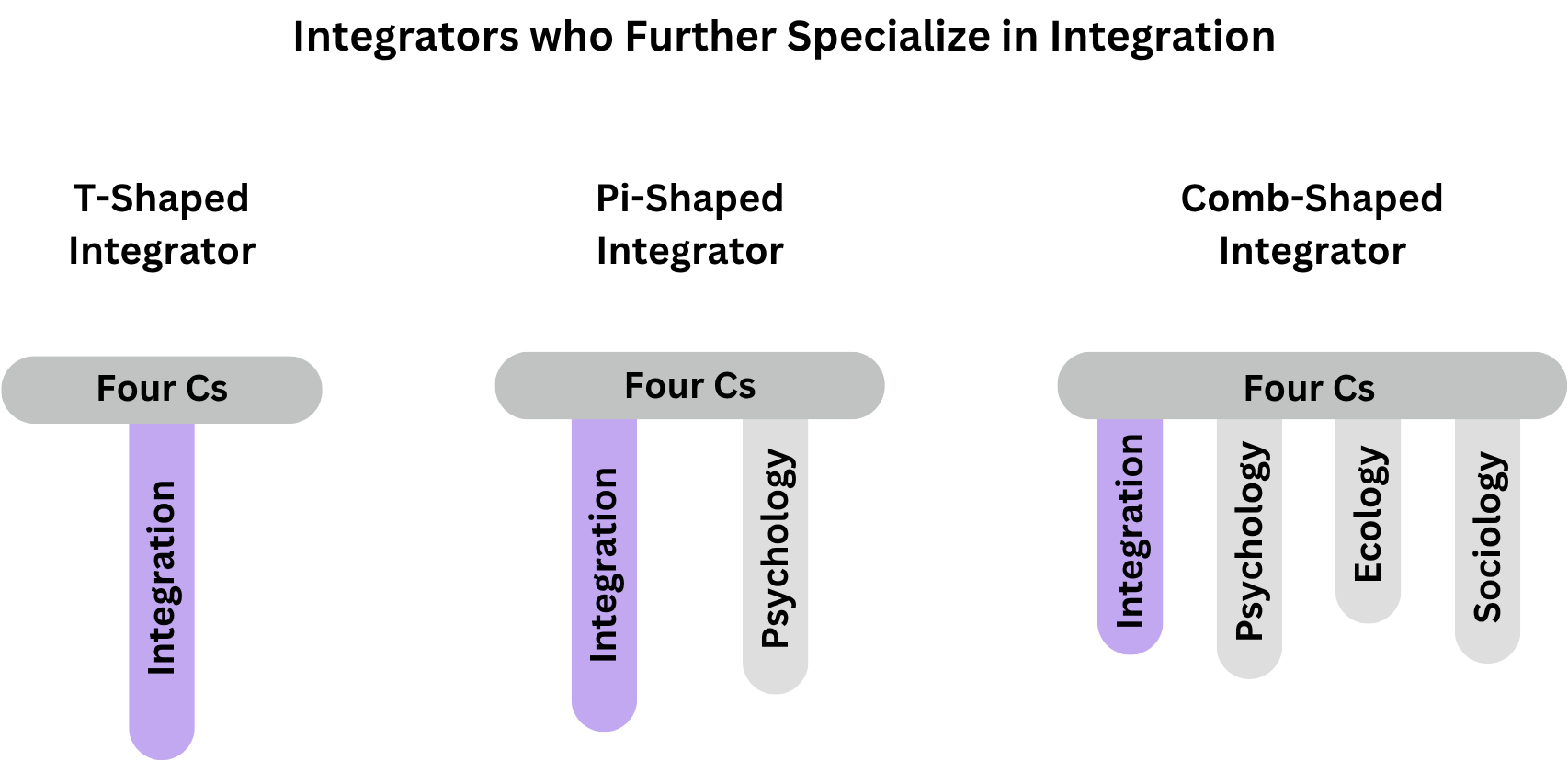
It is also important to mention that knowledge integration is a growing field around the world, though knowledge integrators go by many names (e.g., integration experts, integration and implementation scientists, generalists, inter/transdisciplinarians, knowledge brokers, etc.) so it can be difficult to recognize them as the same type of person. There is an expanding collection of theories and methods specifically about integration, and some scholars are even working to create an academic discipline for the field of integration. This means that knowledge integrators can choose to specialize in integration itself or in some of the activities that are central to integration. For example, a knowledge integrator might choose to specialize even more deeply in complex problem-solving theories and methodologies, or in theories and methodologies that empower them to facilitate collaboration within and between diverse teams.
Although students in the Knowledge Integration program at the University of Waterloo acquire some of the knowledge and frameworks for integration, they would need to pursue further education in integration to become full-blown experts (just as any other I-shaped undergraduate student would need to pursue further study to gain substantial depth in their specialized field).
Where do Knowledge Integrators Work?
Knowledge integrators are incredibly diverse! Some work in academia on cross-disciplinary research teams. Others work in industry, either in the private or public sector. Others work at the interface of academia and the public.
Many students from the Knowledge Integration program go on to pursue a career related to the academic area(s) they chose to specialize in during their degree (i.e., the stem(s) of their “T”, “Pi” or “Comb”). For example:
- Knowledge Integration alum Laura, who pursued a minor in Biology now works at the Canadian Food Inspection Agency as a Policy and Programs Analyst with the Fertilizer Safety Section.
- Knowledge Integration alum Evaleen, who pursued minors in Philosophy and Psychology, now works as a Lawyer and Consultant.
Others go on to pursue a career that is very closely tied to their expertise in the Four C’s. Many Knowledge Integration alumni work as facilitators, project/program managers, consultants (which are really just complex problem-solvers), and in communications roles. For example:
- Knowledge Integration alum Erin works as a Programs Manager at GreenHouse, a social impact incubator housed at United College at the University of Waterloo.
- One Knowledge Integration alum is working at Deloitte as a Senior Business Analyst in the Human Capital Consulting service.
Others go on to pursue a career completely unrelated to the area(s) they chose to specialize in during university. However, their expertise in the Four Cs is highly transferable, making Knowledge Integration students well suited for almost any job. In fact, skills related to the Four Cs are in high-demand by employers across a wide variety of sectors (see The Top Attributes that Employers Look for in Recent Graduates for more information).
Check out the following web pages to see more examples of the diverse careers that alumni of the Knowledge Integration program have gone on to pursue.
- KI grads profiles: This web page explains what some Knowledge Integration alumni are doing and how they customized their degree to match their unique interests and goals.
- KI Alumni Experiences: This web page also explains what some Knowledge Integration alumni are up to and how they have applied their knowledge integration skills in the workplace.
- KI grads at work: This web page lists the specific job titles of some Knowledge Integration alumni along with the company that they work for.
Want to Learn More?
Check out the following links to learn more about the Knowledge Integration program at the University of Waterloo:
- What is the Knowledge Integration program?
- Why Knowledge Integration?
- Knowledge Integration Academic Program
- Knowledge Integration Program FAQ
Check out the following websites to learn more about the growing field of knowledge integration:
- Integration and Implementation (I2S) Insights Blog
- Global Alliance for Inter- and Transdisciplinarity (ITD Alliance)
- International Network for the Science of Team Science (INSciTS)
- Association for Interdisciplinary Studies (AIS)
Check out this PDF to see a two-page overview of this webpage.

About the Creator
Emma LeCouffe. a fourth-year Knowledge Integration student (class of 2025) created this web page and two-page overview for her Knowledge Integration Senior Honours Project. Emma’s goal was to draw on literature about integration and cross-disciplinarity to create an accessible resource that explains what it means to be a knowledge integrator and why knowledge integrators are important. Check out her Senior Honours Project abstract to learn more about her project.