Student-led initiative improves drinking water access for campus residences
A student-led public health initiative at the University of Waterloo is helping to reshape access to safe, convenient drinking water in campus residences. H2oloo, co-founded by Health Sciences students Isabelle Lee and Giordana Staudohar, has successfully secured a commitment from Campus Housing to install 48 new water fill stations in residence buildings, representing an investment of approximately $138,000.
The initiative grew out of an assignment in HLTH 304 Health Communications, where students were challenged by Dr. Ashley Amson to identify a health issue on campus and hypothetically persuade the University to address it. For Lee and Staudohar, that challenge became more than a classroom exercise.
Staudohar points to her own experience while living in Village 1 (V1) during her first year on campus, where restrictive key access often limited her options to unfiltered water from communal bathroom sinks or purchasing bottled water and sugar drinks. “That practice was both detrimental to the environment and to my well-being,” she says.
She helped create H2oloo to address this challenge faced by many students living in residence: limited access to drinking water refill stations due to building design and key restrictions.
“H2oloo aimed to increase the number of water fountains in Campus Housing residence buildings to foster a healthier, more hydrated lifestyle among students,” Lee shares.
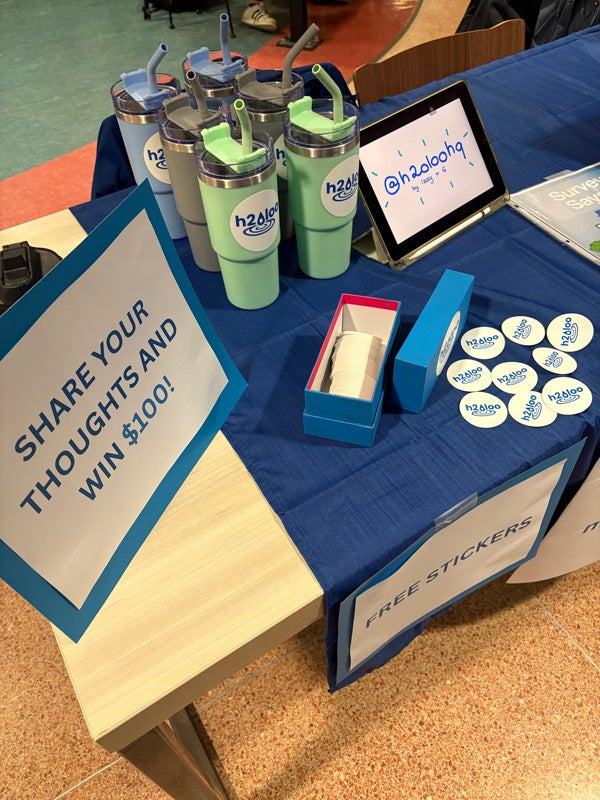
To support their advocacy, the H2oloo duo conducted original research, including a student survey and a pilot test. The survey explored students’ experiences and demand for water fountains in residence. The findings played a central role in Campus Housing’s decision to move forward with the project.
In addition to research, the duo prioritized student engagement. They visited classes, collaborated with professors and hosted pop-up events in residence buildings to highlight the health benefits of hydration and the gaps in existing water infrastructure. Pilot testing involved placing filtered water dispensers in residence lounges to observe whether student would use a conveniently located water source when available.
In just five days, approximately 45 litres of water were consumed by students in Ron Eydt Village (REV) and V1, proving that the fountains would be popular with students upon installation.
Campus Housing plans to install 20 fountains in REV and 28 in V1, ensuring access aligned with the layout and key restrictions of those communities.
“To achieve fair and equitable access to drinking water for all students in V1 and REV, we will install 20 fountains in REV (one per floor) and 28 water fill stations installed in V1 (one per house),” says Raven Urbanowicz, administrative project coordinator in Campus Housing. “Campus Housing will be prioritizing this project in our upcoming planning cycle for 2027.”

H2oloo was developed as part of the WUSA Change Engine competition, which supports student-driven solutions to community challenges. The initiative won the competition in 2025 and received $5,000 in funding to support its research and advocacy work.
While H2oloo does not currently plan to scale beyond residence water access, the initiative demonstrates the impact of applied public health research and student leadership. Through evidence-based advocacy, the project illustrates how student voices can drive institutional change and contribute to healthier campus environments.