


The School of Accounting and Finance (SAF) tackles global challenges by preparing students to think differently. Going beyond the limits of a traditional business school, SAF redefines what it means to be an accounting and finance professional.
Training future-ready leaders in accounting and finance
The future of accounting and finance is collaborative, interdisciplinary and inclusive. SAF graduates are equipped with the integrity and expertise to tackle the world’s most pressing demands like climate uncertainty, emerging technology and AI. The field is constantly evolving with SAF students leading the change.
Learning beyond the classroom
Through paid co-op, international study and travel opportunities, and hands-on experiences, SAF students are gaining real-world skills through experiential learning to make bold, informed decisions through a global lens.
Business meets AI, tech, innovation and sustainability
Our programs connect accounting and finance with artificial intelligence, data analytics, computer science, sustainability, and innovation to prepare students for a fast-changing world.

Accounting and finance shape decisions in every sector of the economy. As emerging technologies and AI transform the world, the need for ethical, adaptable problem-solvers has never been greater. It is also essential to consider the impacts on people, communities, and the environment alongside financial goals, so that decisions create fair and sustainable outcomes. At SAF, we’re preparing graduates to meet that challenge, leading with insight, integrity, and impact on the issues that matter most.


News

Thank you and farewell to Dr. Blake Phillips
After more than 15 years at the University of Waterloo, Dr. Blake Phillips is stepping down as Director of the School of Accounting and Finance (SAF) to become Dean of the Dhillon School of Business at the University of Lethbridge.
Before he goes, his colleagues, staff and friends at SAF want to mark the moment and thank him for everything he has given the School.
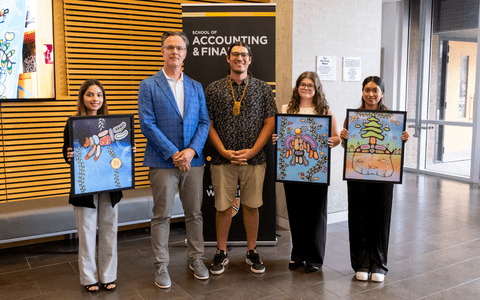
New Indigenous mural finds a permanent home at the School of Accounting and Finance
The School of Accounting and Finance (SAF) unveiled a commissioned three-panel Indigenous mural in the Don Craig Atrium in Hagey Hall on August 11, placing the Haudenosaunee Sky Woman creation story in permanent view at the centre of the School.

Expanding our community of tax professionals: Introducing the MTax Alumni Network
The tax landscape is evolving rapidly, making cross-sector collaboration and lifelong professional connections more vital than ever.
The newly launched Master of Taxation (MTax) Alumni Network is designed to bring together SAF’s global community of tax leaders to share knowledge and support the next generation.
Blog

Leveraging mentorship through the SAF Fellowship Program
Through the Fellowship Program, AFM student Kaavish was paired with both an upper-year mentor and an industry mentor, each offering valuable support on his university journey — one guiding him through academics, the other through the world of work.
Together, these mentorships gave Kaavish a clearer understanding of his professional path along with the confidence, knowledge and support to pursue it.

Finding connection over matcha
It started with a matcha, but led to a meaningful connection between mentor and mentee.
Selena reflects on her experience of being Kailey's mentor as part of the School of Accounting and Finance's Fellowship Program, highlighting how a casual café environment created space for honest discussions about co-op, academics and university life.
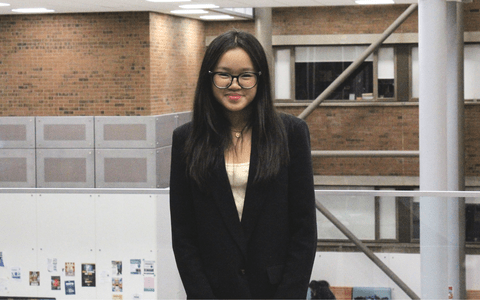
My Fellowship journey at UWaterloo
School of Accounting and Finance (SAF) student Hanna shares how the SAF Fellowship Program provided her with valuable new experiences and deepened her connection to the University of Waterloo community.
From receiving mentorship from an industry-seasoned Waterloo alum to judging case competitions and introducing prospective students to SAF, Hanna reflects on how the program helped her grow both personally and professionally.