
The Department of Applied Mathematics has 30 faculty members and over 100 graduate students. We offer undergraduate plans in Applied Mathematics and Mathematical Physics that attract outstanding students. The wide range of interdisciplinary research being undertaken in the department provides a stimulating environment for our graduate program.
The department has research programs in
- Control and Dynamical Systems (including differential equations)
- Fluid Mechanics
- Mathematical Medicine and Biology
- Mathematical Physics
- Scientific Computing
New: Modified AM undergraduate programs from Fall 2025! (Including the AM-SciML program, our new major focusing on Scientific Machine Learning; new course AMATH 345 - Data-Driven Mathematical modeling; a new Climate and Sustainability specialization; and PHYS 121 no longer being required for the AM major.)
News
Applied Math alum and professor receive IFAC Triennial Journal Award
Former PhD student Yiming Meng, now an Assistant Professor at the Hong Kong University of Science and Technology (Guangzhou), and Professor Jun Liu have received the 2026 Nonlinear Analysis: Hybrid Systems Paper Prize.
The prize recognizes outstanding contributions to the field of hybrid systems published in the International Federation of Automatic Control (IFAC) journal Nonlinear Analysis: Hybrid Systems. At each IFAC World Congress, the prize is awarded to the authors of two selected papers published in the journal during the preceding three years.
Meng and Liu received the award for their paper, “Lyapunov-barrier characterization of robust reach–avoid–stay specifications for hybrid systems”, published in Nonlinear Analysis: Hybrid Systems in 2023. The award will be presented during the Closing Ceremony of the 23rd IFAC World Congress, to be held August 23–28, 2026, in Busan, Republic of Korea.
This is Professor Liu's second Nonlinear Analysis: Hybrid Systems Paper Prize. He and University of Michigan Professor Necmiye Ozay received the same award in 2017 for their paper “Finite abstractions with robustness margins for temporal logic-based control synthesis.”
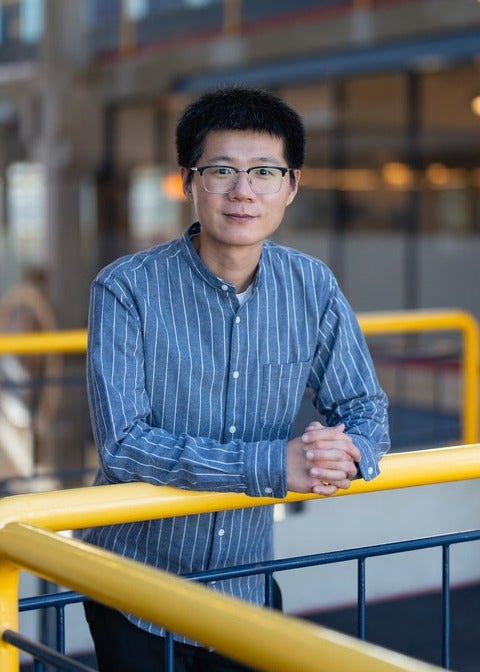
Ruikun Zhou wins Faculty of Mathematics Graduate Research Excellence Award
Ruikun Zhou, who recently completed the PhD program in Applied Math, received a Faculty of Mathematics Graduate Research Excellence Award for the paper, Resolvent-Type Data-Driven Learning of Generators for Unknown Continuous-Time Dynamical Systems, published with supervisor Prof. Jun Liu in IEEE Transactions on Automatic Control. This research develops a new data-driven framework for learning the fundamental operators that govern nonlinear dynamical systems directly from trajectory data, enabling model-based prediction, analysis, and control even for uncertain system.
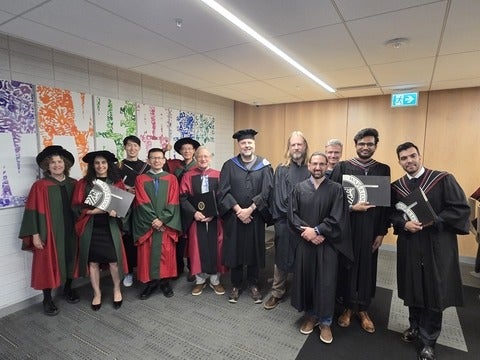
Congratulations to Applied Math Graduates!
Congratulations to all Applied Mathematics graduates who walked the stage at Spring 2026 convocation!
Events
Master's Thesis Defence |Roman Kaharlytskyi, The Role of Radiometric and Skeleton-Derived Features in Cross-Platform LiDAR Leaf-Wood Segmentation
MC 5479
Master's Thesis Defence | Anand Karki, Data-Driven Mobile Sensor Planning and Interpretation
MC 5479
Seminar Speaker: Professor Bruno Blais

Abstract
The simulation of flows using computational fluid dynamics (CFD) has advanced considerably in recent decades and is now an essential tool across industries ranging from aerospace design to process engineering. Although CFD is relatively mature for single-phase flows, multiphase flows (such as particle-laden flows) and multiphysics flows (such as those including microwaves or ultrasound) remain significantly more challenging to simulate, in part due to their intrinsic multiscale nature and conflicting numerical need.
In the recent years, high-order methods have gained considerable momentum in aeronautics, in part due to their significantly lower dispersion and dissipation, but also for their higher arithmetic intensity (FLOPS-to-byte ratio) which suits current hardware capabilities. However, these methods remain seldomly used in chemical-engineering applications, in part due to their multiphase and multiphysics nature.
This talk presents our efforts in designing Lethe, an open-source, high-order multiphysics framework for single- and multiphase flows built on the deal.II library. We first motivate the use of high-order finite elements for CFD applications in process engineering. Then, we present three cases that illustrate the role that these novel computational can play in simulating turbulent flows, particle-laden flows and microwave intensified process. We conclude by drawing some conclusions on the potential of these methods
We conclude by reflecting on the role of open-source software in developing accurate and efficient simulation tools, and some of the lessons learned during the development of Lethe. Finally, we outline future directions for this work, including the integration of AI-driven surrogate model as part of the design of unit operations.
Biography
Dr. Bruno Blais, PEng, PhD, is an Professor at the Department of Chemical Engineering at Polytechnique Montreal. Before this, he was a Research Officer with the Automotive and Surface Transportation Portfolio of the National Research Council of Canada (NRC AST).
Dr. Blais’s expertise lies in the development, verification and validation of high-performance digital models for fluid mechanics, heat transfer and complex multiphase phenomena. He has earned a BEng in Chemical Engineering, a Grande École Engineering Diploma (D.Ing.) from ENSTA ParisTech, a Master in Fundamental Fluid Mechanics from ENSTA and a PhD in Chemical Engineering from Polytechnique Montreal. Dr. Blais is a Vanier Graduate Scholar (2013−2016) and has received the Governor General’s Gold Academic Medal for his work on numerical modelling of multiphase flows. He is a strong advocate of open source software for science and has contributed extensively to open source libraries (Lethe, deal.II).