Graduate Seminar| Environmental Sustainability Challenges in Canadian Healthcare, by Dr. Anita Rao
The Chemical Engineering Department is hosting a special graduate seminar on Environmental Sustainability Challenges in Canadian Healthcare.
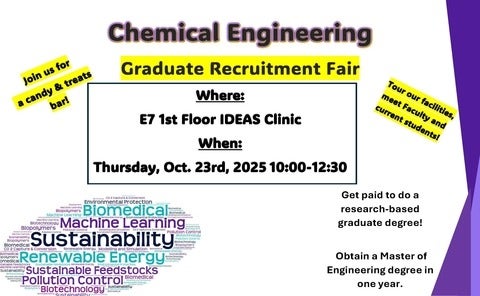
Please join us for a Chemical Engineering Grad Fair on Thursday, October 23rd in E7 in the 1st Floor Ideas Clinic.
The event runs from 10:00am-12:30pm.
Come and learn about the exciting and innovative research happening in our department!
✅ Chat with profs about cutting-edge research
✅ Learn how you can get paid to do a research-based degree
✅ Discover how domestic students pay less than undergrad tuition
✅ Find out how you can finish a course-based Master’s in just 1 year
Did you know our researchers are making new feedstocks from algae, using machine learning to solve real-world problems, making biodegradable plastics from food waste, creating synthetic vascular grafts for bypass patients, and more.
Come and chat with us and stay for the candy bar! We'd love to see you there!
Join us for a CERC Research Lecture by:
Professor Ruibing Wang PHD, FRSC
Wednesday, November 19th 1:30-2:30pm
PSE (E7) 7th Floor – 7303
The Chemical Engineering Department is hosting a special graduate seminar on Materials and interfaces for the next generation batteries.
Abstract :
Humanity faces multiple converging crises such as pandemics, climate change, ecosystem degradation, and environmental pressures from rising global prosperity. We urgently need transformative solutions. At the same time, the past three decades have also witnessed sterling advances in genomics, synthetic biology, and computation, which have re-cast living systems as programmable platforms for innovation. Biology has now matured into a form of infrastructure - an enabling layer upon which solutions to health, the energy transition, material de-fossilization and the circular economy can be built.
Just as physical infrastructure underpinned the industrial age and digital infrastructure drives the current information age, biological infrastructure now offers the foundation for a sustainable one. Engineered biological systems can facilitate a more rapid response to emerging threats, enable sustainable resource recovery, as well as upcycle waste into high-value products. In this sense, biology is no longer confined to the laboratory; it is becoming the scaffolding of a new industrial paradigm where living and designed systems work in concert to sustain civilization.