CERC Research Lecture | Supramolecularly Engineered Cells for Targeted Therapy by Professor Ruibing Wang PHD, FRSC
Join us for a CERC Research Lecture by:
Professor Ruibing Wang PHD, FRSC
Wednesday, November 19th 1:30-2:30pm
PSE 7th Floor – 7303
Join us for a CERC Research Lecture by:
Professor Ruibing Wang PHD, FRSC
Wednesday, November 19th 1:30-2:30pm
PSE 7th Floor – 7303
The Chemical Engineering Department is hosting a special graduate seminar on Materials and interfaces for the next generation batteries.
Abstract :
Humanity faces multiple converging crises such as pandemics, climate change, ecosystem degradation, and environmental pressures from rising global prosperity. We urgently need transformative solutions. At the same time, the past three decades have also witnessed sterling advances in genomics, synthetic biology, and computation, which have re-cast living systems as programmable platforms for innovation. Biology has now matured into a form of infrastructure - an enabling layer upon which solutions to health, the energy transition, material de-fossilization and the circular economy can be built.
Just as physical infrastructure underpinned the industrial age and digital infrastructure drives the current information age, biological infrastructure now offers the foundation for a sustainable one. Engineered biological systems can facilitate a more rapid response to emerging threats, enable sustainable resource recovery, as well as upcycle waste into high-value products. In this sense, biology is no longer confined to the laboratory; it is becoming the scaffolding of a new industrial paradigm where living and designed systems work in concert to sustain civilization.
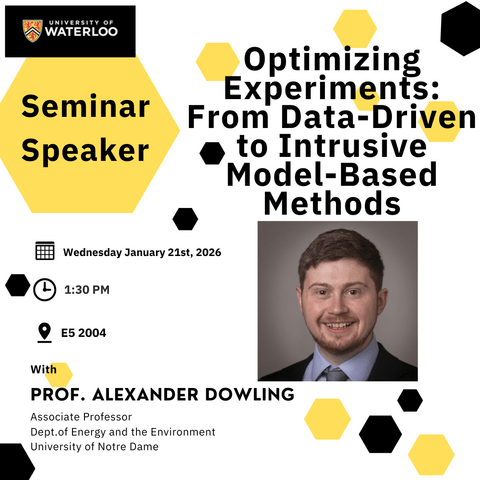
The Chemical Engineering Department is hosting a special graduate lecture on Optimizing Experiments: From Data-Driven to Intrusive Model-Based Methods.
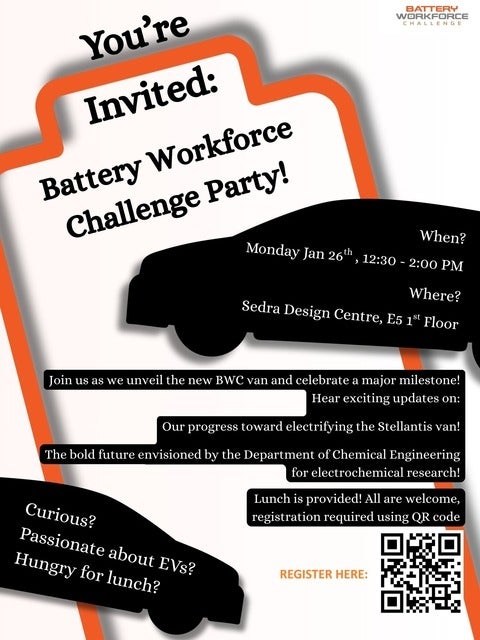
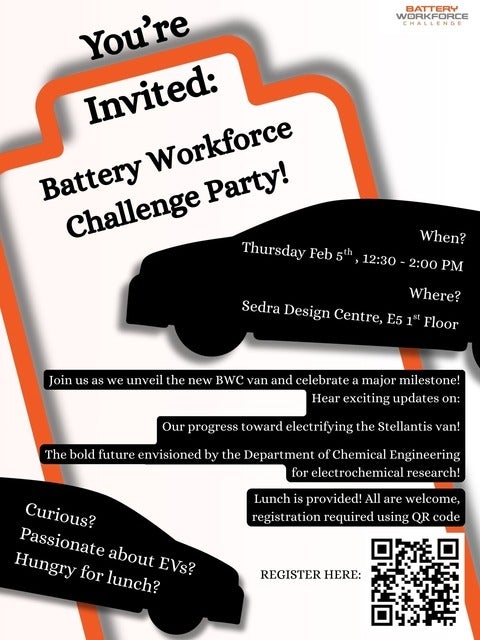
Battery Workforce Challenge party
Please find attached the invitation with our new date, Thursday, Feb. 5th. All are welcome but you must register to attend!
Even if you had previously registered, you must re-register, so we know how much delicious pizza we need to order for the new party date.
Hope to see you there!
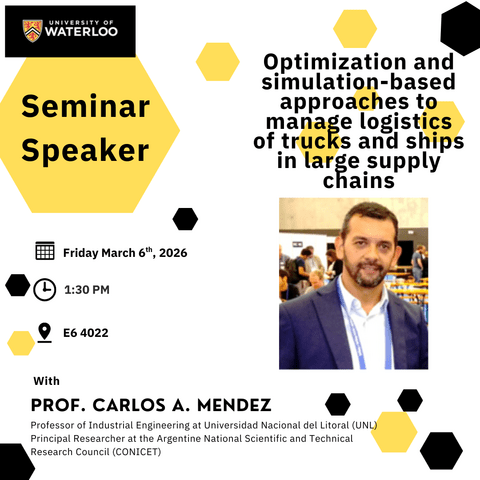
The Chemical Engineering Department is hosting a special graduate lecture on Optimization and simulation-based approaches to manage logistics of trucks and ships in large supply chains.
Abstract: Dehumidification accounts for a substantial fraction of energy use and associated emissions in air‑conditioning systems, representing roughly 53% of energy‑related air conditioning emissions on a global average. Vapor-selective membranes, which preferentially transport water molecules while blocking the transport of other gases, have emerged as a promising alternative technology for the heating, ventilation, and air conditioning (HVAC) industry, even being ranked as a top alternative technology by the US Department of Energy. Over the past 20 years, the field has seen a significant amount of research interest in the development of high-performance membrane materials and synthesis procedures. However, translation of these materials advances into practical HVAC systems has largely relied on idealized thermodynamic system models, with a notable lack in experimental demonstration. As a result, a disconnect persists between membrane material development, component-level limitations, and realistic system and process design. This seminar presents our ongoing work aimed at bridging this gap by explicitly linking real membrane properties to component sizing, operating constraints, and system‑level efficiency. The broader goal of this research is to establish a holistic framework that integrates materials, components, and system design to clarify tradeoffs, define benchmark performance targets, and guide future research and development towards the broader adoption of high-efficiency, membrane-based HVAC technologies.