News

Filter by:

Limit to news where the title matches:
Limit to items where the date of the news item:
Date range
Limit to news items where the audience is one or more of:
Friday, September 22, 2023

Mapping the Future of Flood Response

There were days Robert wondered why he had left a full-time job as a water resources consulting engineer, particularly when he wasn’t successful in applying for a couple of entrepreneurial awards related to his hydrologic modelling research.

But now as a recent recipient of the Jain Family Award for Entrepreneurship, he is no longer questioning coming back to the University of Waterloo for his third environmental engineering degree.

For Robert, the award made possible by a gift from the Vijay Anand Foundation to encourage student entrepreneurship at Waterloo is providing financial assistance and, perhaps more important, confirmation that his research has significant potential.

“Before I received the award, I definitely had some moments of self-doubt,” he said. “Part of receiving the award was validation that I had made the right decision to pursue a PhD.”

Continue reading here

Dr. Chul Min Yeum, an assistant professor in the civil and engineering department at the University of Waterloo, leads a team of researchers using technologies like 5G and augmented reality to identify structural issues in bridges, buildings and other infrastructure before disaster strikes.

Thanks to the University’s Rogers 5G Partnership, Yeum's team can use data-hungry technologies like computer vision and deep learning to improve disaster mitigation tools for civil engineers. 

5G cellular networks provide more bandwidth and higher speeds to send more data across the network faster. But the real value is the technology’s ability to significantly reduce the power requirements for 5G-enabled mobile and wearable devices used for field inspection.

“The major issue of using AI technologies like deep learning and computer vision in remote civil engineering is the level of trust in their accuracy. AI can be up to 99% accurate, but engineers want it to be 100%, so they end up visiting a site in person,” said Yuem.

“5G is helping us create a platform where humans and AI work together to improve structural safety through an enhanced visual inspection process."

Go to Detecting infrastructural issues in time for the full story

Thursday, September 14, 2023

Working together to solve problems

Waterloo Engineering’s Sustainability and Social Entrepreneurship Fellowship program gets students from different countries and disciplines to tackle real-world issues together. 

One of the greatest threats to the health of the Great Lakes is the increasing frequency of algal blooms, occurring in response to excess nutrients in the water due to a warming climate.

In response to the urgent need to better understand and mitigate human impacts on water quality, Dr. Nandita Basu, a civil and environmental engineering professor and Canada Research Chair in Global Water Sustainability and Ecohydrology, has been awarded a Natural Sciences and Engineering Research Council of Canada (NSERC) Alliance grant for one such approach.

Basu's research is developing Poseidon, an innovative web-based water quality portalthat changes the way in which we monitor and analyze stream nitrogen and phosphorus concentrations, loads, and landscape inputs, and will empower stakeholders with invaluable insights to drive conservation efforts.

"We cannot manage what we do not measure," said Basu. “Nutrient pollution management is challenging given limited water monitoring data and large gaps in available datasets. By combining comprehensive data and advanced analytics, Poseidon will empower scientists, policymakers, and communities to make evidence-based decisions and implement targeted interventions to address nutrient pollution effectively.

Go to New funding to support development of AI-powered nutrient load prediction system for the Great Lakes for the full story.

Congratulations to MASc candidate Saida Rezaee who was awarded an American Concrete Institute (ACI) Foundation Fellowship (https://lnkd.in/g5vZpgZ2), which provides funds to attend two ACI conferences and a $10,000 USD educational stipend. The ACI Foundation supports students’ education, research, and innovation throughout the concrete industry to contribute to keeping the industry at the forefront of technological advances in material composition, design, and construction.

Congratulations are in order!!!

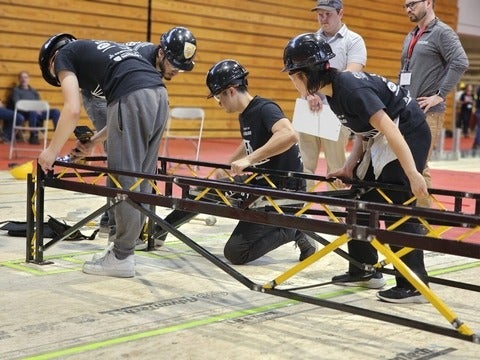
The Waterloo Steel Bridge Team competed at the Canadian national competition on May 11/12 and had an excellent result, placing 3rd nationally and 4th overall (there where 13 teams, including 3 international teams from Puerto Rico, Mexico, and Japan).

Congratulations again to this team - what an amazing job!!!

More details on the competition can be found here: https://www.cscecompetitions.ca/en/home/cnsbc/.