Faculty

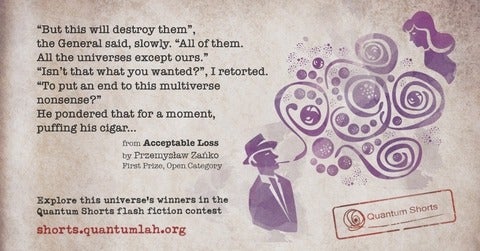
If you’ve ever wished you could escape this world for another Universe, the winner of this year’s Quantum Shorts flash fiction competition offers a cautionary tale.

In “Acceptable Loss” by Przemysław Zańko, a failed relationship puts the entire multiverse under threat. The story is one of five to claim prizes in the competition for fiction inspired by quantum physics. Each winner receives a cash award, certificate, and an engraved trophy.

Tuesday, April 10, 2018 1:30 pm - 1:30 pm EDT (GMT -04:00)

Spatial noise filtering through error correction for quantum sensing

David Layden - Massachusetts Institute of Technology (MIT)

Sensors based on quantum effects can measure various external quantities, such as magnetic fields, with high precision. Moreover, their sensitivity can scale more favourably with their size than is allowed classically — a property analogous to quantum speedups in computing. As with quantum computers, the performance of quantum sensors is limited by decoherence. Quantum error correction (QEC) has recently emerged as a promising approach to mitigate this decoherence, and therefore, to enhance sensitivity.

Friday, April 6, 2018 11:45 am - 11:45 am EDT (GMT -04:00)

RAC1 Journal Club/Seminar Series

Xiaodong MaXiaodong Ma: Topological insulator and the quantum anomalous Hall effect

The quantum anomalous Hall effect (QAHE) is defined as a quantized Hall effect in a system without an external magnetic field. Its physical origin relies on the intrinsic topological inverted band structure and ferromagnetism.

Wednesday, April 4, 2018 10:30 am - 10:30 am EDT (GMT -04:00)

‘Free-space’ Chiral Quantum Optics and a ‘Few-Atom’ Quantum Antenna

Peter Zoller - University of Innsbruck

We start with an overview of chiral quantum optics as quantum light-atom interfaces with broken left- right symmetry and associated quantum optical phenomena and applications. While chiral quantum optics is traditionally discussed in context of nano-photonics and nano fibers , we propose here a novel ‘free-space’ chiral quantum optics realized as atoms in free space coupled to a ‘few-atom’ quantum antenna. In particular, we discuss free space photonic quantum links between atoms (qubits) equipped with sending and receiving quantum antennas.

Tuesday, March 20, 2018 11:45 am - 11:45 am EDT (GMT -04:00)

Quantum Hacking after Measurement-Device-Independent Quantum Cryptography

Anqi Huang - IQC

Quantum key distribution (QKD) is able to achieve information-theoretic security in principle. However, in practice, imperfect devices threaten the security of quantum cryptographic systems. As a promising countermeasure against practical attacks, measurement-device-independent (MDI) QKD is immune to all detector side-channel attacks. Nevertheless, there are some limitations of the MDI QKD protocol. To overcome the technical limitations of MDI QKD, I scrutinized and evaluated other two countermeasures against imperfect detections.