Quantum correlation can imply causation
Contrary to the statistician's slogan, in the quantum world, certain kinds of correlations do imply causation.
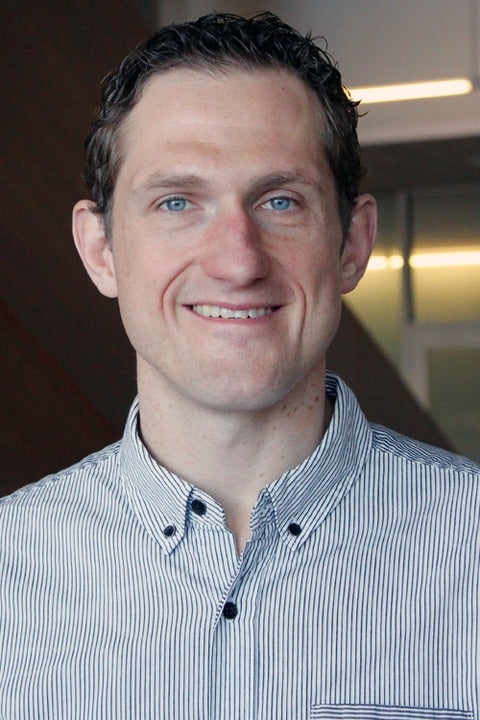
Michael Reimer joins the Institute for Quantum Computing (IQC) as Assistant Professor, bringing the total faculty complement at IQC to 22.
The workshop aims at bringing together researchers from quantum computing and classical programming languages.


The Institute for Quantum Computing (IQC) Advisory Board reconvened this week with a new chair and two new directors.
Mike Lazaridis takes on the chair role from founding chair, Tom Brzustowski. Lazaridis was instrumental in establishing IQC and has been a member of the IQC Advisory Board since its inception in 2005.
Experts from around the world will gather in Ottawa this week to discuss cybersecurity in a quantum world.
From NIST Tech Beat: September 15, 2014
Researchers at the Institute for Quantum Computing at the University of Waterloo in Canada have directly entangled three photons in the most technologically useful state for the first time, thanks in part to superfast, super-efficient single-photon detectors developed by the National Institute of Standards and Technology (NIST).
ETSI, in partnership with the Institute for Quantum Computing (IQC), is pleased to invite you to the second IQC/ETSI Quantum-Safe Crypto Workshop. The event will be held in Ottawa, Canada, on 6th – 7th October, 2014. This workshop will bring together the diverse communities that will need to co-operate to standardize and deploy the next-generation cryptographic infrastructure, in particular, one that will be secure against emerging quantum computing technologies. The event agenda will be announced Early September.
The Quantum Innovators workshop will bring together the most promising young researchers in quantum physics and engineering for a three-day conference aimed at exploring the frontier of our field.
A form of quantum weirdness is a key ingredient for building quantum computers according to new research from a team at the University of Waterloo’s Institute for Quantum Computing (IQC).
In a new study published in the journal Nature today researchers have shown that a weird aspect of quantum theory called contextuality is a necessary resource to achieve the so-called magic required for universal quantum computation.
IQC researchers, led by Thomas Jennewein, have been awarded $250,000 by the Canadian Space Agency to train and develop Canadian grad students through a space science and technology project.
The Canadian Space Agency (CSA) funding will support Thomas Jennewein (Physics and Astronomy) and his QEYSSat team in conducting a demonstration of Quantum Key Distribution (QKD) between a receiver payload on an airborne platform and a transmitter on the ground.