Staff

News Release

Government of Canada announces contract award to the University of Waterloo for research and development in support of Arctic surveillance

April 12, 2018 – Ottawa, Ont. – National Defence/Canadian Armed Forces
En français

New $2.7 million project funded by Department of National Defence will develop technology for quantum radar.

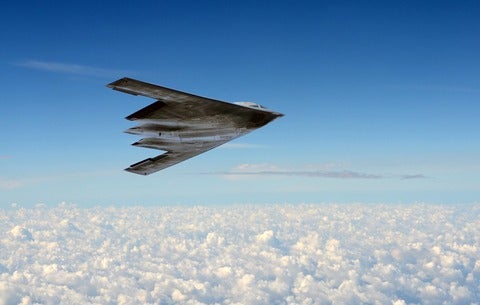
Stealth aircraft in the Canadian arctic will be no match for a new quantum radar system.

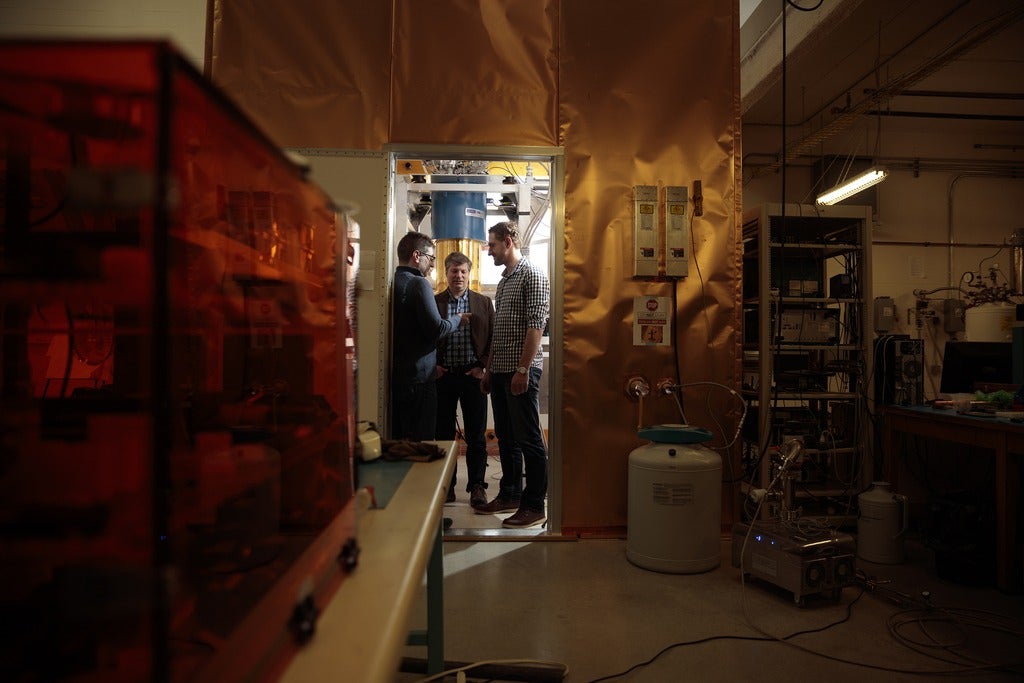
Researchers at the University of Waterloo are developing a new technology that promises to help radar operators cut through heavy background noise and isolate objects —including stealth aircraft and missiles— with unparalleled accuracy.

Monday, April 30, 2018 2:30 pm - 2:30 pm EDT (GMT -04:00)

Asymptotic performance of port-based teleportation

Felix Leditzky, University of Colorado, Boulder

Port-based teleportation (PBT) is a variant of the well-known task of quantum teleportation in which Alice and Bob share multiple entangled states called "ports". While in the standard teleportation protocol using a single entangled state the receiver Bob has to apply a non-trivial correction unitary, in PBT he merely has to pick up the right quantum system at a port specified by the classical message he received from Alice.

Thursday, April 26, 2018 7:00 pm - 7:00 pm EDT (GMT -04:00)

Entangled: The series – QUANTUM + Literature

Chad Orzel, Union College
The invention of quantum physics in the early 20th century forced scientists to reconsider many cherished ideas from classical physics, leading to revolutionary changes in our scientific and philosophical understanding of the universe. Quantum phenomena have also proven to be a rich source of metaphors and inspiration for fiction. 
 

Tuesday, April 10, 2018 10:30 am - 10:30 am EDT (GMT -04:00)

Cryogenic Dissipation in Nanoscale Optomechanical Cavities

Bradley Hauer, University of Alberta

Cavity optomechanics, a field which studies the interplay between the photonic and phononic modes of an optical cavity, has seen rapid progress over the past decade. Micro/nano-scale optomechanical cavities have demonstrated potential for use in technologies such as quantum-limited metrology and transduction, as well as probes for exploring the fundamental nature of quantum mechanics.

Friday, April 20, 2018 11:45 am - 11:45 am EDT (GMT -04:00)

RAC1 Journal Club/Seminar Series

Keysight's Quantum Engineering Toolkit: A commercial, customizable integrated control and test system

Presented by guest speaker Nizar Messaoudi, Keysight Technologies Application Engineer

With traditional classical complementary metal oxide semiconductor (CMOS) computing struggling to keep up with Moore’s law, interest in quantum computing has exploded and the University of Waterloo is at the centre of this technological revolution.

The concept for his latest startup is something straight out of a superhero movie. Just like Batman used high-frequency sonar signals from millions of cell phones to visualize the location of villains throughout Gotham City in Dark Knight, entrepreneur Taj Manku is developing new software that could soon allow our cell phones to see in the dark. 

Wednesday, April 11, 2018 1:00 pm - 1:00 pm EDT (GMT -04:00)

Mind the gap: Cheeger inequalities and adiabatic algorithms

Michael Jarret, Perimeter Institute for Theoretical Physics

The runtime of Adiabatic optimization algorithms are typically characterized by the size of the spectral gap of the corresponding Hamiltonian. Gap analysis nonetheless remains a challenging problem with few general approaches.

Thursday, April 19, 2018 12:00 pm - 12:00 pm EDT (GMT -04:00)

The Polynomial Method Strikes Back: Tight Quantum Query Bounds via Dual Polynomials

Robin Kothari, Microsoft Research (PLEASE NOTE NEW DATE AND TIME)

We use the polynomial method to prove optimal or nearly optimal lower bounds on the quantum query complexity of several problems, resolving open questions from prior work. The problems studied include k-distinctness, image size testing, k-junta testing, approximating statistical distance, approximating Shannon entropy, and surjectivity.​ Paper available at https://arxiv.org/abs/1710.09079. This is joint work with Mark Bun and Justin Thaler.