News

Filter by:

Limit to news where the title matches:
Limit to items where the date of the news item:
Date range
Limit to news items tagged with one or more of:
Limit to news items where the audience is one or more of:
Limit to news items where the faculty or school is one or more of:

A team of researchers from the Institute for Quantum Computing (IQC) has developed a process for reshaping the entanglement of two photons, demonstrating a new set of tools useful for quantum-state engineering.
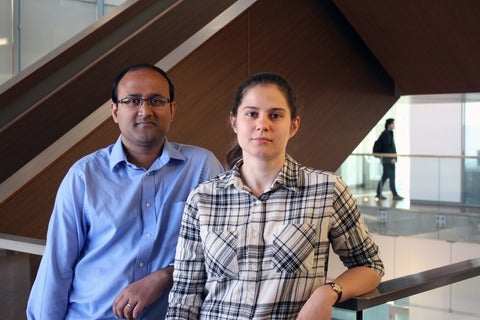
Two alumni attendees of the Institute for Quantum Computing’s (IQC) 2015 Quantum Innovators (QI) workshop joined IQC as faculty members on November 2. The workshop, held each year, brings the most promising researchers exploring the frontiers of quantum physics and engineering to IQC. Experimentalists K. Rajibul Islam and Crystal Senko have been jointly appointed as Assistant Professors with IQC and the Department of Physics and Astronomy in the Faculty of Science at the University of Waterloo.

Zhe Liu, postdoctoral fellow at the Institute for Quantum Computing (IQC) and the Department of Combinatorics and Optimization in the Faculty of Mathematics at the University of Waterloo, received the 2016 FNR Outstanding PhD Thesis award for his research on the security of wireless sensor networks (WSNs). The FNR Awards recognize outstanding researchers and science communicators for excellence in research and science communication.

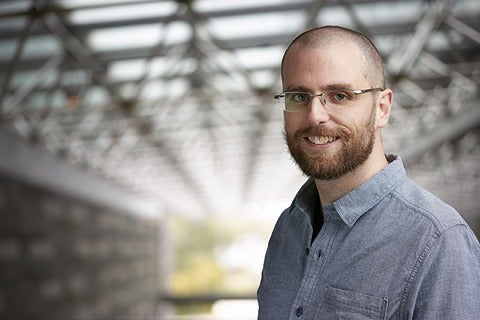
Jon YardJon Yard joins the Institute for Quantum Computing (IQC) as Associate Professor from Microsoft’s Research Station Q team. He is jointly appointed with the Department of Combinatorics and Optimization in the Faculty of Mathematics and as an Associate Faculty member with the Perimeter Institute for Theoretical Physics (PI).
A team led by Thomas Jennewein at the University of Waterloo’s Institute for Quantum Computing (IQC), supported by the National Research Council of Canada’s (NRC) Flight Research Laboratory, has successfully demonstrated quantum key distribution (QKD) between a transmitter on the ground and a receiver payload onboard an airplane. While researchers in Germany and China have previously conducted QKD experiments with quantum transmitters flown on an aircraft and a tethered low-altitude balloon, Jennewein’s team is the first to demonstrate a QKD link with an airborne quantum receiver.

WATERLOO, Ont. (Wednesday, October 12, 2016) – Researchers at the University of Waterloo’s Institute for Quantum Computing (IQC) recorded an interaction between light and matter 10 times larger than previously seen. The strength of the interaction between photons and a qubit was so large that it opens the door to a realm of physics and applications unattainable until now.

Tuesday, October 4, 2016

Solving Tsirelson’s problem

William Slofstra, a research assistant professor at IQC, recently announced a solution for one of these problems, called the strong Tsirelson problem, which gets at the nature of how we model entanglement.