
When: Tuesday,Sep 22, 2026, 10:30 AM
Where: QNC 1501
Fluorinated Anions for Electrolytes and Interphases – A thrive through the Li and Post-Li Battery World
Abstract :
Ingo Krossing steers a synthetic inorganic / organometallic chemistry group that bridges to computational, physical, materials and electrochemistry. His core expertise starts with weakly coordinating anions (WCAs) and was extended over the years to basic and applied Ionic Systems, i.e. compounds and materials (systems) in which ions determine their properties. The Ionic Systems under investigation range from very basic reactive cation salts,[1-5] to more applied systems like electrolytes for batteries and battery materials. To investigate the electrochemical relations between such Ionic Systems, solvent independent unified redox and acidity scales – applicable to all phases – were developed.[6]
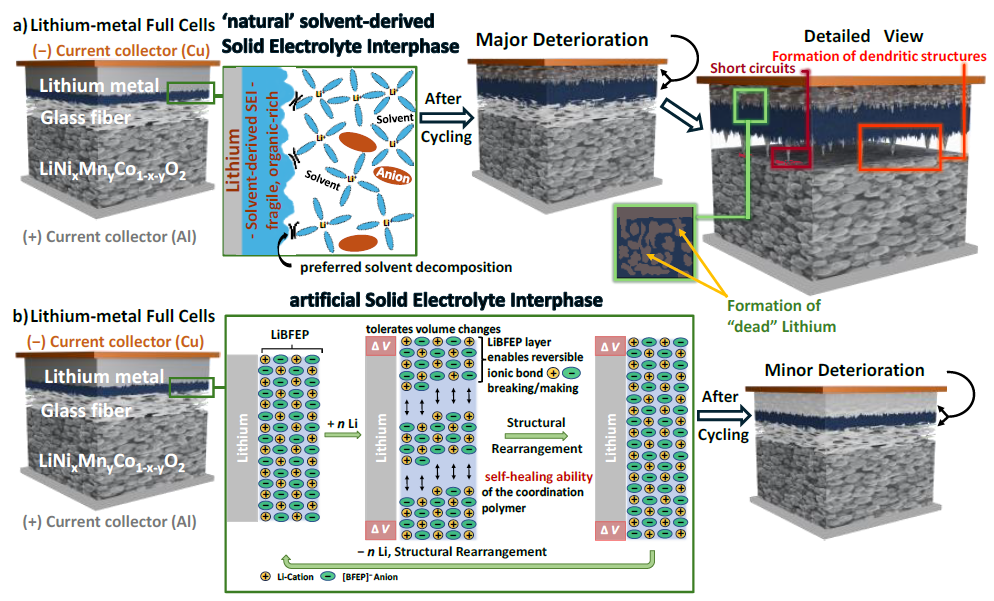
This talk reports on alternative conducting salts to the widely used PF6– anion to overcome known deficiencies, i.e. sensitivity to hydrolysis and others. Here the [M(ORF)4]– type anions (M = B, Al, RF = fluoroalkyl) are an interesting class that first was prepared in ours and S. Strauss’ labs.[7] Applications in Lithium Sulfur Batteries and as Magnesium Ion Battery electrolytes are reported.[8] When searching for alternative conducting salts[9] to be used in electrolytes for Lithium Ion Batteries (LIBs), we prepared salts of the type Li[PO2(ORF)2] (RF = CH2CF3, C(H)(CF3)2, etc.).[10] Despite the conductivities of these fluorinated phosphates remained low, they interestingly acted as inorganic gelling agents and formed stable gels that were highly Lithium ion conducting, when doped with standard LIB electrolytes like LP57 (= 1.0 M LiPF6 in EC/EMC 3:7).[10] Next, we realized that these compounds are suited to modify the interphases of battery electrodes.
We learned that simple addition of Li[PO (ORF) ] to electrolytes enhances the cycle life of batteries including the demanding high voltage cathode active material LNMO (= LiNi0.5Mn1.5O4) with cut-off voltages close to 5 V vs. Li+/Li.[10] Since also the free Bronsted acid HO-PO(ORF)2 is available, we extended the investigation of the manipulation of the interphases of battery electrodes towards lithium metal in Lithium Metal Batteries LMBs. A simple dip process to a solution containing the acid yields a Li-ion coordination polymer on a Li-Metal surface that is Li-ion conducting and electrically insulating. This adaptive and self-healing interphase improves cyclability and lifetime of symmetric, half and full cells,[12] especially if augmented with a low-concentration electrolyte based on ortho-difluorobenzene.[13]
[1] a) M. Schorpp, I. Krossing et al., Angew. Chem. Int. Ed. Engl. 2020, 59, 9453; b) M. Sellin, I. Krossing et al., Chem. Sci. 2022, 13, 9147-9158; c) M. Sellin, I. Krossing et al., Angew. Chem., Int. Ed. Engl. 2024, 63, e202406742. [2] a) C. Armbruster, M. Sellin, M. Seiler, T. Würz, F. Oesten, M. Schmucker, T. Sterbak, J. Fischer, V. Radtke, J. Hunger, I. Krossing, Nat. Commun. 2024, 15, 6721 ; WCA-Review: I. M. Riddlestone, I. Krossing et al., Angew. Chem. Int. Ed. Engl. 2018, 57, 13982. [3] Review: I. Krossing et al., Chem. Soc. Rev. 2016, 45, 789. [4] a) W. Unkrig, I. Krossing et al., Nat. Chem. 2020, 12, 647; b) J. Bohnenberger, I. Krossing et al., Nat Comms 2019, 10, 624; c) M. Schmitt, I. Krossing et al., Angew. Chem. Int. Ed. Engl. 2021, 60, 14800; d) J. Rall, I. Krossing et al.,_
_Angew. Chem., Int. Ed. Engl. 2022, e202204080; M. Sellin, I. Krossing*, Acc. Chem. Res. 2023, 56, 2776–2787. [5] a) M. Sellin, I. Krossing et al., J. Am. Chem. Soc. 2025, 147, 35164–35171; b) M. Sellin,
J. D. Watson, I. Krossing et al., Angew. Chem. Int. Ed. Engl. 2025, e202507494. [6] a) Review: I. Krossing et al., Angew. Chem. Int. Ed. Engl. 2018, 57, 4386; b) V. Radtke, I. Krossing et al., Chem. Eur. J. 2022, e202200509 and Chem. Eur. J. 2023, e202300609.
[7] a) I. Krossing, Chem. Eur. J. 2001, 7, 490-502; b) S. Bulut, I. Krossing et al., Dalton Trans. 2011, 40, 8114; c) A. Rupp, I. Krossing et al., ChemPhysChem 2014, 15, 3729; d) T. J. Barbarich, S. H. Strauss et al., Organometallics 1996, 15, 3776-3778.
[8] a) M. Rohde, I. Krossing et al., ChemPhysChem 2015, 16, 666; b) I. Krossing, L. F. Nazar et al., Angew. Chem. Int. Ed. 2017, 56, 6192; c) A. Schmidt, I. Krossing et al., Batteries & Supercaps 2022, e202200340.
[9] I. Krossing*, B. Esser* et al., Energy Environ. Sci. 2023, 16, 3760-3769 .
[10] M. Schleep, I. Krossing et al-, ChemElectroChem 2016, 3, 774–782.
[11] M. S. Milien, H. Beyer, W. Beichel, P. Klose, H. A. Gasteiger, B. L. Lucht, I. Krossing, J. Electrochem. Soc. 2018, 165, A2569-A2576.
[12] a) W. Beichel, I. Krossing* et al. Batt. & Supercaps 2022, e202100347 . b) S. Burger, I. Krossing* et al., Adv. Energy. Mat. 2025, 2403195.
[13] S. Burger, I. Krossing* at al., Angew. Chem., Int. Ed. Engl. 2026, e23246 .
Biography
Ingo Krossing obtained his Diploma (1994) and Dr.rer. nat. (1997) in preparative inorganic chemistry at the Ludwigs-Maximilians-Universität in Munich. After a two year postdoctoral stay as a Fedor-Lynen fellow in fluorine and quantum chemistry in Canada (University of New Brunswick) he returned to Germany and started his independent research at the Technical University of Karlsruhe in 1999. By 2002 he finished the Habilitation and was appointed Privatdozent. The work around the Habilitation was awarded the well renown ADUC-Jahrespreis für Habilitanden 2001 and later the Akademiepreis für Chemie of the Academy of Sciences in Göttingen in 2004. In the same year he moved as an assistant professor to the EPF Lausanne and in 2006 he was appointed Chair of Molecular and Coordination Chemistry at the Albert-Ludwigs-Universität Freiburg where he is also a member of the Freiburger Materials Research Center FMF (http://www.fmf.uni-freiburg.de/). His research subject – weakly coordinating anions – was awarded the very prestigious Otto-Klung-Weberbank Preis in 2006 (http://www.otto-klung-weberbank-preis.de/).
Ingo Krossing is a member of the board of the Wöhler-Vereinigung für Anorganische Chemie of the GDCh (The inorganic chemistry section of the GDCh) as well as a member of the board of the Arbeitsgemeinschaft Fluorchemie of the GDCh (Fluorine Working Group at HOME ) and scientific advisor of the Ionic Liquids Company IoLiTec (Iolitec - Ionic Liquids Technologies ).
His scientific interests are focused around ionic systems that include weakly coordinating anions (WCAs) as one essential ingredient. Thus, the group develops new WCAs, applies them in Soft Matter areas like polymerizations or Ionic Liquid and studies the very fundamentals of the involved materials usually by a combination of experiment and computational chemistry.