Banting Postdoctoral Fellow Emily Deibert has joined the Waterloo Centre for Astrophysics to advance research on planets beyond our solar system. Amidst a three-year observational campaign with 219 hours of telescope time, she brings extensive data from a long-term survey that she leads at the Gemini South Observatory in La Serena, Chile.
The Banting Postdoctoral Fellowship is among Canada’s most prestigious and competitive postdoctoral awards. Before coming to Waterloo, Deibert was a Gemini Science Fellow and Natural Sciences and Engineering Research Council of Canada (NSERC) Postdoctoral Fellow at the Gemini South Observatory, where she worked as part of the instrument science team for the observatory’s high-resolution optical spectrograph, GHOST.
“GHOST captures light from distant stars, which allows us to study the planets orbiting around them,” says Deibert. “Even small signals in our observations can tell us more about what these planets are made of and how they behave.”
These observations are helping to advance the study of ultra-hot Jupiters and other exoplanets (planets that exist outside our solar system). Ultra-hot Jupiters are similar in size to Jupiter but orbit extremely close to their host stars, resulting in atmospheres that can reach thousands of degrees.
“I’m interested in them because they’re puzzling to us,” says Deibert. “When exoplanets were first discovered, they challenged our understanding of how planets form. We wouldn’t expect such a large planet to form so close to its host star in such an extreme environment.”
A key driver of this research is the ability to track how exoplanet atmospheres evolve, which is made possible by recent advances in observational technology.
“Historically, we didn’t have a strong enough signal in our observations to examine fine details in these atmospheres, so we had to average data over time,” she explains. “But with newer instruments, we can now track how atmospheric signals change. For example, we study wind speeds in these atmospheres and can observe how they vary over time.”
During her time at Waterloo, she hopes to uncover the drivers of these changes while working closely with Professor Lisa Dang and mentoring undergraduate and graduate students. She is also a member of the NIRPS consortium, which operates an instrument on another telescope in Chile, where she will be travelling in August to conduct observations.
On top of her research schedule and international travel, Deibert still makes time for her longtime passion for writing. She began her undergraduate studies in English at the University of Toronto before an Astronomy 101 course took her on a journey through science.
She tapped into her passion for storytelling last year, publishing her first children’s novel, Bea Mullins Takes a Shot, a story about a seventh grader who joins her school’s hockey team and develops a crush on the team captain. Looking ahead, she hopes to merge her love of astronomy and storytelling by writing a children’s book that teaches young readers about space.
The Faculty of Science is proud to welcome Deibert to the Department of Physics and Astronomy and looks forward to her contributions in advancing exoplanet research.
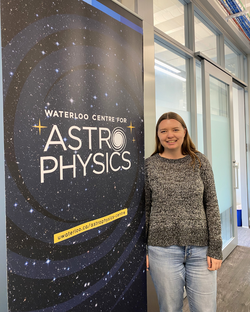
Banting Postdoctoral Fellow Emily Deibert has joined the Waterloo Centre for Astrophysics to advance research on planets beyond our solar system.
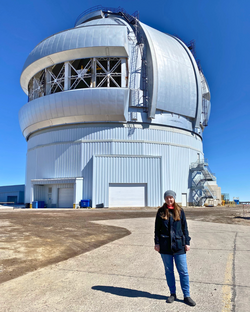
Deibert at the Gemini South Observatory in La Serena, Chile.
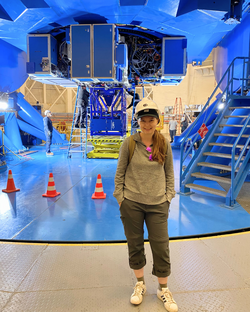
Deibert is part of the Gemini South Observatory's instrument science team for the high-resolution optical spectrograph, GHOST.