
The Department of Applied Mathematics has 30 faculty members and over 100 graduate students. We offer undergraduate plans in Applied Mathematics and Mathematical Physics that attract outstanding students. The wide range of interdisciplinary research being undertaken in the department provides a stimulating environment for our graduate program.
The department has research programs in
- Control and Dynamical Systems (including differential equations)
- Fluid Mechanics
- Mathematical Medicine and Biology
- Mathematical Physics
- Scientific Computing
New: Modified AM undergraduate programs from Fall 2025! (Including the AM-SciML program, our new major focusing on Scientific Machine Learning; new course AMATH 345 - Data-Driven Mathematical modeling; a new Climate and Sustainability specialization; and PHYS 121 no longer being required for the AM major.)
News

Applied Math Professor Elected IEEE Technical Committee Chair and SIAM Activity Group Vice Chair
Jun Liu, professor of applied mathematics and Canada Research Chair in Hybrid Systems and Control, has been elected Vice Chair of the SIAM Control and Systems Theory Activity Group. According to the SIAM website, the activity group fosters collaboration among mathematicians, engineers, and scientists working in systems and control, and promotes the development of theory and methods for modeling, estimation, control, and approximation of complex biological, physical, and engineering systems.
Professor Liu has also been elected Chair of the IEEE Control Systems Society Technical Committee on Hybrid Systems. According to the IEEE website, the committee provides forums for technical discussion and information sharing for researchers interested in hybrid systems and their applications. It organizes and supports conferences and educational events in the field, including the ACM International Conference on Hybrid Systems: Computation and Control, part of Cyber-Physical Systems Week, and the IFAC Conference on Analysis and Design of Hybrid Systems.
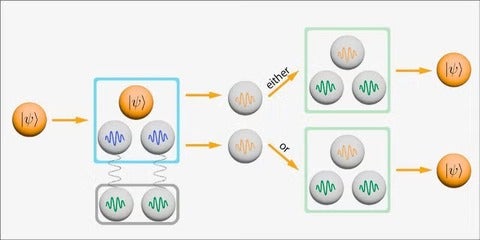
Applied Math research team achieves breakthrough in duplicating quantum information
In a recent publication in the journal Physical Review Letters, Koji Yamaguchi, a former postdoctoral fellow, and Prof. Achim Kempf show how encrypted cloning of unknown quantum states can be achieved. As Kempf describes, “This breakthrough will enable quantum cloud storage, like a quantum Dropbox, a quantum Google Drive or a quantum STACKIT, that safely and securely stores the same quantum information on multiple servers, as a redundant and encrypted backup.”

Recent Applied Math alum wins prestigious Irwin Oppenheim Award from the American Physical Society
Dr. José Polo-Gómez, a recent graduate of the Applied Mathematics PhD program, has received the 2026 Irwin Oppenheim Award from the American Physical Society. This award, which honours early-career scientists, recognizes Dr. Polo-Gómez for showing that the second law of thermodynamics limits the ability to distinguish between quantum states. He reported this result in a 2024 paper entitled “Thermodynamic bound on quantum state discrimination”. Dr. Polo-Gómez, who worked under the supervision of Professor Eduardo Martin-Martinez, is now a postdoctoral researcher at the Max Planck Institute of Quantum Optics.
Events
Applied Math Distinguished Lecture/ Dean's distinguished women in mathematics, statistics, and computer science lecture series | Marina Gavrilova, Fair Play: Spotting Data and Machine Learning Bias in Real-World Datasets
MC 5501
PhD Comprehensive Exam | Shri Lal Raghudev Ram Singh, Stabilization of Linear and Nonlinear Partial Differential Equations
DC 1304
Applied Math/ Computational Math Colloquium | Frédérick P. Gosselin, FENNM: A Variational Framework Integrating the Formalism of the Finite Element Method with Physics-Informed Neural Networks
MC 5501