Graduate Seminar| Materials and interfaces for next generation batteries , by Dr. Yang Zhao
The Chemical Engineering Department is hosting a special graduate seminar on Materials and interfaces for the next generation batteries.
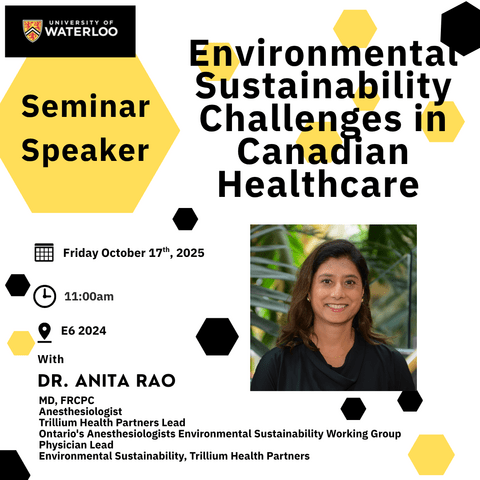
The Chemical Engineering Department is hosting a special graduate seminar on Environmental Sustainability Challenges in Canadian Healthcare.
Grad and Post-doc Networking event
Biological systems are essential in biopharmaceuticals, where rising demand requires efficient bioreactor operation. Scaling from lab to industry is limited by gradients from poor mixing, reducing yields through cell stress and adaptation. This work quantified dissolved oxygen, pH, and kLa gradients in a 20 L bioreactor. While cell density and metabolite gradients were inconclusive, metabolic responses were modeled with modified Monod kinetics, which adapted well to differing conditions.
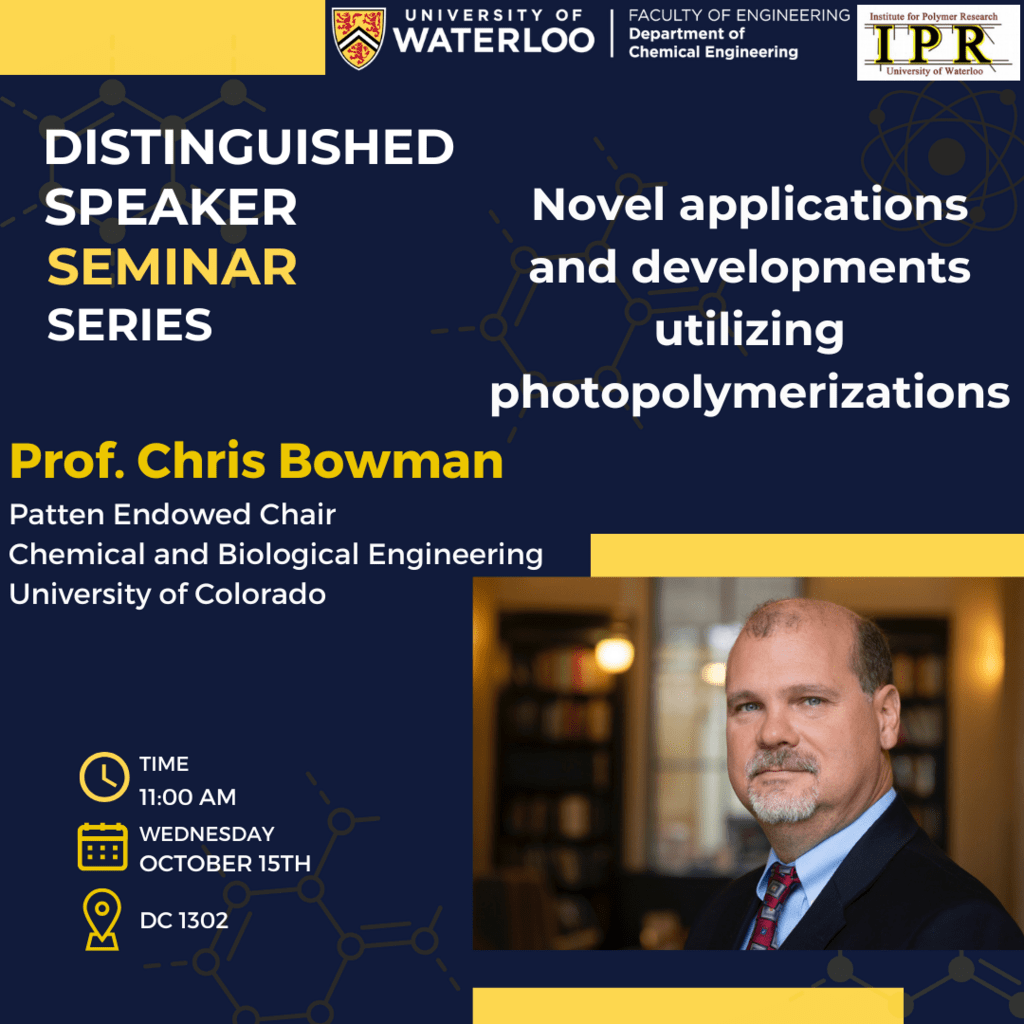
Photopolymerization reactions have been explored and utilized since the time of the ancient Egyptians; however, development of new photopolymerization methodologies and applications continues at an ever more rapid pace. Traditionally, photopolymerization of multifunctional monomers results in highly crosslinked materials suitable for applications as optical lenses, optical fiber coatings, and dental materials. These reactions are ubiquitous not only because of the nature of the final polymer product, but also for the characteristics of the reaction itself. Photopolymerizations are far more energy efficient than their thermal counterparts, are typically performed in a solventless manner that is more environmentally compatible, the reactions occur rapidly at ambient conditions, and the polymerization can be controlled in both time and space.
Abstract:I
It is clear, that by mid-century, to avoid the worst-case scenarios of anthropogenic climate change, our society will have to rely on sustainable and renewable resources rather than fossil fuels. Biomass is a key proposed component of several climate mitigation strategies, with substantial involvement of future energy and material systems. The general objective of my research is utilizing biomass, photo/bio/electro-catalysts, and cell factories to design and fabricate renewable and sustainable bioproducts and systems, via bioinspired routes, for Energy, Environmental, and Biomedical application. These hybrid technology approaches provide potential route to economically viable energy production (hydrogen + biofuels) + biomass CO2 captured negative emission technologies (NET) (biomaterials + biochemicals), thus are clearly an important early step in the complete decarbonization of our society. In this presentation, I will introduce our new technology platform of using photocatalysis and photo/electro-bio hybrid system for biomass valorization. I will also talk about our recent progress on design and fabrication of cellulose based materials with genetically engineered proteins for biomedical application
Chitosan/SIFSIX-3-Cu Cryogels on Printed Laser-Induced Graphene for CO2 Electric Swing Capture
Analysis of integrated heating approaches for cold-start conditions in 21700 lithium-ion battery modules using 1D thermal simulation
Dry Extraction of Nickel from Mixed-Hydroxide Precipitates via Reduction and Carbonylation
Techno-economic and Life Cycle Assessment of Airport Hydrogen Production Infrastructure for Future Hydrogen-based Aviation in Canada