Avidrone Aerospace puts co-op students at the controls
By: Matthew King
At this Waterloo Region drone manufacturer, co-op students don’t just shadow engineers — they contribute to bringing aircraft systems to new heights.
Avidrone Aerospace designs and manufactures heavy-lift, long-haul cargo drones for industrial, government and defence customers. Its tandem-rotor aircraft prioritize endurance, payload capacity and strict regulatory environments.
With a small team of about 15 employees, Avidrone sees co-op students as an essential component to how the company operates.
“We cannot afford to give co-ops throwaway work,” says Greg Toombs, Senior Manager of Software Development at Avidrone. “The work they do is what a junior or even intermediate developer would be doing.”
Company snapshot
- Industry: Aerospace and robotics (heavy-lift cargo drones)
- Location: Breslau, Ontario
- Years in operation: Founded in 2007
- Years as a Waterloo co-op employer: More than six years
- Total Waterloo co-op work terms: 20
- Key co-op roles: Software developer, firmware developer, mechanical engineer
Avidrone hires three rotating co-op students across software, firmware and mechanical engineering roles. The company embeds students directly into product teams where they contribute to unique projects each term, from developing flight software to testing systems and aircraft hardware they build and deliver to customers.
“Our projects look pretty different from term to term,” says Toombs. “We have a lot of stuff to do, so the work really varies. Co-op students have written our GPS trackers, they’ve rewritten our entire simulator, they’ve rewritten our entire user interface.”
For Computer Engineering student Evan Armoogan, that responsibility was clear from his first day.
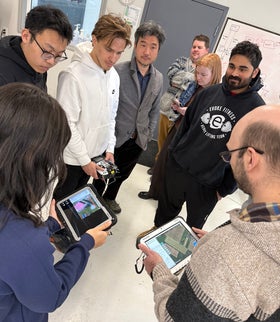
Group of Waterloo students looking at tablets that control heavy-lift, long-haul cargo drones
Even in his first work term, Armoogan’s supervisor gave him ownership over meaningful tasks and provided mentorship without micromanaging his work.
“I didn’t feel like they were handholding me,” Armoogan says. “The work was going straight from my desk to the customer.”
Avidrone has a robust code and design review process in which senior staff support co-op students in identifying bugs and improving quality prior to release. At the same time, the company is small and agile enough to move through this process quickly and without significant overhead.
That combination of autonomy and accountability is one reason he keeps returning to the company. Armoogan is now completing his fifth work term at Avidrone.
I’ve had a few different roles. When I first started, I was doing more software but in the last two terms I’ve been doing firmware. That’s helped me dig into what I really enjoy, and it’s influenced the courses I’m choosing next.
From simulator to safety
During his third work term at Avidrone, Armoogan took on one of his largest projects;modernizing Avidrone’s flight simulator.
At the time, the simulator relied on outdated architecture that required duplicate code updates. Over the course of the term, Armoogan rebuilt the simulator, to deliver more reliable and accurate testing before flights.
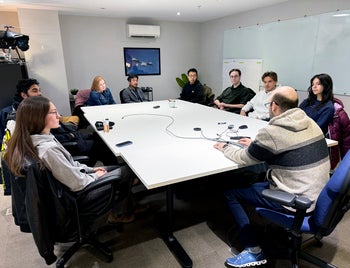
Waterloo students sitting in the Avidrone board room with Greg Toombs
“We can now run proper tests and catch bugs before we put a drone in the air,”Armoogan explains.
Evan described scenarios where this category of testing prevented the team from releasing issues to the customer.
In heavy-lift aerospace, preventing even one issue in the field represents significant time, cost and risk mitigation.
The simulator overhaul remains in use today and plays a critical role in the company’s product development.
Along the way, Armoogan began mentoring newer co-op students, helping them navigate complex systems and freeing senior engineers to focus on strategic priorities.
“Each term, I’ve taken on different kinds of projects, which has helped me figure out what I enjoy most and build new skills each time,” says Armoogan.
The experience has also shaped Armoogan’s academic path. When it was time to select his classes, his exposure to aerospace systems and embedded controls influenced the electives he chose. He now feels more confident pursuing a career direction that aligns with his coursework.
“Three years ago, I probably wouldn’t have chosen a controls course,” Armoogan says. “Now it directly applies to what I want to do.”
A strategic advantage
Avidrone’s approach works because it is intentional. The company trusts students with meaningful responsibilities, including projects that directly impact customer outcomes, while providing accessible mentorship.
“Evan operates at the level of a senior software developer,” says Toombs. “We’ve had good students, and we have had exceptional students.”
The exceptional co-op students augment Avidrone’s team and help propel their product development significantly further. For Avidrone, co-op is not just a recruitment tool; it’s a strategic advantage.
For students, it’s a rare chance to contribute to mission-critical aerospace systems long before graduation.