Students help make quantum leaps to accelerate innovation at Qubic
By: Krista Henry (she/her)
Qubic Technologies is pushing the boundaries of quantum sensing with help from Waterloo co-op students. During their work terms, students dive into complex projects that help the small team move faster to innovate.
When the quantum hardware company needed extra hands and minds, they called on Waterloo co-op students. Although Qubic’s work developing quantum-enhanced radar systems is complex, Waterloo co-op students had the skills and drive to jump in.
For Meg Panetta (she/her), lead quantum scientist at Qubic, having students on board brings in fresh thinking and approaches.
We’re a small team with a lot of hardware tasks and students help us move faster. They also sharpen our permanent staff by asking questions and bringing fresh perspectives.

Meg Panetta, lead quantum scientist, Qubic
Company snapshot
Industry: Deep technology
Location: Waterloo, Ontario
Years of operation: 5
Years as a co-op employer: less than a year
Total Waterloo co-op work terms: 6
Key co-op student roles: Quantum device integration and experiment co-op, fast microwave and radar hardware co-op and microwave engineering for superconducting quantum circuits
Integrating students into deep tech
In the short time it has been hiring co-op students, Qubic has already seen significant contributions from its Waterloo co-op students. A physics student took over a radar prototype project and brought it online.
The prototype produced data to share with a multi-institution collaboration. She later improved its design.
Another student, as a side project, learned the coding language Python and wrote functional control code for instrumentation in just two weeks. Other students contributed to:
- Electromagnetic modelling and simulation for hardware design
- Experiment code integration for larger-scale testing
- Cryogenic hardware design for ultra-low temperature environments
“Waterloo co-op students show up ready to learn, ask questions and take ownership of their work. That energy is contagious and elevates the whole team,” Panetta says.
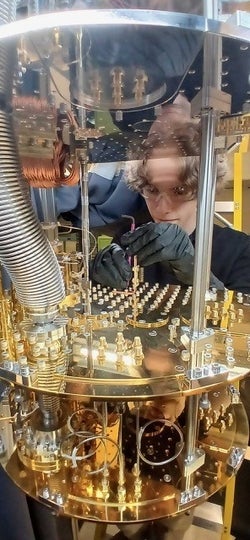
A student examines a device in the laboratory at Qubic Technologies
Why small tech companies should hire students
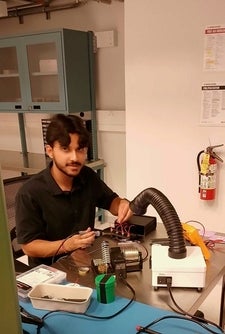
A student works on a device in the lab
For Panetta, hiring students is a no-brainer. At first, she worried about having students work with complex machinery and approaches from different technical fields.
However, that concern was quickly alleviated when students demonstrated their capability. Panetta encourages other small, high-tech organizations to hire students as well.
“Students bring energy, motivation and new ways of thinking. It’s a positive contribution that sharpens your team and helps everyone grow,” Panetta says.
For long-term growth, Panetta values the skills Waterloo co-op students bring. They apply new techniques from the classroom to the workplace, and their information literacy benefits the company.
“Students influence the team positively. They ask questions that make us rethink assumptions. And teaching them helps our staff refine their own expertise,” Panetta says.
The takeaway?
Qubic’s experience proves it: co-op students are more than extra hands—they’re accelerators of innovation. Their curiosity, adaptability and drive strengthen teams and help companies achieve goals faster.
Want to move faster, think sharper and build bolder? Hire students.