Remembering Stephen Hawking

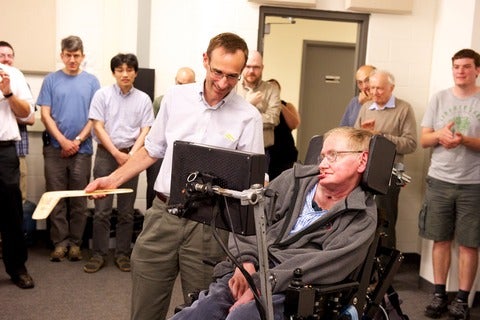
The scientific community, and the world, is deeply saddened by the news of Professor Stephen Hawking’s passing.

The scientific community, and the world, is deeply saddened by the news of Professor Stephen Hawking’s passing.
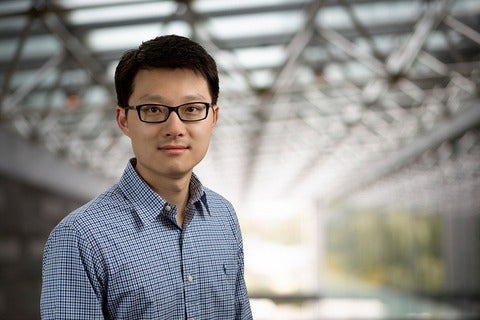
Wei Tsen, assistant professor at the Institute for Quantum Computing (IQC) and the Department of Chemistry, is one of eleven University of Waterloo researchers receiving an Early Researcher Award, the Government of Ontario announced.
Quantum key distribution (QKD) is able to achieve information-theoretic security in principle. However, in practice, imperfect devices threaten the security of quantum cryptographic systems. As a promising countermeasure against practical attacks, measurement-device-independent (MDI) QKD is immune to all detector side-channel attacks. Nevertheless, there are some limitations of the MDI QKD protocol. To overcome the technical limitations of MDI QKD, I scrutinized and evaluated other two countermeasures against imperfect detections.
Researchers at the Institute for Quantum Computing (IQC), in collaboration with researchers from the National Institute of Standards and Technology (NIST) and the National Institute of Health (NIH), have developed a neutron interferometry technique that is more powerful, robust and practical than existing techniques, paving the way for advances in imaging, materials science, and fundamental physics and quantum research.
After the discovery of topological insulators, the concept of topology permeated the various fields of condensed matter physics. Symmetry of a quantum system plays an intriguing role in close association with topology, expanding the range of topological quantum systems to superconductors/superfluids. Superfliuid 3He, which has been a prime example of symmetry breaking phase transition, is also recognized as a quantum system with various topological nature.
My research focuses on probing superconducting quantum bits or qubits with acoustic radiation in the form of surface acoustic waves (SAWs). This allows the investigation of sound interacting with artificial atoms on a quantum mechanical level, i.e. quantum acoustics with traveling phonons. We can then reproduce findings from quantum optics with sound taking over the role of light, highlighting the similarities between phonons and photons.
Emergence of quantum information science has led to a paradigm shift in communication systems. In the past couple of decades, quantum information processing tasks like quantum cryptography, dense coding, quantum teleportation etc. have been shown to have advantages over their classical counterparts and have also been successfully implemented in laboratories.
The study of charged particles dynamics in a Paul trap is the foundation of its wide-ranging applications, including analyzing proteins, determining isotope ratios, and constructing a quantum computer. However, in the simplest case of two-particle dynamics, there remains a controversy on whether a two-ion planar crystal undergoes an order-to-chaos transition at a critical, well-defined trap parameter value. Via analytical and numerical investigation of the Mathieu-Coulomb equations, I show that the transition does not exist.
It is generally believed that experimental violations of Bell's inequalities (especially the recent so-called loophole-free experiments) provide evidence that quantum theory cannot be both local and realistic. We demonstrate to the contrary that all reversible-dynamics no-signalling operational theories (including unitary quantum theory) can be given a local-realistic interpretation.
Emergence of quantum information science has led to a paradigm shift in communication systems. In the past couple of decades, quantum information processing tasks like quantum cryptography, dense coding, quantum teleportation etc. have been shown to have advantages over their classical counterparts and have also been successfully implemented in laboratories.