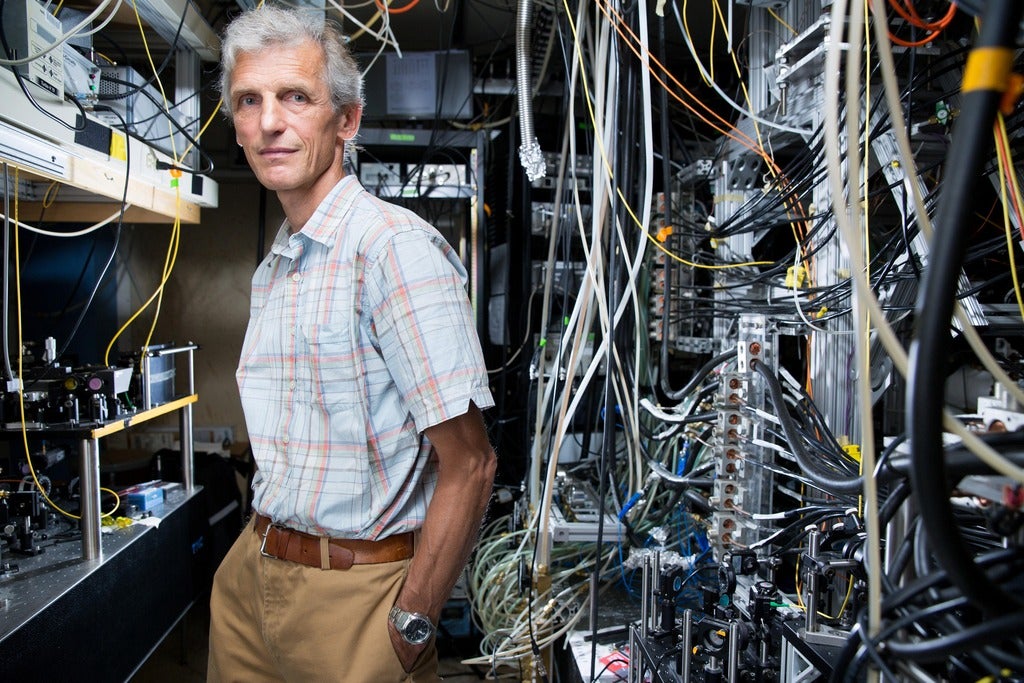
Quantum Frontiers Distinguished Lecture
Cooling close to absolute zero temperature: a recipe for discoveries
Wolfgang Ketterle, 2001 Nobel Laureate

Understanding the interplay of non-equilibrium effects, dissipation and many body interactions is a fundamental challenge in condensed matter physics. In this work, as a case study, we focus on the transient dynamics and the steady state characteristics of the double-dot Aharonov-Bohm (AB) interferometer subjected to a voltage and/or temperature bias. We first consider an exactly solvable case, the noninteracting double-dot AB interferometer.
The properties of ultracold atoms can be profoundly modified with the help of laser beams. They can modify the wavefunction of neutral atoms in such a way that they show behavior of charged particles, e.g. electrons in high magnetic fields. In this way, synthetic magnetic fields and spin-orbit coupling have been realized, and a supersolid phase has been observed. A supersolid is superfluid and breaks translational symmetry, i.e. it has shape.
We present a verifiable and blind protocol for assisted universal quantum computing on continuous-variable (CV) platforms. This protocol is highly experimentally-friendly to the client, as it only requires Gaussianoperation capabilities from the latter. Moreover, the server is not required universal quantum-computational power either, its only function being to supply the client with copies of a single-mode non-Gaussian state. Universality is attained based on state-injection of the serverʼs non-Gaussian supplies.
Candidate: Christopher Chamberland, Physics and Astronomy
Supervisor: Raymond Laflamme
Rydberg atoms, which possess large-dipole moments and the resulting strong dipole- dipole interactions, have been intensively investigated owing to its potential applications in diverse fields ranging from quantum nonlinear optics to quantum information and computation. Exclusive examples includes photon blockade, attractive photons and single-photon transistors, to mention a few.
We devise an all-optical scheme for the generation of entangled multimode photonic states encoded in temporal modes of light. The scheme employs a nonlinear down-conversion process in an optical loop to generate one- and higher-dimensional tensor network states of light. We illustrate the principle with the generation of two different classes of entangled tensor network states and report on a variational algorithm to simulate the ground-state physics of many-body systems.
In recent years, the magnetic random-access memory (MRAM) have been attracting attention as a next generation memory device due to their fast switching speed and non-volatility characteristics. The biggest challenge for the switching device using a magnetic material is an easy magnetization reversal.
Sandia National Laboratories is a multidisciplinary National Laboratory in the United States dedicated to developing advanced technologies. Here, I will explain the ongoing work in quantum information science using trapped ions. In particular, I will describe requirements of surface ion traps fabricated at Sandia’s MESA facility. Additionally, I will discuss results obtained using these traps relevant to building a quantum information platform, including ion shuttling, electric field control, and high-fidelity quantum operations.
Thursday, November 1
7:30 pm
Patent Social - 17 Erb Street East, Waterloo
Experience the unique combination of quantum physics and craft beer and learn how they are anecdotally intertwined.