Waterloo co-op student joins Caltech’s Exoplanet Technology Laboratory through a prestigious summer research program.
The University of Waterloo’s Faculty of Science attracts some of the brightest students in the country with its top-ranked physics program. Among them is Ariana Pearson, a fourth-year Physics and Astronomy student who chose Waterloo for its renowned co-op program and strong reputation in astrophysics research. That choice has led to opportunities far beyond the classroom, most recently, a summer at the California Institute of Technology (Caltech) through the prestigious Summer Undergraduate Research Fellowship (SURF).
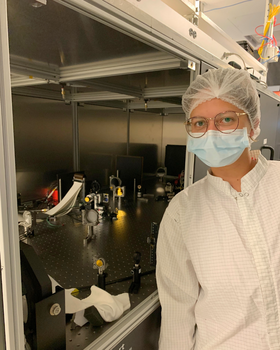
Pearson joined professor Dimitri Mawet’s Exoplanet Technology Laboratory after completing a rigorous application process that included an interview and a detailed research proposal. Mawet’s group specializes in developing advanced technologies for high-contrast imaging and the spectroscopic characterization of exoplanets.
Her role was hands-on in direct imaging instrumentation such as coronagraph technologies essential for detecting planets beyond our solar system. She specifically focused on improving the efficiency of a high-contrast spectroscopy testbed, where she developed a control algorithm for a tip-tilt mirror to correct for jitter, the tiny fluctuations in a light source.
“Further developing these technologies moves us closer to the discovery of potentially habitable planets,” says Pearson. “We’ve discovered 6,000 exoplanets so far, and although we haven’t found life, we have found planets in the habitable zones of their stars and others that contain elements in their atmosphere that could potentially host life.”
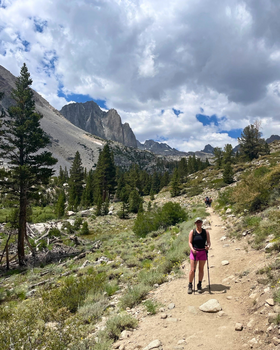
Outside of the lab, Pearson took advantage of all that California has to offer, spending her free time hiking, camping, and visiting beaches along the coast. This experience also brought her a step closer to figuring out her path, coming home inspired to pursue graduate school to continue research in exoplanet instrumentation and computational research.
Just as her time at Caltech helped shape her future goals, her co-op experiences at Waterloo have taught her to embrace new challenges and step outside her comfort zone.
“Don’t be afraid to accept a co-op role outside of your research interests,” she says. “My first co-op wasn’t related to physics, but I gained skills and experience that opened doors to future opportunities. Don’t stress about having it all figured out. Focus on exploring projects that excite you and enjoy the learning process. It goes by fast!”
Over the next year, Pearson will be working towards completing her undergraduate degree while exploring opportunities for graduate research that will push the boundaries of scientific discovery.