The American Astronomical Society (AAS) has announced its selection of the Dark Energy Spectroscopic Instrument (DESI) collaboration as the recipient of the 2026 Lancelot M. Berkeley–New York Community Trust Prize. Established in 2011, the prize is awarded annually to recognize outstanding and highly meritorious work in astronomy that advanced the field in the previous year. Previous recipients have included both individuals and teams for their work in diverse areas of astronomy.
The 2026 prize recognizes the DESI collaboration for its work on two papers published this year. The first, published in February, presents baryon acoustic oscillation (BAO) results from the first year of DESI data, while the second, released in March, reports BAO results from observations of 14 million galaxies and quasars, obtained in the first three years of DESI operations.
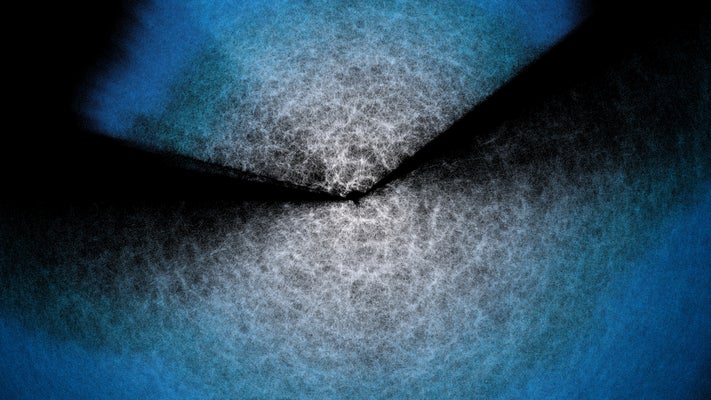
DESI has made the largest 3D map of our universe to date and uses it to study dark energy. Earth is at the center in this animation, and every dot is a galaxy.
Dr. Will Percival, Distinguished Research Chair in Astrophysics and Director, Waterloo Centre for Astrophysics, is co-spokesperson for the DESI experiment. His role has given him a front-row seat to the amazing science happening within this collaboration.
“DESI is an amazing experiment, able to perform a galaxy survey that is more than 20 times faster than previous experiments,” he says. “Whenever you have such an experimental advance, you open a huge discovery space, as the recent results from DESI have demonstrated. It’s great to receive this award from the American Astronomical Society recognizing the hard work that has been put in to make DESI a reality by many hundreds of scientists around the world.”
The observations not only constitute the largest 3D map of the Universe ever made, they also provide new insights into the nature of dark energy and the evolution of the Universe. When combined with other cosmological constraints, the DESI results provide strong hints that dark energy evolves over time, challenging our current leading model of the Universe, Lambda CDM.