As a fourth-year Environmental Sciences student in the Water Science specialization Miles Yoshida gained hands-on research experience by developing and calibrating a fibre-optic oxygen sensor system to measure soil oxygen levels. His work was supported through the Faculty of Science's Summer Undergraduate Research Fund (SURF), an initiative designed to increase undergraduate research opportunities. The experience has strengthened his skills as an independent researcher and provided valuable preparation for his future goal of pursuing graduate studies in water and environmental science.
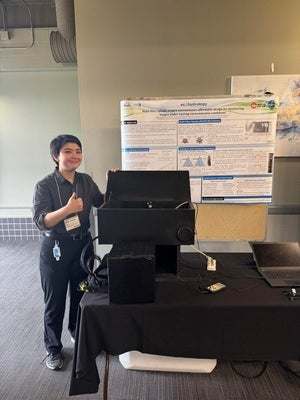
Miles Yoshida, a fourth-year Environmental Sciences student.
Whose lab did you work in this summer, and what is your relationship like with your supervisor?
I worked with the Ecohydrology Research Group in the Department of Earth and Environmental Sciences under Drs. Philippe Van Cappellen and Fereidoun Rezanezhad. Ecohydrology is a very large group, so I’m also lucky to work with a team of full-time staff who help me plan my lab work, design my setup, and analyze my data. Dr. Rezanezhad and I had offices right across the hall from each other, so we had meetings on a regular basis to discuss project updates, results of new tests, and potential next steps.
Tell us about the research, and what you are learning
My research is focused on the development and calibration of an in-house oxygen sensor system, specifically designed for fine-scale measurements in soils. I used fibre-optic cables coated in Platinum(II) meso-tetra(pentafluorophenyl)porphine (PtTFPP), a platinum complex whose luminescence decreases in the presence of increased oxygen. I used it to quantify changes in soil oxygen levels based on changes in emitted light intensity that I capture with a standard DSLR camera.
Throughout the summer, I made gradual improvements to the sensor design and tested the new system at various temperatures and oxygen concentrations. I also analyzed data to calculate numerical parameters related to the system’s performance that can be compared to commercial oxygen sensors.
What is the impact of this research?
Soil oxygen levels have a huge impact on other environmental characteristics like microbial activity, nutrient cycling, contaminant transport, and more. Therefore, it’s incredibly important to understand soil oxygen dynamics to study where these processes occur and how they change over time, especially in environments like shorelines and wetlands where water level fluctuations create incredibly dynamic conditions. Commercial oxygen sensors can be expensive and difficult to customize to experimental needs. So, we hope that through this project, we can create something versatile, easy to build, and accessible to other researchers.
How did you receive this summer research assistantship?
I was initially hired as a research assistant for my second co-op term in Fall of 2024 through Waterloo Works. I was very interested in the work the group did on biogeochemical cycling and microplastic pollution in unique environments such as stormwater ponds and I knew I wanted to return for my honour's thesis. I reached out to the group about returning as a Research Assistant for my last two co-op terms to get a head start on my senior thesis project.
Why did you choose to study at the University of Waterloo?
Environmental science is a very broad, interdisciplinary field. I liked that Waterloo allowed me to choose a specialization early to help focus my studies. I chose the Water Science specialization because of the university’s commitment to solving complex water-related issues through organizations like the Water Institute, the Global Water Futures Observatories (GWFO), and the many hydrology and hydrogeology focused groups in the Earth and Environmental Sciences department.
How do you feel you have benefited from being a summer Research Assistant?
This summer, I took on more responsibility than I have at any of my previous jobs. It’s been an incredibly difficult but rewarding experience to be able work on this project and help guide its progress. I’ve rapidly developed my skill set in independent data collection and management. I’ve also become more confident in my ability to ask and answer relevant research questions. In many ways, it’s felt like a practice run for graduate school.
What are your career goals, and what would you like to do after you graduate?
I'm hoping to pursue a master's degree after completing my undergraduate studies and continue working in a research lab setting. While I haven't yet decided exactly where my research journey will lead, I'm eager to keep exploring the many ways water shapes our environment and our everyday lives, and to contribute to solving the complex challenges that come with it.
Learn more about undergraduate research opportunities in the Faculty of Science.