Waterloo’s Rocketry team is gaining national attention for a liquid bi-propellant student rocket that soared to 38 thousand feet, setting a new apogee record for Waterloo Rocketry and for Canadian liquid rockets.
Second-year physics and astronomy student Connor Stubbs plays an essential role on the team as co-lead on the payload system, which involves designing, manufacturing, and testing experiments for flight.
Last year, Stubbs helped develop a custom 3U CubeSat equipped with a peristaltic IV pump to study the effects of rocket launch conditions on medical pumping systems. The team also flew a vibration experiment to determine how fasteners respond to intense launch vibrations. These experiments were part of Borealis, the team’s groundbreaking rocket, which reached 19,000 feet with speeds of 1,646 km/h, drawing national media attention from CTV and CBC.
In the summer, the team doubled down on liquid rocketry with Aurora, a rocket that flew to 38 thousand feet, setting a new apogee record for Waterloo Rocketry and Canadian liquid rockets.
Now, Stubbs and his team are drawing from physics to take their rocket to new heights. They are developing a deployable payload complete with a student-designed mid-infrared (Mid-IR) hyperspectral camera capable of detecting atmospheric gases such as nitrous oxide and carbon dioxide. The design is deployable and allows an unobstructed view of the ground and clouds below it, letting the team use the Earth’s infrared radiation or reflected infrared from clouds as a light source to detect greenhouse gas absorption. Built for only $2,000, the goal of this low-cost design is to create an accessible method for detecting these emissions.
“The spectrometer and payload were completely designed, machined, and wired by students,” says Stubbs. “From my work on these rockets, I have developed skills in machining, 3D CAD design, PCB design, firmware and software development, electrical harnessing, and optical simulation, which helped me land a co-op role with the Canadian Space Agency working on Thin Ice Clouds and Far InfraRed Emissions (TICFIRE).”
TICFIRE is a cutting-edge climate instrument developed by the Canadian Space Agency as part of a larger satellite mission to study how thin ice clouds and far-infrared heat radiation affect Earth’s climate. Stubbs is utilizing his hands-on experience with student-built rockets and payloads to contribute to the design, testing, and calibration of instruments that measure these delicate atmospheric phenomena from space.
“The skills I gained designing and flying our rockets translate directly to real-world space missions,” says Stubbs. “My experience at the University of Waterloo is now helping support national efforts to collect critical climate data.”
To learn more about Waterloo Rocketry’s Aurora payload design, view their report.
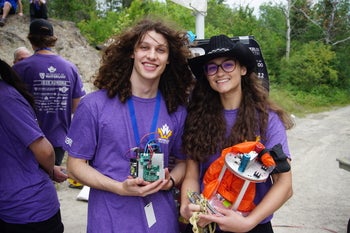
Second year Physics and Astronomy student Connor Stubbs, with co-lead Rhea Scollie, a second year biomedical engineering student.

The Aurora rocket flew to 38 thousand feet, setting a new apogee record for Waterloo Rocketry and Canadian liquid rockets.