


The department's small class-sizes, engaging teaching practices, and hands-on learning in our state-of-the-art facilities empower our students to solve real-world problems.
The Department of Chemical Engineering is a vibrant center of collaborative research addressing some of the most pressing challenges in energy and materials. Our faculty members are engaged in a diverse array of research in areas such as machine learning and process systems engineering, CO2 capture and conversion, polymer engineering, renewable energy, synthetic biology, environmental remediation, and materials science that push the boundaries of innovation.


Find out more by exploring the programs, research and news stories on this site.
News
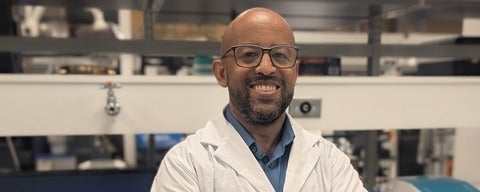
Replacing lead in X-ray shielding
A research group led by Professor Tizazu Mekonnen has designed a lightweight, flexible polymer-based material that blocks X-ray radiation, offering a potential alternative to heavy lead aprons currently used.
X-rays are a necessary tool in medical diagnostics, industrial inspection, security screening, military applications and more. Exposure to radiation is a concern, highlighting the need for lightweight, lead-free shielding materials that protect against harmful radiation.
In a previous study investigations focused on using safer alternative elements to lead, which comes with its own health risks. Researchers experimented with using bismuth, tungsten, gadolinium, barium, and other heavy metals, as well as their compounds that were incorporated into a polymer matrix.
In the current work, the research group used tungsten because it has high density at the atomic level, which is effective in blocking x-ray radiation. The focused is on the polymer’s design architecture, the group discovered that when they added more tungsten nanoparticles, the material blocked X-ray radiation better but became stiff.

Student-led research team pioneers a new method for programming motion in soft robots
A student lead research team designs an easy method to generate programmed shape-change and movement in soft robots.
The team worked with hydrogels—soft, tissue‑like materials that are biocompatible. These materials are promising for developing microrobots to perform non-invasive biomedical tasks within biological media, like gastrointestinal or reproductive tracts. Their approach could pave the way to create motion in soft robots and other smart devices, opening the door to a new generation of soft medical devices.
This research was driven by student curiosity. PhD student Negin Bouzari was inspired by a review paper.
Her supervisor Hamed Shahsavan, a professor in the Department of Chemical Engineering, hired four undergraduate co-op students from across faculties to assist with her research.
A research team on point with Waterloo’s commitment to bringing undergrads into the heart of cutting-edge research and fueling interdisciplinary collaboration.

From co-op to cutting-edge research
Cole Fredericks is a master’s student in the Department of Chemical Engineering. Fredericks also did his undergraduate degree in chemical engineering (BASc '25) at the University of Waterloo.
Fredericks was the recipient of the Canada Student Merit Award by the Society of Chemical Industry, which is bestowed upon students who have attained the highest standing in their fourth year of a chemical engineering undergraduate degree.
For Fredericks, earning this distinction was the culmination of a mindset shaped by a lifelong love of learning and harmony in life both inside and outside the classroom.
“I have always been very curious and tried my best in everything that I did academically. My philosophy is that learning itself is a skill that must be practised, a muscle that must be exercised to better master what really interests you,” says Fredericks.
Events
PhD Comprehensive/Topography-Functionalized Biomaterials for Tissue Engineering by Daichen Liu
Thesis Proposal Title: Topography-Functionalized Biomaterials for Tissue Engineering
PhD Comprehensive/Biomimetic Hydrogels: Design Strategies and Transformative Applications in Biomedicine by Maggie Wong
Biomimetic Hydrogels: Design Strategies and Transformative Applications in Biomedicine