- Library releases annual report
- 5 takeaways from the hope and climate change conversation with Katharine Hayhoe
- More than a million smokers likely to quit after U.S. bans menthol cigarettes
Editor:
Brandon Sweet
University Communications
bulletin@uwaterloo.ca
Library releases annual report

A message from the University of Waterloo Library.
The Library is delighted to share its 2021 Annual Report. As the challenges of COVID-19 persisted, the Library continued to provide the Waterloo community with anywhere, anytime resources and services to advance learning, research and scholarship.
The report articulates Library accomplishments in three strategic areas – catalyzing learning and research, engaging with our community and strengthening our expertise and services – and highlights the Library’s role as trusted partner to students, faculty and researchers at every stage of their Waterloo journey.
You can view the report now at Annual Report.
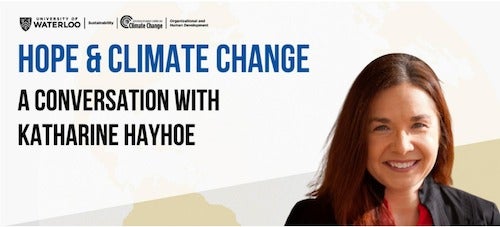
5 takeaways from the hope and climate change conversation with Katharine Hayhoe
This article was originally published on the Interdisciplinary Centre on Climate Change (IC3) website.
On April 27, 2022, IC3’s Executive Director, Sarah Burch, spoke with climate scientist Katharine Hayhoe, who The New York Times called “one of the nation's most effective communicators on climate change.” They discussed climate change communications, strategies for individual and collective action, transition inequities, the role of children and youth, and so much more. They also weighed in on what we’re all wondering – is there hope? Here are five highlights from that conversation:
1. We must communicate the risks as well as the solutions.
Emissions over the last 10 years have been the highest they have been in human history. Without immediate and deep action, the goal of limiting warming to no more than 1.5 degrees Celsius is beyond reach. But, for the first time ever, we have evidence that climate solutions are working. The solutions to climate change now exist; we just have to adopt them. These two parts of the conversation are inseparable and must be talked about in tandem.
2. Ordinary people are the only ones who have ever been able to change the course of our world.
And we must do it again! Now, more than ever, our choices determine the future we want to have. The future is up to us and there is a growing consensus that immediate action is needed.
3. Our actions matter, but even more important is acknowledging how we make a difference.
How our actions influence those around us. As Mother Theresa said, “I alone cannot change the world, but I can cast a stone across the waters to create many ripples.” In saying that, we must also acknowledge that individuals are currently locked into high carbon systems that make individual choices expensive/hard. These systems need to change. That’s why voting is so important. And why taking climate action, in whatever way is available to you, is significant because it shows decision makers that you are prioritizing climate action, which should in turn make it a priority for them too.
4. We must talk about the future we are working towards.
Missing from the climate conversation are discussions about what we want our future to look like. What are we working toward? What is the future we are trying to obtain? It is more mobilizing to focus on our vision than the impending doom.
5. Caring for yourself is a climate action.
Be kind to ourselves. Spend time with those you love, what you love and where you love. It will help you keep going in this work.
Sarah and Katharine’s rich conversation led to the conclusion that the future is not guaranteed, but it is up to us! To have hope means coming to terms with the truth of the climate crisis. Once we do, we can identify important opportunities and focus on solutions that can help steer us along a transition to a resilient, low carbon future.
For more details, watch the recording and check out the resources Sarah and Katharine shared below.
The event was organized by the University of Waterloo’s Interdisciplinary Centre on Climate Change (IC3), Sustainability Office, and Organizational & Human Development with the intention of driving action and reigniting hope on the climate crisis. Thank you to the 200+ attendees for your thoughtful questions and engagement.
Resources
- The Intergovernmental Panel on Climate Change (IPCC) released a new report, Climate Change 2022: Mitigation of Climate Change. The report is important as it informs international negotiations and tells us where we are in terms of our global greenhouse gas emissions, what steps we can (and already are) taking to reduce them, and how we can speed up this process while also taking justice and competing priorities into account.
- Hope in the Dark by Rebecca Solnit shows us how activism has changed the world before and provides new grounds for political engagement in the present. Her work also talks about the difference between hope and optimism – that hope, which she defines in a way that appreciates the nuances and hard truths of problems while also taking into consideration the possibilities for changing them.
- The Don’t Look Up – Count Us In climate platform is a helpful resource for inspiring individual climate action.
- Katharine encourages us to think less about our footprint and more about our “climate shadow,” a concept developed by Emma Pattee. Check out her article Forget your carbon footprint. Let’s talk about your climate shadow.
- FLICC is an acronym for the approaches people use to spread false information. It means: Fake experts, Logical fallacies, Impossible expectations, Cherry picking, and Conspiracy theories. Check out Cranky Uncle’s history of FLICC for more information about the 5 techniques of science denial.
- Talking to kids about climate change is important. Here are four resources to help adults have that conversation with the young people in their lives:
- What we most need is a vision of a better future. The Future We Choose by Christiana Figueres and Tom Rivett-Carnac is an excellent read on the subject.
- The Influential Mind by Tali Sharot can help us understand how the brain reacts when we face fear and anxiety, and underscores why it’s important to focus on the better future we’re working toward to help us sustain climate action.
- Iron + Earth is a great resource to learn more about the just transition in Canada’s oil and gas community.
- Saving Us: A climate scientist’s case for hope and healing in a divided world has many hopeful examples of win-win-win solutions in low-income countries.
More than a million smokers likely to quit after U.S. bans menthol cigarettes

This article was originally published on Waterloo News.
A new study projects that a U.S. ban on menthol cigarettes, proposed by the U.S. Food and Drug Administration, will lead more than 1.3 million smokers to quit. Among them, Black smokers will see the greatest impact.
Researchers from the University of Waterloo led the study, in collaboration with researchers from the University of Toronto and seven U.S. universities. To make the projection, the team evaluated the impact of Canada’s ban on menthol cigarettes, which came into force nationally in 2017. They combined data from the International Tobacco Control Policy Evaluation Project (ITC Project) and the Ontario Menthol Ban Study, which surveyed people before and after the ban. Smokers of menthol cigarettes in Canada quit smoking at a rate of 22.3 per cent, compared to 15.0 per cent of non-menthol smokers. The difference of 7.3 per cent is highly statistically significant.
“Our study confirms that Canada’s menthol cigarette ban led to substantial public health benefits,” said Geoffrey T. Fong, professor of psychology and public health sciences at the University of Waterloo and lead author of the study. “Smoking is the number one preventable cause of death and disease in Canada, the United States, and globally. ” Fong is also senior investigator at the Ontario Institute for Cancer Research and principal investigator of the ITC Project.
To estimate the impact of a U.S. ban on menthol cigarettes, the study applied the effect the Canadian ban had on quitting to U.S. statistics on menthol smokers. The study projected that a U.S. ban on menthol cigarettes would lead to an increase in quitting of 1,337,988 U.S. smokers. Because 80 per cent of Black smokers smoke menthols—compared to about 35 per cent of U.S. smokers overall—the impact of a menthol cigarette ban in the U.S. would be proportionately greater for them. The projections are that 381,272 Black smokers would quit after a U.S. ban on menthols.
“These findings provide the foundation for the U.S. and other countries considering menthol cigarette bans to estimate the possible impact of such bans on reducing smoking,” said Michael O. Chaiton, scientist at the Centre for Addiction and Mental Health, director of research at the Ontario Tobacco Research Unit, and principal investigator of the Ontario Menthol Ban Study.
For more than a decade, public health experts, scientists, civil rights groups, and anti-tobacco organizations—including the World Health Organization—have called upon governments to ban menthol cigarettes. In addition to Canada, more than 30 other countries have banned menthol cigarettes, including all member states of the European Union.
Menthol is added to cigarettes because it creates a cooling sensation that takes the edge off the harshness of cigarette smoke, making it easier to start smoking and facilitating addiction, all reasons why public health experts have called for a menthol ban.
The study appears in the journal Tobacco Control.
Link of the day
When and Where to get support
Students can visit the Student Success Office online for supports including academic development, international student resources, immigration consulting, leadership development, exchange and study abroad, and opportunities to get involved.
Instructors looking for targeted support for developing online components for blended learning courses, transitioning remote to fully online courses, revising current online courses, and more please visit Agile Development | Centre for Extended Learning | University of Waterloo (uwaterloo.ca).
Instructors can visit the Keep Learning website to get support on adapting their teaching and learning plans for an online environment.
Course templates are available within your course in LEARN to help you build and edit your content and assignment pages quickly.
The following workshops, webinars, and events are offered by the KL team (CTE, CEL, ITMS, LIB):
- Independent Remote Course Design Essentials, self-directed, continuous self-enrollment course in LEARN.
- Independent Blended Course Design (iBlend), self-directed, ongoing
- Copyright Overview for Waterloo Instructors and Staff - self-directed, continuous self-enrollment course in LEARN.
Supports are available for employees returning to campus. Visit IST’s Hybrid Work and Technology guidelines and workplace protocols to assist with the transition.
The Writing and Communication Centre has virtual services and programs to help undergrads, grad students, postdocs and faculty members with academic writing.
- Meet with writing advisors in one-to-one appointments to brainstorm, draft, revise, and polish. No time for an appointment? Try email tutoring for undergrads.
- Beat isolation and make writing progress at weekly Virtual Writing Cafés for grad students and faculty or PJ-Friendly Writing Groups for Undergrads.
- Take an online workshop or apply to our popular Dissertation Boot Camp program.
- Faculty can request custom in-class workshops for their courses, or the WCC can facilitate any existing workshops for student groups.
- Course-integrated support available. Attention faculty and instructors: The application form for Writing and Communication Centre course-integrated support is now available online. We offer five unique support streams for your courses including synchronous and asynchronous workshops and monitored discussion boards.
Co-op students can get help finding a job and find supports to successfully work remotely, develop new skills, access wellness and career information, and contact a co-op or career advisor.
The Centre for Career Action (CCA) has services and programs to support undergrads, grad students, postdocs, alumni, and employees in figuring out what they value, what they’re good at, and how to access meaningful work, co-op, volunteer, or graduate/professional school opportunities. Questions about CCA's services? Live chat, call 519-888-4047, or stop by our front desk in the Tatham Centre 8:30 a.m. to 4:30 p.m., Monday to Friday.
Drop-in to Warrior Virtual Study Halls on Wednesdays from 5:30 p.m. to 7:00 p.m. Come together in this virtual space to set goals and work independently or in groups each week.
Renison's English Language Institute continues to offer virtual events and workshops to help students practice their English language skills.
If you feel overwhelmed or anxious and need to talk to somebody, please contact the University’s Campus Wellness services, either Health Services or Counselling Services. You can also contact the University's Centre for Mental Health Research and Treatment. Good2Talk is a post-secondary student helpline available to all students.
The Library is open with expanded hours for access to book stacks, drop-in individual study space, bookable group study rooms, drop-in access to computers and printers, book pick-up services and IST Help Desk support. Librarian consultations, Special Collections & Archives and the Geospatial Centre are available by appointment. Full details on current services and hours are available on the Library’s COVID-19 Update webpage.
The Faculty Association of the University of Waterloo (FAUW) continues to advocate for its members. Check out the FAUW blog for more information.
The University of Waterloo Staff Association (UWSA) continues to advocate for its members. Check out the UWSA blog for more information.
The Sexual Violence Prevention and Response Office (SVPRO) supports all members of the University of Waterloo campus community who have experienced, or been impacted, by sexual violence. This includes all students, staff, faculty and visitors on the main campus, the satellite campuses, and at the affiliated and federated Waterloo Institutes and Colleges. For support, email: svpro@uwaterloo.ca or visit the SVPRO website.
The Office of Indigenous Relations is a central hub that provides guidance, support, and resources to all Indigenous and non-Indigenous campus community members and oversees the University's Indigenization strategy.
The Waterloo Indigenous Student Centre, based at St. Paul’s University College, provides support and resources for Indigenous students, and educational outreach programs for the broader community, including lectures, and events.
WUSA supports for students:
Peer support - MATES, Glow Centre, RAISE, Women’s Centre - Visit https://wusa.ca/peersupport to book an appointment either in person or online for the Fall term.
Food Support Service food hampers are currently available from the Turnkey Desk 24/7 in the Student Life Centre. Drop off locations are also open again in SLC, DC, DP, SCH and all residences.
Co-op Connection all available online. Check https://wusa.ca for more details.
Centre for Academic Policy Support - CAPS is here to assist Waterloo undergraduates throughout their experience in navigating academic policy in the instances of filing petitions, grievances and appeals. Please contact them at caps@wusa.ca. More information is available.
WUSA Student Legal Protection Program - Seeking legal counsel can be intimidating, especially if it’s your first time facing a legal issue. The legal assistance helpline provides quick access to legal advice in any area of law, including criminal. Just call 1-833-202-4571.
Empower Me is a confidential mental health and wellness service that connects students with qualified counsellors 24/7. They can be reached at 1-833-628-5589.
GSA-UW supports for graduate students:
The Graduate Student Association (GSA-UW) supports students’ academic and social experience and promotes their well-being.
Advising and Support - The GSA advises graduate students experiencing challenges and can help with navigating university policies & filing a grievance, appeal, or petition.
Mental Health covered by the Health Plan - The GSA Health Plan now has an 80 per cent coverage rate (up to $800/year) for Mental Health Practitioners. Your plan includes coverage for psychologists, registered social workers, psychotherapists, and clinical counselors.
Dental Care - The GSA Dental Plan covers 60 to 70 per cent of your dental costs and by visiting dental professionals who are members of the Studentcare Networks, you can receive an additional 20 to 30 per cent coverage.
Student Legal Protection Program - Your GSA fees give you access to unlimited legal advice, accessible via a toll-free helpline: +1-833-202-4571. This advice covers topics including housing disputes, employment disputes, and disputes with an academic institution.
The Graduate House: Open Monday to Friday 11:30 a.m. to 6:00 p.m. We’re open to all students, faculty, staff, and community members. The Graduate House is a community space run by the GSA-UW. Vaccination Records and Government ID continue to be required for all dine-in guests. Graduate students who paid their fees can get discounts and free coffee.
When and Where (but mostly when)
Warriors vs. Laurier Blood Donation Battle. Join our “Waterloo Warriors” team on the Blood.ca website or app. #ItsInYouToGive
Master of Taxation, Virtual Information Sessions, full time info session Monday, May 2, 3:00 p.m., part-time info session, Monday, May 2, 4:00 p.m.
Armchair Chat with The Right Honourable David Johnston, Monday, May 9, 1:00 p.m. to 2:00 p.m. (armchair chat), 2:00 p.m. to 2:30 p.m. (book signing), School of Optometry and Vision Science, Room 1129.