
What does it mean to have “well-being”? The words “health” and “well-being” are difficult to define. In many ways, it is easier to describe the absence of health and well-being, than it is to describe what it means to have them.
The well-being of our community matters! The Faculty of Engineering (FoE) Community Well-being was created to support and promote the well-being of our community throughout the year.
The World Health Organization defines health as:
"A state of complete physical, mental and social well-being and not merely the absence of disease or infirmity."
Well-being goes beyond the aspects of physical health to include other social, psychological, and personal aspects.
Having well-being includes the ability of “an individual or group to identify and to realize aspirations, to satisfy needs, and to change or cope with the environment".
From this perspective, well-being can be seen as a “resource” or “asset” that helps people live their everyday lives. The FoE is currently developing a Well-being Framework to guide strategic initiatives designed to improve the well-being of our community. Information on our progress and strategic initiatives can be found on our Well-being Framework and Strategic Initiatives webpage.
In addition, in the FoE, we utilize a dimensional model approach to well-being. While there are many helpful models and ways to think of well-being, we chose a dimensional model because dimensional models recognize that people have many elements or aspects that contribute to their overall wellness. In the FoE, we utilize the Nine Dimensions of Well-being: physical, intellectual, emotional, relational, spiritual, vocational, cultural, financial, and environmental.
The FoE Community Well-being Program seeks to provide resources, support, and referrals to staff, faculty, graduate and undergraduate students to assist in the strengthening of their nine dimensions of well-being. For more information on models of well-being and the nine dimensions in particular, please see our nine dimensions of well-being webpage.
Dial 988

Events
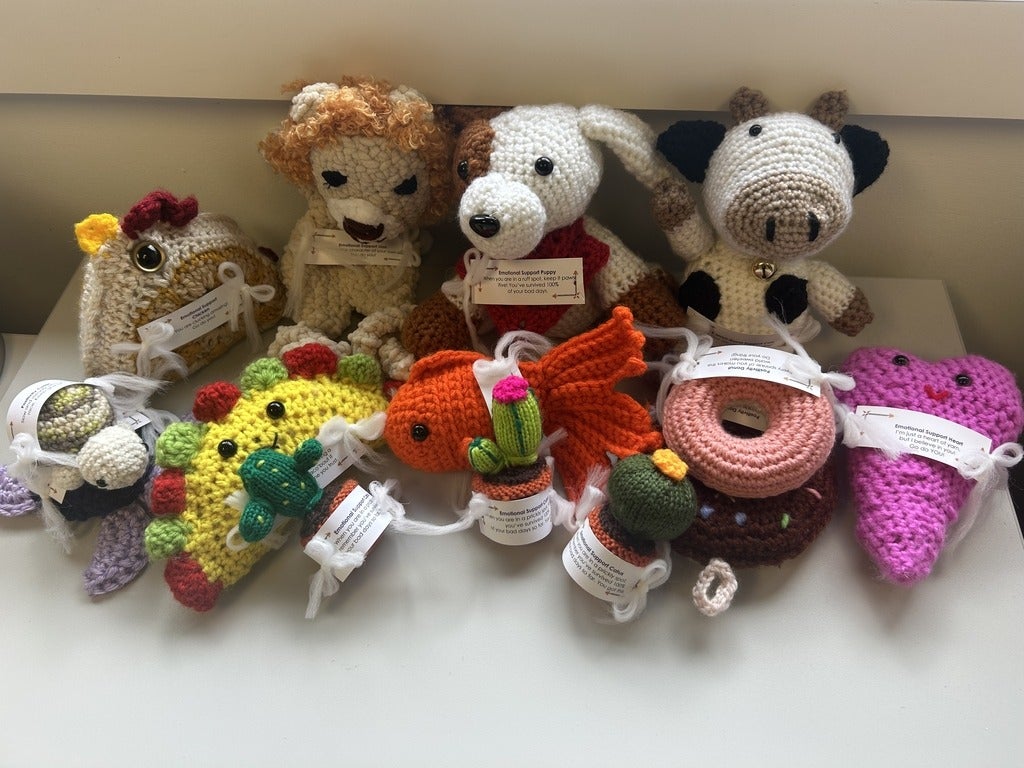
Community Yarn Creatures: Lunch-time Yarn-in
Made by our community for our community!
Join other members of the community in making yarn creatures for well-being during our lunchtime yarn-in. The Community Yarn Creature Program supports our community in three ways:
- Donate: Decrease your stress and anxiety by decluttering your home and donating unneeded creature supplies to us.
- Create: Join us and create these adorable creatures. Research shows that participating in yarn crafts can improve mental health and well-being. (Make one for yourself and one to give to someone in our community).
- Receive: Take one home with you. Yarn creatures can increase joy and comfort in your home or office. Adopt a yarn creature today!
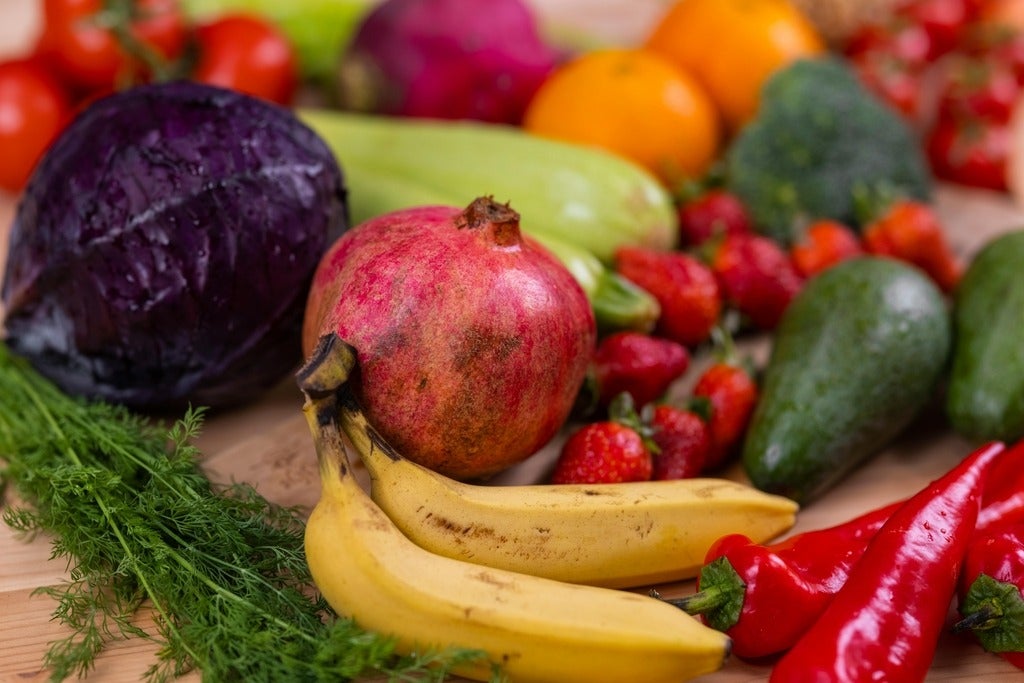
Fruit and Veggie Market
The FoE Community Well-being team is partnering with Produce Place, a vendor at the St. Jacob Farmers' Market, to bring the Fruits and Vegetables to you!
Time: 12:00 pm (noon) - 4:00 pm (while supplies last)
Locations: The market will be held in three locations on the same day, at the same time.
- Faculty of Engineering: PSE, 1st floor by the Robohub
- SLC: Student Life Centre Marketplace.
- EV3: Environment 3
Who can Attend: All members of the University of Waterloo community are welcome (students and employees)
Payment Options: Cash, debit, or credit
Blog

Featured Resource - Employee Career Development Advisor
Information on the Employee Career Development Advisor
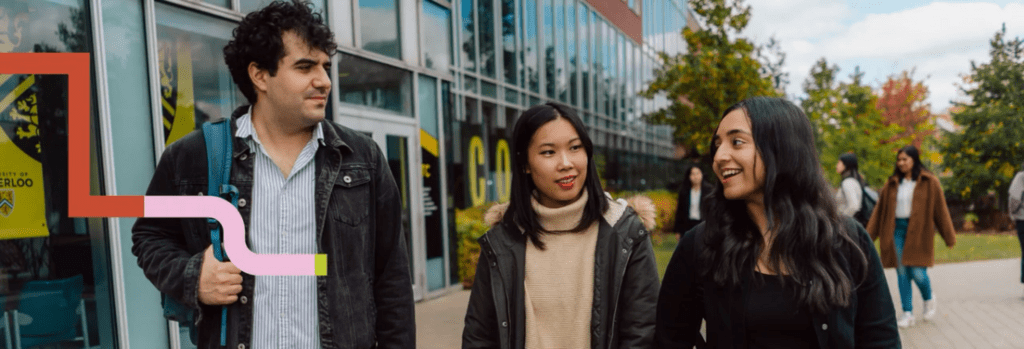
Featured Resource - Centre for Career Development
Information on the Centre for Career Development.
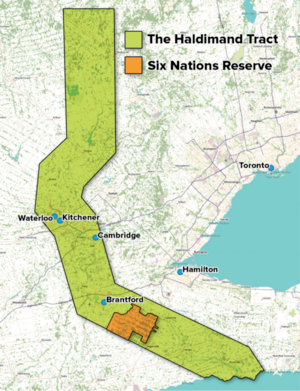
The University of Waterloo acknowledges that much of our work takes place on the traditional territory of the Neutral, Anishinaabeg and Haudenosaunee peoples. Our main campus is situated on the Haldimand Tract, the land granted to the Six Nations that includes six miles on each side of the Grand River. It is the belief of the ENGWellness Program that reconciliation must go beyond recognition, and we must acknowledge that as a post-secondary institution, we carry much power and privilege.
We also understand our positionality as wellness supports and how that positionality intersects with the experiences and cultures of the student communities we aim to support. We also recognize that the holistic approach to wellness that we promote is rooted in Indigenous healing practices which further contributes to our institution’s commitment to the Okanogan Charter whose key principles include using “whole system approaches” that “value local and Indigenous communities’ contexts and priorities”. With that spirit, we as wellness supports continue to actively participate in educational opportunities to further explore our nation’s history and the rich heritage of Indigenous, First Nations, Inuit, and Métis (FNIM) peoples. We also aim to continuously examine our positionality and systems of discrimination throughout the conversations we have and the work we carry out. We encourage all of us, as a community, to do the same.
For more information, visit the Truth and Reconciliation Response website.
Map source: Adam Lewis, “Living on Stolen Land,” Alternatives Journal December 2015

We're here to help enhance and support your wellness in a safe, respectful, and inclusive environment. Our offices and spaces are a place where human rights are respected and where 2SLGBTQIA+ people, and their friends and allies, are welcome and supported.