Future students

Dr. John Muñoz (J&F Alliance) may be one of the most versatile researchers the GI has ever housed. Just when you think you have heard about everything he has done (working with NASA, creating virtual reality (VR) games, using mind-controlled devices for biofeedback, and working with robots, to just name a few), John brings up another project, in a completely different field than the rest of his work.

Postdoctoral Fellow Dr. Brianna Wiens took an unconventional path to the GI starting as a PhD student at York University who visited the GI as part of a crew filming a documentary about qCollaborative (qLab)—a feminist design research lab with members from multiple Canadian universities, including UW.

Congratulations to the following GI faculty members for securing $565,580 in Tri-Agency funding for their research projects!

Dr. Adan Jerreat-Poole (Communication Arts) received an Insight Development Grant for their project "Disabled Feminists and Digital Storytelling: Zine-Making Pandemic Lives" ($21,330).

Dr. Lai-Tze Fan (Sociology and Legal Studies) is a collaborator on the Insight Development Grant "Digital Imaginations and the Decameron Storyworld" ($66,750).

Dr. Lennart Nacke (Stratford School of Interaction Design and Business) received an NSERC Discovery Grant for his project "Engineering Novel Game Technology To Improve People's Lives" ($52,000 per term for five terms totalling $260,000).

Dr. Ville Makela (Stratford School of Interaction Design and Business) received an NSERC Discovery Grant for his project "Developing Technologies for Bringing Physical Objects into Virtual Reality" ($41,000 per term for five terms totalling $205,000 + $12,500 for the Discovery Launch Supplement).

Visiting scholar, Eléa Thuilier (University of Galway) presented her research to the Waterloo community at the Games Institute which focuses on designing and assessing virtual rehabilitation through Exergames for people with Osteoporosis.

From October 10th to October 13th, 2023, CHI PLAY took place at the Stratford School of Business and Interaction Design. In this retrospective, we sit down with GI faculty Drs. Cayley MacArthur, Jen Whitson and Leah Zhang-Kennedy who recount their experiences at CHI PLAY, including what makes it so unique, what they took away from the 2023 conference, and what advice they would give to those looking to attend in the future.

Thursday, April 4, 2024 3:00 pm - 4:00 pm EDT (GMT -04:00)

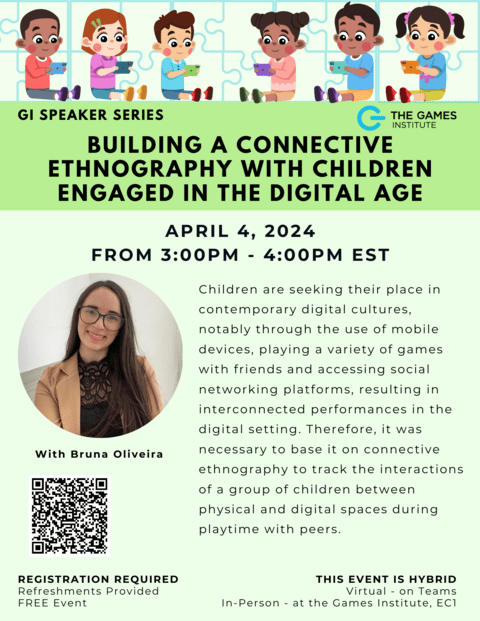
Building a Connective Ethnography with Children Engaged in the Digital Age

Children are seeking their place in contemporary digital cultures, notably through the use of mobile devices, playing a variety of games with friends and accessing social networking platforms, resulting in interconnected performances in the digital setting. Therefore, it was necessary to base it on connective ethnography to track the interactions of a group of children between physical and digital spaces during playtime with peers.

Register with Ticketfi!

This event will be held in HYBRID format. Please join us in-person at the Games Institute, EC1 at the University of Waterloo or virtually through Microsoft Teams.

Speaker: Bruna Oliveira

Bruna is a Ph.D. candidate in Education at the Federal University of Sergipe and a visiting researcher at the University of Waterloo. She has been researching topics involving children's engagement with digital games, children's playful experiences with digital technologies, children as content producers, and research methodologies involving children in the digital era.

Members of The First Three Years Project PhD candidate Kenzie Gordon (University of Alberta), Dr. Jennifer Whitson (Sociology & Legal Studies), Dr. Johanna Weststar (Western University), and Dr. Sean Gouglas (University of Alberta) published an op-ed in The Conversationto unpack why so many layoffs are currently happening in the games industry.

Series editors Drs. Neil Randall (Executive Director) and Steve Wilcox (Alum) have already published two new edited collections as part of their Palgrave Games in Context series this year. Previous publications in the series have spoken on aspects of feminism within games, theory and practice within tabletop roleplaying communities, and critical reflections on games like Minecraft. The two latest additions to the series continue the critical examination of games within the context of our culture, technology, politics, and more.