Dr. John Muñoz Interviewed about Seas the Day on Rogers TV
On Thursday, November 17th, Dr. John Muñoz, Chief Science Officer at J&F Alliance Group and Adjunct Professor at the University of Waterloo, was interviewed by Angela Liu on Rogers TV.
The Games Institute (GI) is pleased to announce the recipients of its first-ever seed grant funding competition. In total, the GI Seed Program will support eight interdisciplinary initiatives for a total of $110,000 over the next year. The competition promoted interdisciplinary collaborations in teams of researchers spanning many different disciplines and research areas.
The seed grant recipients will combine their varied expertise to tackle real-world problems facing indigenous communities, health care workers, children with speech difficulties, mothers facing homelessness, citizen scientists, and VR, XR and social media consumers.
On September 27th Dr. Nick Bowman, Associate Professor of Emerging Media at the S.I Newhouse School of Public Communications at the Syracuse University, gave a lecture at the Games Institute titled “The Psychology of Fun and Frustration: Understanding the Demands and Interactivity.” The lecture covered interactivity-as-demand model based on research into video games and virtual reality technologies, highlighting its implications for game design and player psychology.
Dr. Cayley MacArthur is a long-standing name in the Games Institute (GI) ever since the GI opened its physical doors to researchers and students. She’s spent time here working on her undergraduate and Master’s theses, her Doctoral research, and has officially joined the GI as a faculty member. As Assistant Professor, Dr. MacArthur teaches out of UWaterloo’s Stratford School of Interaction Design and Business. But how did she get here? Well, luckily, Dr. MacArthur took the time to answer questions we had for her about her time at the GI and her hopes of continuing on with her research.
For the first time in over five years, the Royal Society of Canada | La Société royale du Canada hosted their Excellence and Engagement Symposium in the Waterloo Region on November 15, 2023. The University of Waterloo was proud to present the varied and interdisciplinary projects the research institutes at the University engage in.
Dr. John Muñoz - Chief Science Officer at J&F Alliance Group and an Adjunct Professor at the University of Waterloo - hosted an interactive workshop on October 4th, 2023. This workshop covered the exploration of biometrics (or physiological measures) in game user research, driven by advancements in sensing technologies and the increased accessibility of signal processing tools.
Please note that this is an in-person event at the Games Institute , EC1 at the University of Waterloo. Online participation may be accommodated for individuals with accessibility requirements, however, the workshop is designed for an in-person audience. Please reach out to the Games Institute (games.institute@uwaterloo.ca) if you would like to discuss the online option.
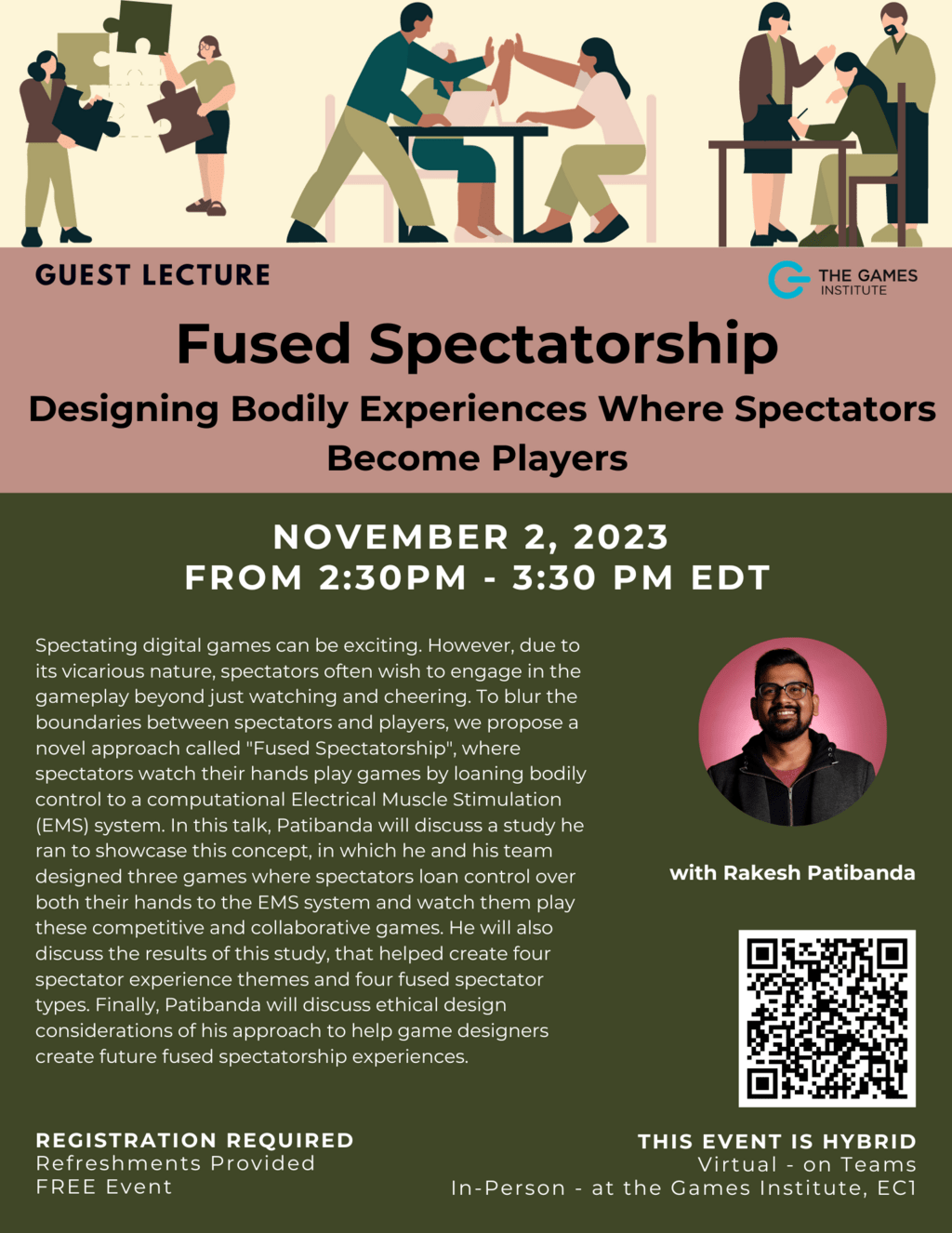
This workshop hosted by Dallas Squire of Onkwehonwe Games offers participants the opportunity to learn about the history and culture of the people of the Six Nations (also called Haudenosaunee) through Traditional Games. Interactive and hands-on, their approach to teaching is indigenous in its foundation.
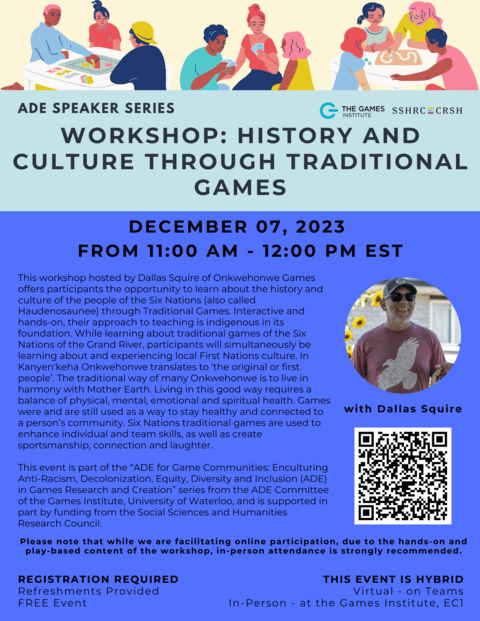
This panel highlights emerging scholars in Asian/American games studies. Panelists will present recent and/or ongoing work, sharing a glimpse of the emerging research questions animating the field. Topics include He’s analysis of NPC discourse, particularly the phenomena of NPC streaming, as an Asiatic form, Ganzon’s examination of Filipino political activism in digital games that extend public and community spaces, and Howard’s inquiry on 'region locking' in online games as racial practices.
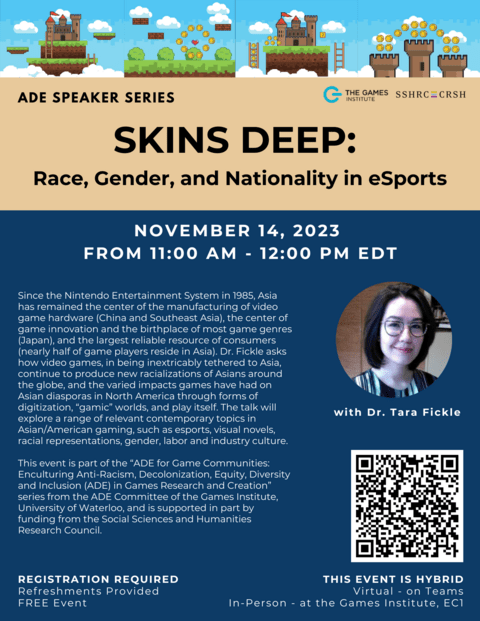
Since the Nintendo Entertainment System in 1985, Asia has remained the center of the manufacturing of video game hardware (China and Southeast Asia), the center of game innovation and the birthplace of most game genres (Japan), and the largest reliable resource of consumers (nearly half of game players reside in Asia).
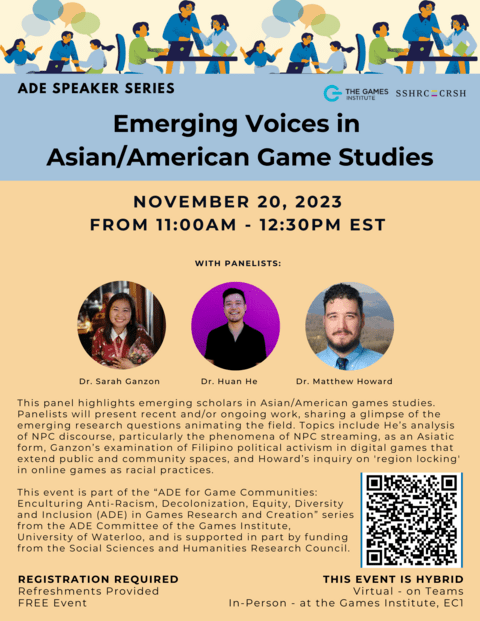
Spectating digital games can be exciting. However, due to its vicarious nature, spectators often wish to engage in the gameplay beyond just watching and cheering. To blur the boundaries between spectators and players, we propose a novel approach called "Fused Spectatorship", where spectators watch their hands play games by loaning bodily control to a computational Electrical Muscle Stimulation (EMS) system.