GI Members at the Urgency of Social Justice
On Wednesday September 20th, GI Members turned out for The Urgency of Social Justice event at the Arts Quad on main campus for an event presented by the Gender and Social Justice (GSJ) program.
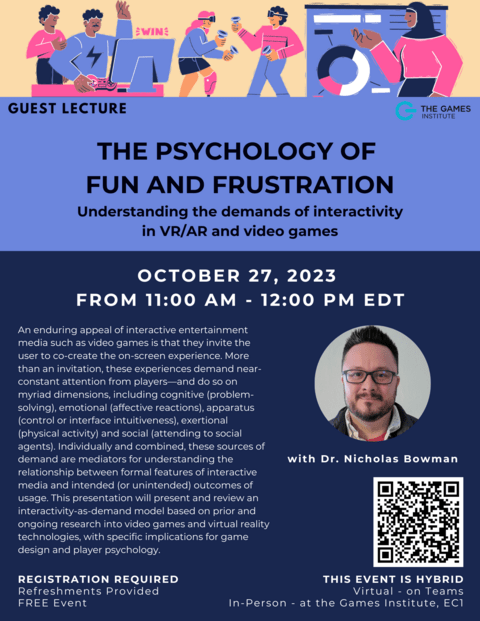
An enduring appeal of interactive entertainment media such as video games is that they invite the user to co-create the on-screen experience. More than an invitation, these experiences demand near-constant attention from players—and do so on myriad dimensions, including cognitive (problem-solving), emotional (affective reactions), apparatus (control or interface intuitiveness), exertional (physical activity) and social (attending to social agents).
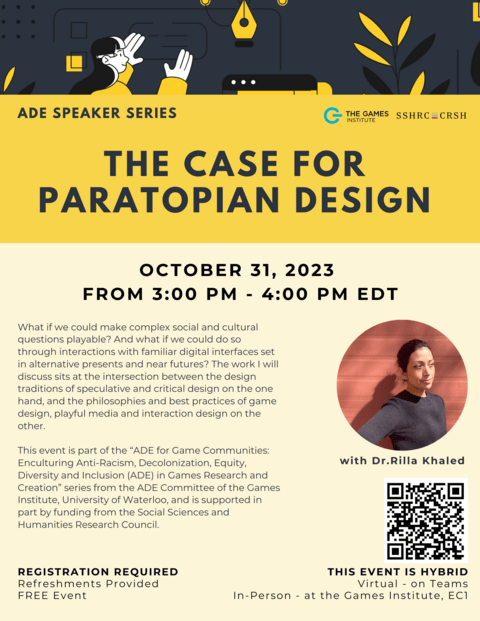
What if we could make complex social and cultural questions playable? And what if we could do so through interactions with familiar digital interfaces set in alternative presents and near futures? The work I will discuss sits at the intersection between the design traditions of speculative and critical design on the one hand, and the philosophies and best practices of game design, playful media and interaction design on the other.
Florian Marcher’s first contact with the GI was—like with many international students—with Dr. Lennart Nacke at a CHI conference. Then, through the suggestion of his master’s supervisor in Graz, Austria, Marcher applied as an International Visiting Graduate Student (IVGS) to Dr. Nacke not only for his guidance, but also for Dr. Nacke’s expertise in the field of Human Computer Interactions (HCI). After he was accepted, Marcher made the trip over to Waterloo, Ontario to make progress on his Master’s thesis “Procedural Generational Tools for Green Spaces” with a focus on their usability and feasibility.
Congratulations to GI member Dr. Lai-Tze Fan (Sociology and Legal Studies) who was recently announced as a Tier 2 Canada Research Chair (CRC) in Technology and Social Change for her work with inclusive artificial intelligence (AI).
On August 10th, Nima Zargham, a PhD candidate from the University of Bremen, presented and hosted an informal presentation and discussion on his recent research about human-agent speech interaction.
The Games Institute is happy to announce that three of its members, Drs. Lai-Tze Fan, Neil Randall, and Susan Roy have been recognized through The Canadian Foundation for Innovation (CFI) and Social Sciences and Humanities Research Council (SSHRC). The three have been awarded a sum of $412,000 for their respective groundbreaking research focuses.
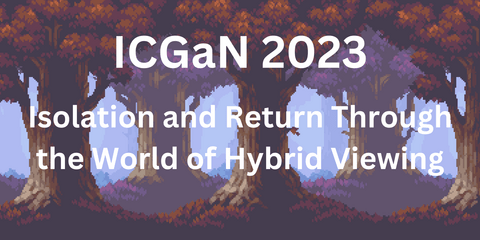
From May 15 – 19, 2023, the Games Institute (GI) hosted the second International Conference on Games and Narrative (ICGaN). It focused on the theme Isolation and Return: The Making of Narrative Worlds. Speakers from 40 universities joined from around the world explained how, societally, we have all been forced to consider and rethink personal and communal lives necessitated by the COVID-19 pandemic. The final turnout of the 2023 conference resulted in 17 sessions, 47 unique presentations, 5 keynotes, 3 workshops, 4 academic game streams, and a game jam.
Drs. Gerald Voorhees and Daniel Harley, in association with the Anti-Racism, Decolonization, and Equity, Diversity, and Inclusion (ADE) Committee at the Games Institute, are continuing their SSHRC-funded ADE for Game Communities: Workshop and Speaker Series with an additional 8 events this term. The Speaker Series is creating opportunities for meaningful equitable change in games academia and industry that requires active and inclusive community-building.
On August 9, 2023, Dr. Ifi Mavridou and Dr. John E. Muñoz (J&F Alliance, Adjunct) spoke at a panel on the use of physiological monitoring, biofeedback equipment, and tools for VR applications and research. Both researchers are experts in this field, with Mavridou talking about the creation and design of hardware and Muñoz about design and the use of software, they presented their experiences on what these tools can offer for research in games and more. The applications that both Mavridou and Muñoz work with are cutting edge and provide researchers with a toolkit on how they can design and approach their studies. This approach personalizes and tailors the study design not only to make it easier for researchers but also for study participants to jointly design and study immersive experiences.