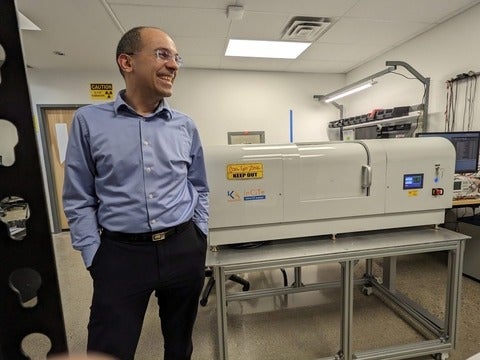
The Waterloo Institute for Nanotechnology (WIN) is a global leader in discovering and developing smart and functional materials, connected devices, next generation energy systems, and therapeutics and theranostics. These discoveries by our scientists and engineers are fundamentally changing our world and helping solve some of humanity's most pressing issues. Our 285, 000 square foot, state-of-the-art facility meets the highest scientific standards for the control of vibration, electromagnetic radiation, temperature, and humidity, making it a global centre of excellence for nanotechnology and its applications.
Why is nanotechnology important? It is about creating new materials and improving ways of manufacturing products. To be more efficient, better, stronger and cheaper. Also improving the economy, environment and society. To achieve societal impact and a sustainable future, WIN has now mapped its thematic areas with the United Nations Sustainable Development Goals.


News

WIN Core Member Professor Linda Nazar wins prestigious Hughes Medal from Royal Society U.K.
Linda Nazar, University of Waterloo professor and Canada Research Chair has been recognized for her outstanding contribution in the field of energy with a Royal Society U.K. Hughes Medal.
Professor Boxin Zhao has been awarded the OPEA Engineering Research and Development Medal
Professor Boxin Zhao is this year’s recipient of the Ontario Professional Engineering Association (OPEA) Research and Development Engineering Medal. Administered by OPEA, the Research and Development Engineering Medal is awarded to individuals who have advanced engineering knowledge and have developed useful and novel applications. Zhao certainly fits the bill. Zhao's research is at the frontier of surface science and engineering. His work focuses on innovative soft matter engineering and bionanomaterials research aimed at advancing sustainable manufacturing. This includes the development of smart polymers, advanced adhesives, and coating materials.