Current students

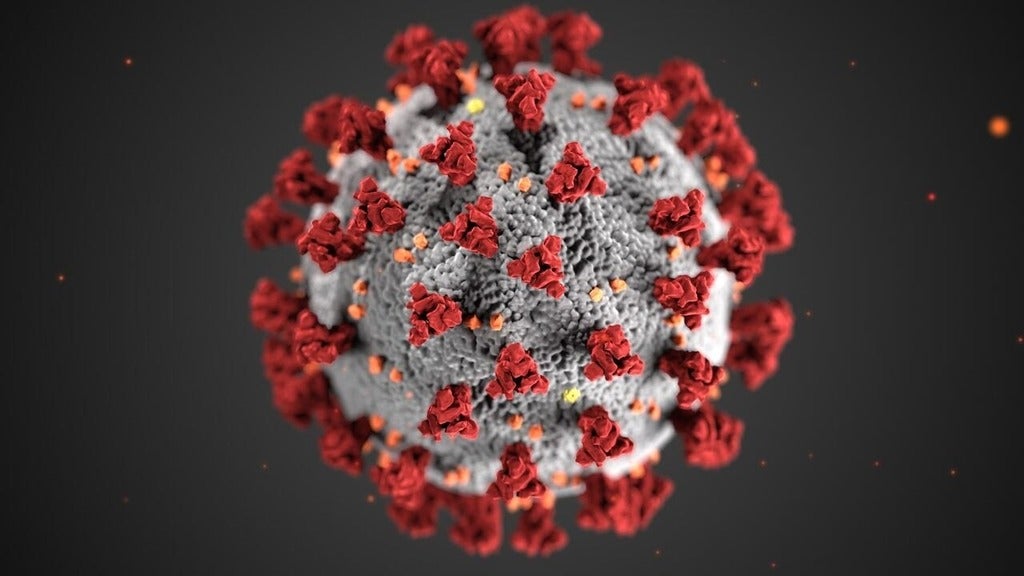
A biotechnology company co-founded by a Waterloo Engineering alumnus has been awarded almost $300,000 in government funding to develop a portable diagnostic test for COVID-19.

Nicoya, a Kitchener-based provider of advanced analytical instruments for the biotechnology and pharmaceutical industries, grew out of a Capstone Design project by nanotechnology engineering student Ryan Denomme (BASc ’10, MASc ’12).

The funding is part of a challenge issued by the Public Health Agency of Canada and the National Research Council of Canada.
Monday, July 6, 2020 1:30 pm - 3:00 pm EDT (GMT -04:00)

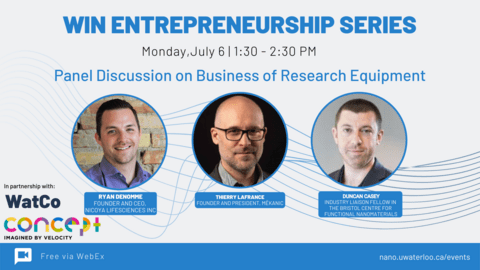
WIN Entrepreneurship Series: Panel discussion on Business of Research Equipment

Year after year, UWaterloo is ranked #1 in Canada (and #20 in the World according to 2017 PitchBook rankings) of universities that produce the most venture capitalist-backed entrepreneurs. Nanotechnology research and education programs at UWaterloo have measurably affected the local entrepreneurship scene. In this Nanotechnology Entrepreneurship series, we are complementing existing educational programming on the campus.

Serapis Labs develops prototype for a testing kit that is simple enough for anyone to use

By Alana Rigby and Brian Caldwell University of Waterloo

Monica Hoang had no idea earlier this year that she’d be spending the last few months of her PhD working on the design of a COVID-19 testing kit.

The School of Pharmacy student moved back to her hometown when the University of Waterloo decided to go online for the spring term and planned to do her PhD defence digitally.

We are living in times of extraordinary advancement of technology. A significant contribution to this innovation is coming from companies that were just a group of students a few years ago doing their graduate research, and now their ideas have grown to become multimillion international businesses. These successes would not have happened without access to educational resources and tremendous support. The University of Waterloo has entrepreneurship embedded in its DNA.

We are living in times of extraordinary advancement of technology. A significant contribution to this innovation is coming from companies that were just a group of students a few years ago doing their graduate research, and now their ideas have grown to become multimillion international businesses. These successes would not have happened without access to educational resources and tremendous support. The University of Waterloo has entrepreneurship embedded in its DNA.

Today, two prominent Waterloo scientists were among the 60 exceptional scientists selected to be Fellows and Foreign Members of the Royal Society, the United Kingdom’s national academy of sciences. 

Chemist Linda Nazar, a WIN member, and Physicist Donna Strickland were both elected for their outstanding contributions to their field and scientific understanding.

Wednesday, July 22, 2020 1:00 pm - 3:00 pm EDT (GMT -04:00)

WIN Intellectual Property Series: Panel Discussion

University of Waterloo has long been known for researchers who are entrepreneurial thinkers and industry partners. At the core of entrepreneurship is Intellectual Property (IP) Rights Policy #73, also called "creator-owned," which grants ownership to the inventor. It's the engine for driving commercialization success of research-based innovations and may be the most entrepreneurial oriented IP policy in North America.

In a world where just about everyone has a smartphone it also means that almost everyone has become an amateur photographer. In 2019, more than 657 billion smartphone photographs were taken – and many of them blurry. But help is on the way. A promising new student venture, Scope, is hoping their invention of a new type of optical zoom lens system with electronically tunable optical power will help people take better photos while reducing the battery use, costs, and processing power of smartphones.