
Researchers in the Faculty of Science have been awarded funding through the Natural Sciences and Engineering Research Council of Canada (NSERC) Alliance Quantum grants program. This funding supports projects that aim to advance quantum computing, quantum communications, and quantum sensing.
Learn more about the newly funded projects and how they’re helping to implement Canada’s National Quantum Strategy.
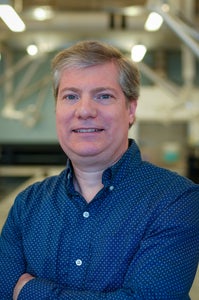
Jonathan Baugh | Next-generation photonic source to enable quantum remote sensing and communications
Chemistry / Institute for Quantum Computing
$450,000
Dr. Jonathan Baugh’s team is developing a new kind of quantum light source: a tiny semiconductor device that can be electrically controlled to release light one photon at a time. Baugh’s work focuses on building and testing these on-demand photon sources for future use in secure communications, quantum sensing, and precision measurement.
This newly awarded supplement extends the project toward light at telecom wavelengths—the same range used in fibre-optic networks. Baugh and his team will focus on making these semiconductor devices more practical by controlling how many photons are emitted and exploring operation at higher temperatures. This work also strengthens collaborations with the National Research Council (NRC) and Defense Research and Development Canada (DRDC) on real-world testing and training.
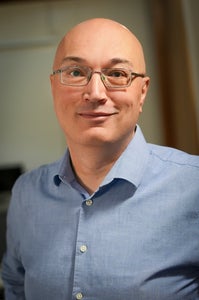
Adrian Lupascu | Superconducting levitation in the quantum regime - a platform for quantum science and technology
Physics and Astronomy / Institute for Quantum Computing
$450,000
Levitation of nanometer and micrometre size particles is a fast-developing area of research. Levitating particles provide a new tool to explore the foundations of quantum mechanics and develop new force sensors for various applications, including gravimetry, accelerometry, and particle detection. This project, led by Dr. Adrian Lupascu and carried together with Dr. Raffi Budakian and in partnership with Defence Research and Development Canada, looks at the levitation of micron size superconducting and ferromagnetic particles.
The trapping force of levitating particles is due to the diamagnetic force on a superconductor and has the advantage of very small associated friction forces, which enable high force sensitivity. Lupascu’s team will focus on the mitigation of noise in force detection by reducing noise in the trapping force and developing sensing protocols that are robust against noise. This NSERC funding will support additional training of graduate students and research costs for device nanofabrication and experiments.
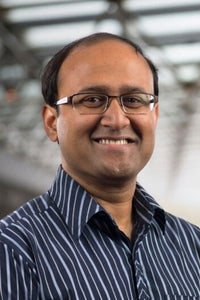
K. Rajibul Islam | Simulating high energy physics models with a trapped ion quantum simulator
Physics and Astronomy / Institute for Quantum Computing
$25,000
Dr. K. Rajibul Islam's team is advancing trapped ion-based quantum simulators to tackle scientific problems beyond the reach of today's classical computers. This project explores how quantum simulators can help answer long-standing questions in high-energy physics about how matter and fundamental forces behave. Quantum simulators reproduce real-time evolution in a controllable laboratory setting, offering a way to study dynamics that are otherwise inaccessible.
Islam’s team has developed a trapped-ion quantum simulator called Bloodstone that will help establish a reliable workflow connecting theory and experiment. It will help identify a meaningful model, implement it on quantum hardware, and compare outcomes with the best available calculations, building confidence in what the simulator can reveal. This will help convert Canada's quantum-hardware investments into validated applications, positioning Canadian quantum simulators as tools for discovery in fundamental science.