


The department's small class-sizes, engaging teaching practices, and hands-on learning in our state-of-the-art facilities empower our students to solve real-world problems.
The Department of Chemical Engineering is a vibrant center of collaborative research addressing some of the most pressing challenges in energy and materials. Our faculty members are engaged in a diverse array of research in areas such as machine learning and process systems engineering, CO2 capture and conversion, polymer engineering, renewable energy, synthetic biology, environmental remediation, and materials science that push the boundaries of innovation.


Find out more by exploring the programs, research and news stories on this site.
News
Teaching tomorrow’s engineers in greener labs
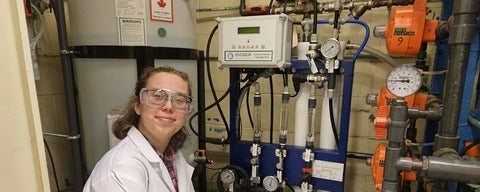
The Department of Chemical Engineering continues to advance its role as leader in sustainability, pioneering innovative solutions to reduce its carbon footprint.
Demonstrating a steadfast commitment to sustainablility teaching and practice, the Department of Chemical Engineering achieves Green Lab Gold Certification of its undergraduate teaching labs in the Douglas Wright Engineering Building (DWE).
The labs earned Green Lab Gold Certification for the second year in a row, with a higher score than last year!
It’s clear that sustainability is more than a buzzword for the department; the certification demonstrates the department’s focus on sustainability as an integral part of how experiential learning is designed and delivered.
“I am thrilled to see the work from Chemical Engineering to integrate sustainability into labs. Labs are areas of high resource intensity and environmental impact, and the team has identified meaningful activities for operational improvement,” says Mat Thijssen, Director of Sustainability at the University of Waterloo.

Moving towards long-term sustainability for critical minerals
Professors Luis Ricardez-Sandoval and Pascal Poupart received $480K from the Bank of Montreal (BMO) and MITACS to design reinforcement learning tools for rare earth element (REE) recycling. The four-year interdisciplinary project between the Department of Chemical Engineering and Cheriton School of Computer Science will use reinforcement learning (RL) to design more efficient, sustainable recycling systems for REEs.
RREs are essential to global economies and used in a wide range of high-tech applications. They are used in the electronics, clean energy, aerospace, automotive, and defence industries to create products like cell phones, computers, batteries, MRI machines, jet craft, lasers, LEDs and more.
Canada is invested in being a global leader in critical‑mineral recycling and leveraging its resources to strengthen national security and promote economic growth. As demand for batteries, semiconductors, and clean‑energy technologies accelerates, Canada is looking beyond traditional mining.
“Eventually we’re going to run out of those mining resources, and we will need to recycle rare earth elements using advanced systems that can reduce waste, capital expenses and energy consumption,” says Ricardez-Sandoval, Director of the Chemical Process Optimization, Multiscale Modelling and Process Systems Group
Bacteria poised to battle cancer
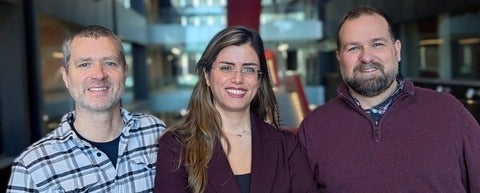
Researchers at the University of Waterloo and industrial partner Center for Research on Environmental Microbiology (CREM Co Labs) have advanced research that uses bacteria to target cancer. The research group leveraged synthetic biology to prompt bacteria to “eat” tumors from the inside out to treat cancer.
The idea began as PhD student Bahram Zargar’s dream to create a therapy that could attack cancer tumors from the inside. He studied under the supervision of Professors Brian Ingalls and Pu Chen.
The center of a cancer tumor is made of dead cells with no oxygen present. Clostridium sporogenes is a bacterium that can only grow in the absence of oxygen. These bacteria can grow in the dead, oxygen-free center of tumors and “eat” them from the inside.
“C. sporogenes will form spores that will grow under "good" growth conditions. These conditions exist in the core of a solid tumour. The challenge is that these organisms die when they reach the outer part of the tumour where oxygen still exists and are unable to complete the job of getting rid of the tumor fully,” says Marc Aucoin a professor in the department of chemical engineering who has continued this work with Ingalls.
Events
PhD Comprehensive/Examine the biochemical and biomechanical effects of Descemet's membrane on human corneal endothelial cell responses in an in vitro model by Lexie Xi
Examine the biochemical and biomechanical effects of Descemet's membrane on human corneal endothelial cell responses in an in vitro model
PhD Comprehensive/Life-like Hydrogels: From Passive Molecules to Intelligent Microrobots by Negar Rajabi Dehnavi
Life-like Hydrogels: From Passive Molecules to Intelligent Microrobots
PhD Comprehensive/Soft Microrobots for Advanced Reproductive Cell Transport (SMARCT) by Negin Bouzari
Soft Microrobots for Advanced Reproductive Cell Transport (SMARCT)