


The department's small class-sizes, engaging teaching practices, and hands-on learning in our state-of-the-art facilities empower our students to solve real-world problems.
The Department of Chemical Engineering is a vibrant center of collaborative research addressing some of the most pressing challenges in energy and materials. Our faculty members are engaged in a diverse array of research in areas such as machine learning and process systems engineering, CO2 capture and conversion, polymer engineering, renewable energy, synthetic biology, environmental remediation, and materials science that push the boundaries of innovation.


Find out more by exploring the programs, research and news stories on this site.
News
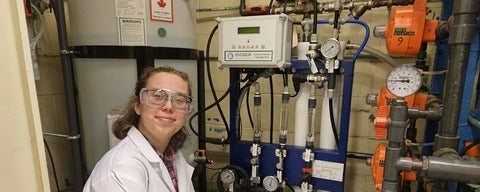
Teaching tomorrow’s engineers in greener labs
The Department of Chemical Engineering continues to advance its role as leader in sustainability, pioneering innovative solutions to reduce its carbon footprint.
Demonstrating a steadfast commitment to sustainablility teaching and practice, the Department of Chemical Engineering achieves Green Lab Gold Certification of its undergraduate teaching labs in the Douglas Wright Engineering Building (DWE).
The labs earned Green Lab Gold Certification for the second year in a row, with a higher score than last year!
It’s clear that sustainability is more than a buzzword for the department; the certification demonstrates the department’s focus on sustainability as an integral part of how experiential learning is designed and delivered.
“I am thrilled to see the work from Chemical Engineering to integrate sustainability into labs. Labs are areas of high resource intensity and environmental impact, and the team has identified meaningful activities for operational improvement,” says Mat Thijssen, Director of Sustainability at the University of Waterloo.

Moving towards long-term sustainability for critical minerals
Professors Luis Ricardez-Sandoval and Pascal Poupart received $480K from the Bank of Montreal (BMO) and MITACS to design reinforcement learning tools for rare earth element (REE) recycling. The four-year interdisciplinary project between the Department of Chemical Engineering and Cheriton School of Computer Science will use reinforcement learning (RL) to design more efficient, sustainable recycling systems for REEs.
RREs are essential to global economies and used in a wide range of high-tech applications. They are used in the electronics, clean energy, aerospace, automotive, and defence industries to create products like cell phones, computers, batteries, MRI machines, jet craft, lasers, LEDs and more.
Canada is invested in being a global leader in critical‑mineral recycling and leveraging its resources to strengthen national security and promote economic growth. As demand for batteries, semiconductors, and clean‑energy technologies accelerates, Canada is looking beyond traditional mining.
“Eventually we’re going to run out of those mining resources, and we will need to recycle rare earth elements using advanced systems that can reduce waste, capital expenses and energy consumption,” says Ricardez-Sandoval, Director of the Chemical Process Optimization, Multiscale Modelling and Process Systems Group
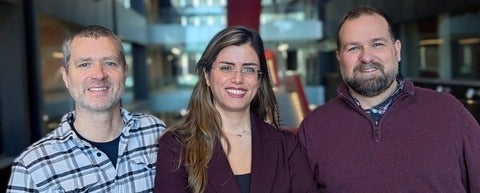
Bacteria poised to battle cancer
Researchers at the University of Waterloo and industrial partner Center for Research on Environmental Microbiology (CREM Co Labs) have advanced research that uses bacteria to target cancer. The research group leveraged synthetic biology to prompt bacteria to “eat” tumors from the inside out to treat cancer.
The idea began as PhD student Bahram Zargar’s dream to create a therapy that could attack cancer tumors from the inside. He studied under the supervision of Professors Brian Ingalls and Pu Chen.
The center of a cancer tumor is made of dead cells with no oxygen present. Clostridium sporogenes is a bacterium that can only grow in the absence of oxygen. These bacteria can grow in the dead, oxygen-free center of tumors and “eat” them from the inside.
“C. sporogenes will form spores that will grow under "good" growth conditions. These conditions exist in the core of a solid tumour. The challenge is that these organisms die when they reach the outer part of the tumour where oxygen still exists and are unable to complete the job of getting rid of the tumor fully,” says Marc Aucoin a professor in the department of chemical engineering who has continued this work with Ingalls.
Events
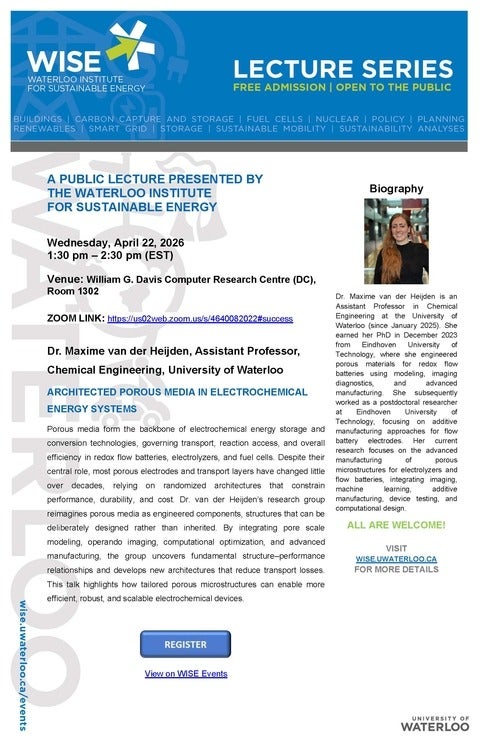
Lecture Series
Porous media form the backbone of electrochemical energy storage and conversion technologies, governing transport, reaction access, and overall efficiency in redox flow batteries, electrolyzers, and fuel cells. Despite their central role, most porous electrodes and transport layers have changed little over decades, relying on randomized architectures that constrain performance, durability, and cost. Dr. van der Heijden’s research group reimagines porous media as engineered components, structures that can be deliberately designed rather than inherited. By integrating pore‑scale modeling, operando imaging, computational optimization, and advanced manufacturing, the group uncovers fundamental structure–performance relationships and develops new architectures that reduce transport losses. This talk highlights how tailored porous microstructures can enable more efficient, robust, and scalable electrochemical devices.
PhD Defence/Halide and Sulfide Solid Electrolytes for All-Solid-State Batteries: Structure and Interface Engineering by Lanting Qian
All-solid-state batteries (ASSBs) are widely regarded as a promising next-generation energy-storage technology due to their potential to deliver enhanced safety, higher energy density, and improved compatibility with high-voltage electrode materials. This thesis focuses on the design, structural elucidation, and interfacial engineering of halide and sulfide solid electrolytes for high-voltage ASSBs, with particular emphasis on understanding how crystallographic disorder and chemical modification influence lithium-ion transport and interfacial stability. A comprehensive suite of experimental and computational techniques—including synchrotron and neutron diffraction, total scattering and pair distribution function analysis, electron microscopy, X-ray spectroscopies, time-of-flight secondary ion mass spectrometry (ToF-SIMS), electrochemical characterization, and first-principles calculations—is employed to establish robust structure–property–interface relationships.
PhD Comprehensive/Structure-Processing-Function Relationships in Aqueous-Processed Highly Conductive Hybrid Materials by Hossein Ipakchi
Structure-Processing-Function Relationships in
Aqueous-Processed Highly Conductive Hybrid Materials