ENGL 344: Modern American Literature
Modernist Techno-Culture - Data, Network, Surveillance, Automation
Fall 2025
Dr. Heather A. Love (halove@uwaterloo.ca)
Telephone. Radio. Phonograph. Film.
Automobiles. Airplanes. Factory production lines. Anti-aircraft guns.
American modernist authors were writing during an historical period of major technological change and disruption that parallels our own twenty-first century world in many ways. New innovations reshaped human experience in contexts ranging from communication and entertainment to transportation, labour, and warfare. Technology-enabled systems allowed for greater quantities of information, people, products, and ideas to circulate faster and farther than ever before.
And just as we are forced to do (as we scroll our social media feeds, stream our favourite movies and music, and interact with ever-more-algorithmically complex online platforms and programs), early-twentieth-century citizens were forced to navigate new and often disorienting paths through a constantly evolving technological landscape.
Authors responded in creative and insightful ways as they sought to understand the implications of these changes and articulate strategies for addressing their challenges; and scholars have argued that modernist texts offer generative “literary lessons” to today’s readers. In this course, we will explore some of those transhistorical resonances by tracking connections between modernist-era texts and four present-day technology keywords: Data, Network, Surveillance, and Automation.
During the semester, as we deploy these terms as “lenses” for studying modernism’s contemporary relevance and value, we will engage with texts that cover a range of genres and authors, including the following:
- Nella Larsen’s novella Passing (1929)
- Zora Neal Hurston’s novel Their Eyes Were Watching God (1937)
- Sophie Treadwell’s play Machinal (1928)
- Vignettes from Jean Toomer’s Cane (1923), and John Dos Passos’s U.S.A. Trilogy (1930-1936)
- Nonfiction excerpts from W.E.B. Du Bois The Souls of Black Folks (1903) and Gertrude Stein’s Everybody’s Autobiography (1937)
- Poetry by Mina Loy, Marianne Moore, Ezra Pound, Walt Whitman, and William Carlos Williams
This course will appeal to undergraduate students who are curious about the formal and thematic dimensions of modernist American literature, seek opportunities to develop their own critical voice, and would like to read historical texts in the context of current issues. It is open to all students at the 2A level or above, or by permission of the instructor.
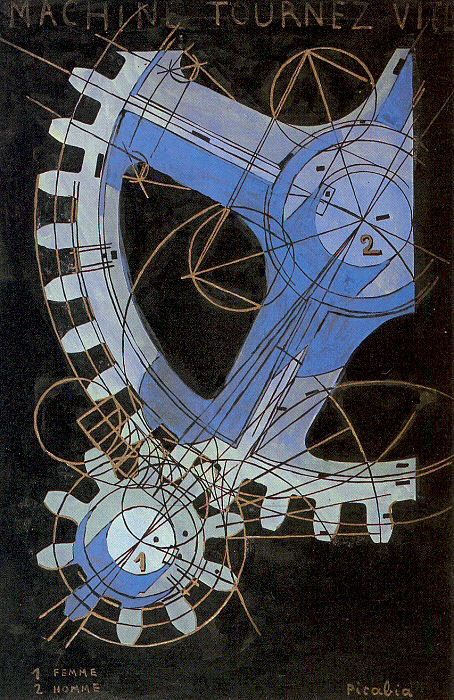
(Image Credit: by Francis Picabia - http://cgfa.sunsite.dk/p/p-picabia4.htm, Public Domain, https://commons.wikimedia.org/w/index.php?curid=143767205)