
Tuesday, March 27, 2018 4:00 pm
-
4:00 pm
EDT (GMT -04:00)
 Featured Speaker: Dr. Ron Dembo
We start with an overview of chiral quantum optics as quantum light-atom interfaces with broken left- right symmetry and associated quantum optical phenomena and applications. While chiral quantum optics is traditionally discussed in context of nano-photonics and nano fibers , we propose here a novel ‘free-space’ chiral quantum optics realized as atoms in free space coupled to a ‘few-atom’ quantum antenna. In particular, we discuss free space photonic quantum links between atoms (qubits) equipped with sending and receiving quantum antennas.
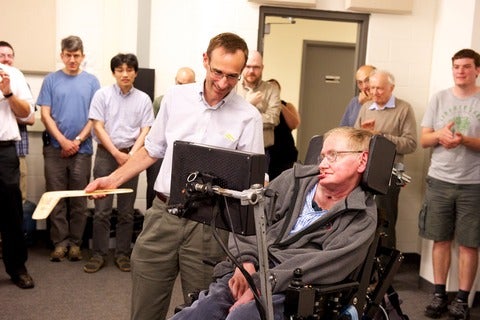

The scientific community, and the world, is deeply saddened by the news of Professor Stephen Hawking’s passing.
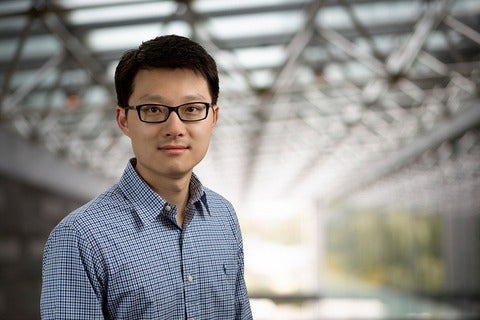
 Wei Tsen, assistant professor at the Institute for Quantum Computing (IQC) and the Department of Chemistry, is one of eleven University of Waterloo researchers receiving an Early Researcher Award, the Government of Ontario announced.
Researchers at the Institute for Quantum Computing (IQC), in collaboration with researchers from the National Institute of Standards and Technology (NIST) and the National Institute of Health (NIH), have developed a neutron interferometry technique that is more powerful, robust and practical than existing techniques, paving the way for advances in imaging, materials science, and fundamental physics and quantum research.
After the discovery of topological insulators, the concept of topology permeated the various fields of condensed matter physics. Symmetry of a quantum system plays an intriguing role in close association with topology, expanding the range of topological quantum systems to superconductors/superfluids. Superfliuid 3He, which has been a prime example of symmetry breaking phase transition, is also recognized as a quantum system with various topological nature.
It is generally believed that experimental violations of Bell's inequalities (especially the recent so-called loophole-free experiments) provide evidence that quantum theory cannot be both local and realistic. We demonstrate to the contrary that all reversible-dynamics no-signalling operational theories (including unitary quantum theory) can be given a local-realistic interpretation.
Emergence of quantum information science has led to a paradigm shift in communication systems. In the past couple of decades, quantum information processing tasks like quantum cryptography, dense coding, quantum teleportation etc. have been shown to have advantages over their classical counterparts and have also been successfully implemented in laboratories.
The ability to engineer and manipulate different types of quantum mechanical objects allows us to take advantage of their unique properties and create useful hybrid technologies. Thus far, complex quantum states and exquisite quantum control have been demonstrated in systems ranging from trapped ions to superconducting resonators. Recently, there have been many efforts to extend these demonstrations to the motion of complex, macroscopic objects.
Quantum mechanics reveals that at its core, the world is not as it seems – it is far more interesting.
In the quantum world, outcomes are counter-intuitive, differing from what we expect based on our everyday experiences. The particle physicist Richard Feynman remarked that this means we seem to have to walk “a logical tightrope” when we talk about a quantum system.