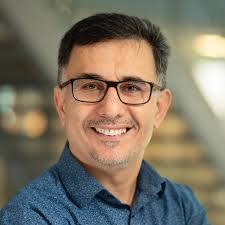
Shoja Chenouri
Professor of Statistics & Actuarial Science
Room: MC 5501
Detecting Structural Changes in Complex Data: From Euclidean Spaces to Manifolds and Beyond
Change-point analysis focuses on detecting and localizing structural changes in sequences of observations. Such changes arise naturally across a wide range of applications, including engineering systems, environmental monitoring, computer vision, and artificial intelligence. Although classical change-point methods were developed primarily for Euclidean-valued observations, many modern applications involve complex data objects, such as networks, images, covariance matrices, shapes, etc, that exhibit nonlinear geometric or structural constraints. These challenges, together with outliers and unknown distributional forms, motivate the development of robust and flexible statistical methods.
In this talk, I will introduce a unified, robust, and nonparametric framework for detecting single and multiple change points in sequences of random objects taking values in general metric spaces, including Riemannian manifolds. The approach uses depth-based ranks and cumulative sum statistics, avoiding the need for linear structures or parametric distributional assumptions. I will discuss the methodology’s key theoretical properties, including its asymptotic behaviour, consistency in detecting and localizing changes, and robustness to contamination. I will also present extensions to multiple change points using binary segmentation and wild binary segmentation. Numerical studies and applications in highway traffic monitoring, vehicle health monitoring, and additive manufacturing will illustrate the framework’s versatility and practical advantages.
This is a joint work with Ahmad Mozaffari.