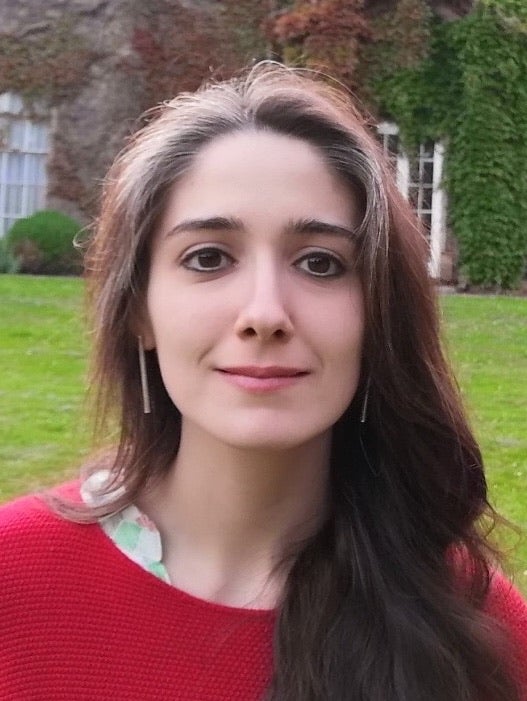
Congratulations to Dr. Eugenia Colafranceschi, recipient of a Banting Postdoctoral Fellowship, who will be joining the Department of Applied Mathematics next fall. The prestigious $70,000 fellowship (administered over two years) is one of seventy such awards given annually by the government of Canada to postdoctoral researchers. The Fellowship program aims to fund “the very best postdoctoral applicants, both nationally and internationally, who will positively contribute to the country’s economic, social, and research-based growth.”
“I am incredibly lucky and excited to have the opportunity to continue my research at the University of Waterloo,” Colafranceschi says. “The Banting Fellowship gives me the chance to pursue my research in a setting that directly supports the kinds of questions I am working on.”
Colafranceschi’s project is titled “Axiomatic Framework for Quantum Gravity: Unravelling Black Hole Entropy.” Her research, she explains, focuses on one of the “biggest mysteries in theoretical physics: how to bring together Einstein’s theory of gravity with quantum mechanics.”
Einstein showed that space and time are actually a single entity called “spacetime,” which bends and stretches to create what we experience as gravity. However, Einstein’s theory of gravity has not been reconciled with “the strange rules of quantum mechanics,” an issue that becomes especially pressing in in certain extreme situations such as near black holes or in the early universe, where both theories are expected to play a key role.
“My work aims to build a bridge between these perspectives through a shared mathematical framework,” she says. “I focus especially on black holes, which are regions where gravity is so strong that not even light can escape. When quantum effects are taken into account, black holes are expected to emit radiation and gradually evaporate. I study what happens to the information that falls into a black hole as this evaporation takes place. This question has been debated for decades and cuts to the heart of how we understand space, time, and information at the most fundamental level.”
Colafranceschi’s project at Waterloo will be a continuation of research undertaken during a joint postdoctoral position between the University of California, Santa Barbara and the University of Western Ontario. She is grateful to Professors Don Marolf, Carlo Rovelli and Francesca Vidottoand from those institutions, who have collaborated with her and helped her develop her research in the past.
At Waterloo, “I am especially grateful to Professor Florian Girelli for encouraging me to apply and for making this collaboration possible by supporting my application. Moreover, the connection with the Perimeter Institute provides a valuable opportunity to engage with a wide range of approaches to quantum gravity. This field often advances through the exchange of ideas across different perspectives. I hope my work can contribute to that broader conversation and help build bridges that future researchers can continue to explore and expand.”
Colafranceschi is one of two 2024-25 Banting Fellows joining the University of Waterloo. The other, Dr. Emily Deibert, will be joining the Department of Physics and Astronomy. To learn more about the Banting Postdoctoral Fellowship, including a full list of awardees, visit the Fellowship website.