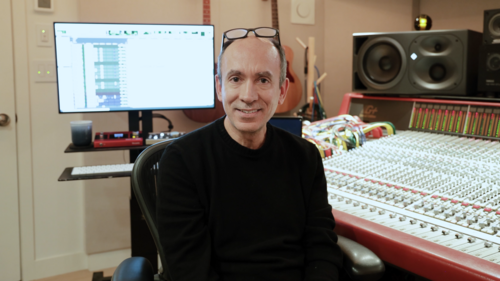
Today, George Seara is an award-winning mix and recording engineer. He has been nominated for multiple Juno and Grammy awards, including winning the 2012 Juno for Recording Engineer of the Year, and collaborated with household names like Shawn Mendes, Rihanna, Drake, Sabrina Carpenter and Taylor Swift.
For a long time, however, he was just a kid who loved music and computers and couldn’t figure out a way to combine the two.
In the seventh grade, Seara learned how to play guitar and performed in bands all through high school. He loved the culture surrounding music, but his parents, hardworking immigrants from Portugal, encouraged him to build a strong academic foundation, so Seara decided to study computer science at the University of Waterloo.
“Waterloo really taught me to think,” he recalls. “The computer science program challenged me, because I had to become comfortable with not always knowing the answer, not necessarily having one definitive solution for a problem.”
In his computer science classes, he learned the importance of pattern recognition, iteration and persistence despite repeated failure. “That can be really destabilizing when you’re 18,” he says, “having to independently decide that you’ve created the best solution for something. But that’s a skill that’s necessary in the adult world of work, when most of the time you’re dealing with ambiguity and open-ended problems.”
As Seara learned programming languages and problem-solved, he kept playing music on the side. Gradually, however, he realized that he wasn’t interested in performing on stage; he wanted to work behind-the-scenes.
“I was so excited when I found a way to combine the two: that foundational skill set I developed at Waterloo, and my creativity, my love of music.”
Seara ultimately completed his studies at Fanshawe College in London, which at the time was the only school in Canada offering training in Music Industry Arts: Recorded Music Production and Engineering.
At Fanshawe, Seara learned about music theory, recording engineering and production. Even as he worked alongside fellow music enthusiasts, however, the foundation he built at Waterloo put him a step ahead. “The industry was rapidly changing,” he says. “We were still recording on tape, but we were also using Pro Tools on computers, and technology was shifting fast. I think having a stronger computer background and a really keen interest in technology was a strength that opened doors for me and got me in the room with more experienced engineers once I graduated.”
Over the years, Seara built relationships with industry professionals and musicians, and gained a reputation as someone who expertly combined technical finesse and creative instinct. Today, he works closely with artists and producers throughout the recording process, helping them articulate their vision for an album, creating rough mixes and fine-tuning every instrument and effect.
“On the one hand, at this point, the work feels very natural, very instinctive,” he says. “But so much of it draws on the skills I learned back at Waterloo. If a mix isn’t feeling right, for example, there are parts of it that sort of feel like coding, because I’m having to debug. Like, what is it that’s causing a problem with the vocal? Is the bass taking up too much room? It’s about optimizing, iteration, and looking for best solution to a problem.”
Though he now primarily works from his private studio in Toronto, Seara says his favourite part of the job remains collaboration.
“It’s nice to receive recognition, of course, but the biggest high for me is when an artist trusts me and brings me into their creative space. Sharing those vulnerable moments, building trust, and creating something meaningful together never gets old.”
For students navigating uncertainty about their future, Seara offers reassurance.
“Stay curious. Stay calm. Your career will likely unfold if you continue engaging with what genuinely interests you,” he says. “Waterloo is such a great place, and I’ll always be grateful for the foundation it gave me, the way it taught me to think. That’s a skill set that will always be valuable.”