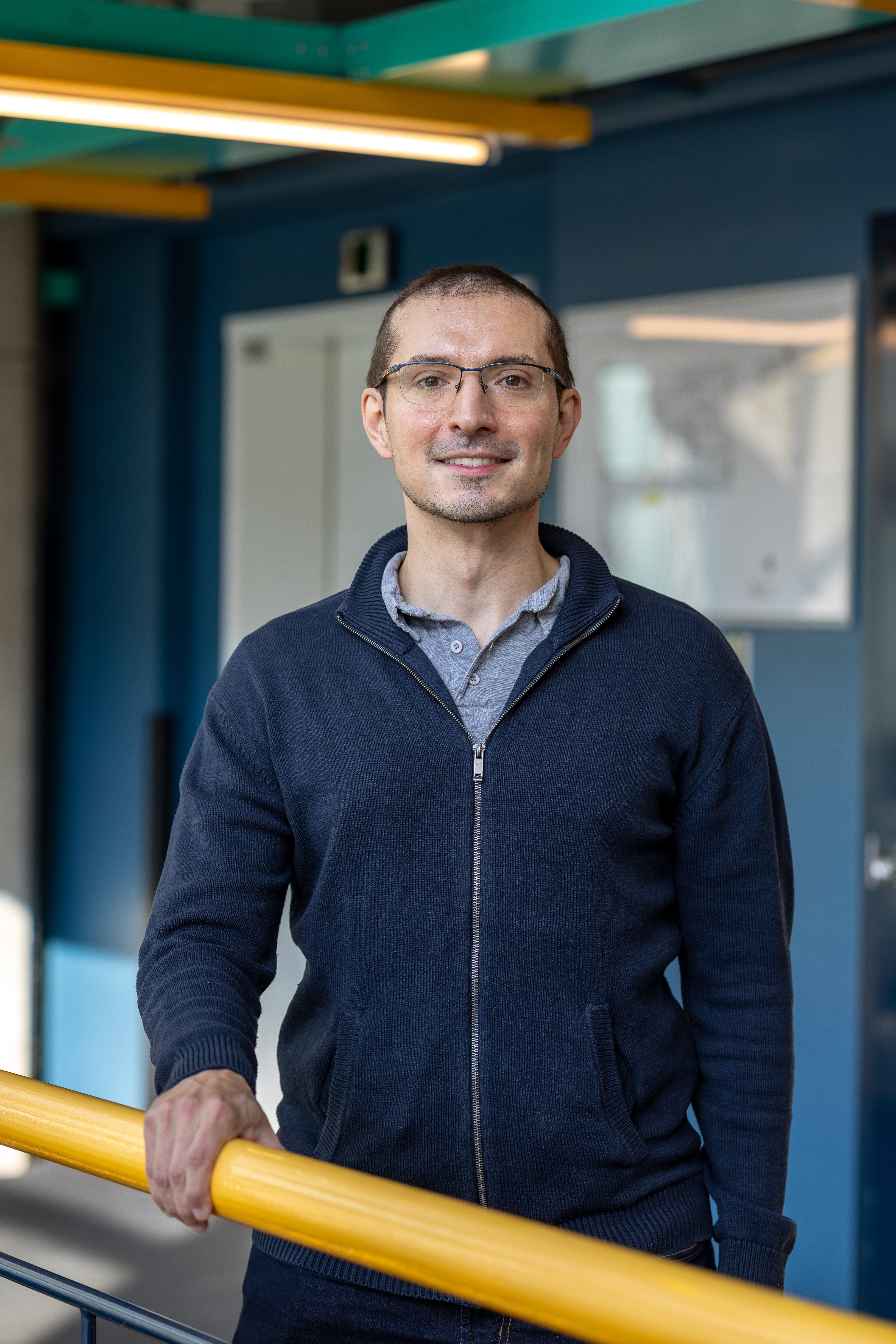
Professor Eduardo Martín-Martínez has been named a 2026 Faculty of Mathematics Research Chair. The designation recognizes exceptional scholarly achievement and leadership in a particular field.
A professor of mathematical physics in the Department of Applied Mathematics, Martín-Martínez studies relativistic quantum information, a field that brings together quantum information science, quantum field theory and relativity.
Quantum field theory describes the microscopic world of particles and fields, while Einstein’s general theory of relativity describes gravity and the structure of space and time. Physicists are still working to understand how these two theories fit together. Martín-Martínez approaches the problem through quantum information, asking what an observer can measure, what information they can access and what they can do with it. His work asks how the geometry of spacetime shapes quantum fields and what those fields can reveal about spacetime itself.
One focus of his group’s work is entanglement in quantum field theories. Entanglement is a connection between parts of a quantum system that cannot be fully understood by looking at each part separately. Even when the parts are considered individually, important information about the system is only revealed when they are considered together. Even the quantum vacuum (seemingly empty space) has quantum structure, including entanglement.
Through a process called entanglement harvesting, small quantum systems that have never interacted directly can each interact with a field and acquire some of the entanglement already there. His group has helped explain this process, how spacetime geometry shapes it and how researchers can use it to investigate the structure of quantum fields.
Working with the late Professor Raymond Laflamme, postdoctoral scholar Hemant Katiyar and former student Nayeli Rodríguez-Briones at the Institute for Quantum Computing (IQC), Martín-Martínez took part in the first experimental demonstration of quantum energy teleportation. The demonstration showed how quantum correlations can make energy available for extraction at one location without the energy itself travelling there from another.
“I find it remarkable that studying something as seemingly practical as the transmission of information can teach us about the fundamental nature of spacetime and the mathematics that we can use to model it,” he says.
Martín-Martínez came to Waterloo in 2012 as a postdoctoral scholar at IQC. He was appointed assistant professor in the Department of Applied Mathematics in July 2016 and became a full professor in 2024. He is also an associate at IQC, a member of the Waterloo Centre for Astrophysics and an affiliate at the Perimeter Institute for Theoretical Physics.
Professor Achim Kempf, whom Martín-Martínez describes as a mentor who has always been there for him, first convinced him to come to Waterloo. He says the concentration of expertise in mathematics and mathematical physics is what has kept him here. “The combination of the Faculty of Mathematics, IQC and Perimeter Institute provides an extraordinary environment for research that bridges these areas and crosses traditional disciplinary boundaries,” he says.
Students play a central role in Martín-Martínez’s research group, Barrio-RQI. “Students are not simply carrying out tasks that I assign to them,” he says. “They often contribute original ideas, challenge assumptions, develop new methods and frequently open entirely new research directions.”
He is particularly proud of the research community his group has built, from seeing former students develop independent research careers to knowing that researchers around the world now pursue ideas from this group.
For Martín-Martínez, the designation is especially meaningful. “I am grateful to the Faculty,” he says. “It is very nice to get this recognition for this kind of multidisciplinary research that does not quite fit in a single standard box.”
He is quick to share the credit. “I’d like to thank my students, collaborators and colleagues in Applied Mathematics, IQC and Perimeter Institute,” he adds. “They are the people who make the research happen.”
He sees the recognition as an opportunity to highlight the importance of fundamental, curiosity-driven research. Quantum mechanics, he notes, began as an effort to understand the basic behaviour of matter before giving rise to technologies that shape everyday life. “I think it is essential that universities continue to provide an environment where researchers and students can explore difficult fundamental questions, even when we cannot predict where the answers will lead,” he says.