“Computers loom large in the world of tomorrow,” declared an October 1968 article in the University of Waterloo Quarterly. “They will help educate children, run complex industrial plants, revolutionize the communications industry; they will drastically alter the way we shop for food, clothing and other merchandise.”
The article accompanied a photo of the brand-new Mathematics and Computer (MC) building, which was completed earlier that year. It was the largest building on campus, and featured the biggest and fastest computer in Canada at the time: a testament to the Faculty of Mathematics’s focus on cutting-edge technology and innovation.
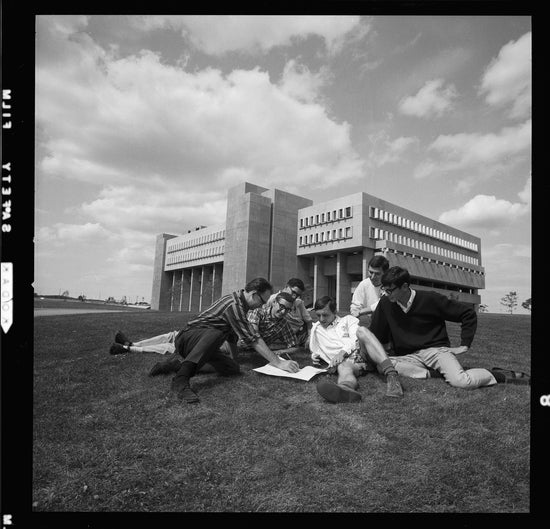
Students study together in front of the newly completed MC, 1968
Today, we are living in the world of tomorrow predicted by that writer, and Mathematics 4, the Faculty of Math’s cutting-edge new building, is scheduled to be completed in 2027: just in time for the sixtieth anniversary of the Faculty.
In honour of Math 4, we’re looking back at the other buildings on Waterloo’s “Math Campus,” and how they came to be.
The Mathematics and Computer Building (MC)
The Faculty of Mathematics began as the Department of Mathematics, chaired by Dr. Ralph Stanton and part of the Faculty of Arts. The visionaries in that department – including Stanton, Dr. Bill Tutte, and Dr. Wes Graham – knew that they were at the beginning of something great. Before Math even became an official Faculty in January of 1967, construction began on a building to house their research.
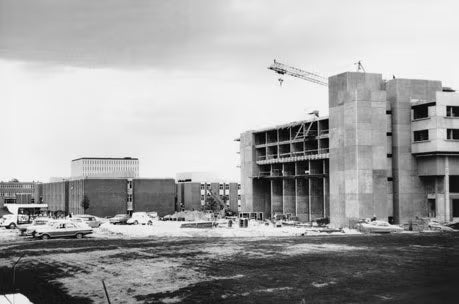
MC under construction, 1967
The Math and Computer Building (MC) was a departure in size, style, and focus from the brick buildings that had been built since the university’s founding in 1956. An iconic example of Brutalist architecture, it was built primarily from concrete, expressing “frugality, as well [as] strength and functionality.”
It also had something that Math’s previous home in the Physics building didn’t have: designated women’s washrooms!
The heart of the building was the iconic Red Room: a two-story chamber housing an IBM 360/75. Of the building’s $7.5 million price tag (around $65 million today); $4.5 million was just for the computer!
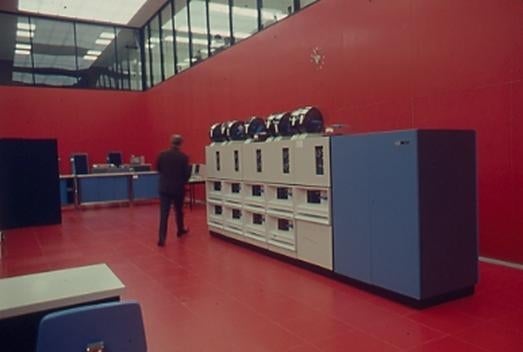
The Red Room, circa 1968
Signing off on that massive purchase was the responsibility of the current provincial minister for University Affairs, the Honourable William G. Davis. Davis believed in the vision of the Faculty’s founders: a university where every student and faculty member, regardless of their field of study, could access a computer.
“That very gutsy decision not only enabled us to reach for our dream,” reflected university president Douglas Wright in 1988, “but it sent shock waves through higher education, and did much to drive the development of computing in universities.”
The W. G. Davis Computer Research Centre (DC)
When it came time for a much-needed expansion, there was no more logical namesake for a new computer science-focused building than Davis.
By the 1980s, computers had undeniably arrived in mainstream society. In 1982, the Faculty of Math established the Institute for Computer Research (ICR), which aimed to “foster computer research…facilitate interaction with industry, and encourage advanced education in computer science and engineering.” The ICR soon outgrew their existing facilities, and in recognition of their pioneering work, the Ontario government announced they would be helping to fund a new building.
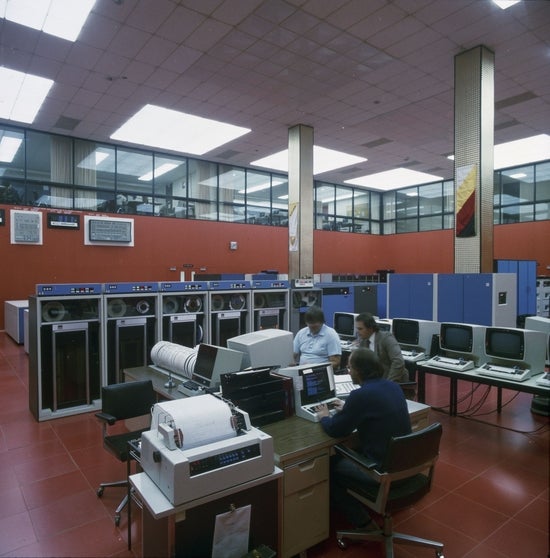
The Red Room, 1984
As with MC, planners thought big, inviting architects across the country to compete to design this cutting-edge, future focused building.
The winners, IKOY Partnerships, created a design that would accommodate advanced electronic systems, a huge library, and windows for each of the building’s 400 offices. The price tag? Fifty million dollars (including $31 million from the Ontario government): “a bargain,” promotional materials bragged, “at just under $110 per square foot.”
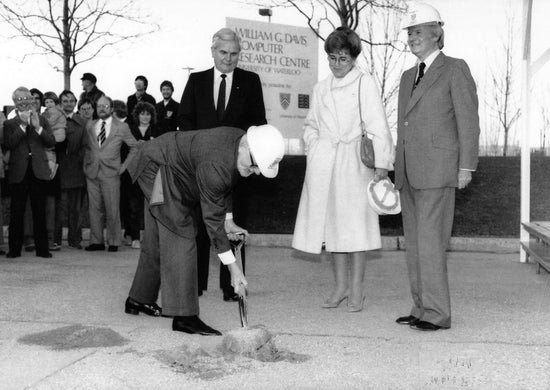
Officials break ground on DC, 1985
Much like MC before it, the Davis Centre represented a new and exciting look for a campus building. The colourful, industrial building was “a metaphor for the visual world of the computer monitor,” wrote associate professor of architecture Larry Richards in a brochure created for the grand opening. “[R]eal green and pink material lines merging with moving green and pink digitized, screen lines. Add to this romantic notion the flow of thousands of people and the result is a motion picture of academic pursuit, an 80s transformation of 60s op-kinetic art.”
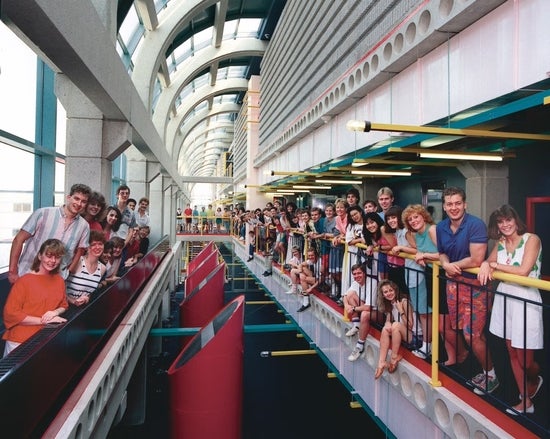
Students in the Davis Centre, late 1980s
Mathematics 3 (M3)
Fourteen years ago, the third building in the Math family, nicknamed “M3,” celebrated its grand opening. Designed by Robbie Young + Wright / IBI Group Architects, the four storey, 90,000 square foot building existed because of more than $36 million in funding from the Ontario and federal government. As always, the new Math build set records: this time for its 392-seat lecture hall, the largest on campus.

The 2011 Orientation issue of mathNEWS celebrated M3's first school year
M3 was specifically built to encourage growth in three key areas: computational intelligence, health informatics, and new media technologies. It represented a new chapter in the Math story – one written for a world in which computers touch every research area and aspect of daily life.
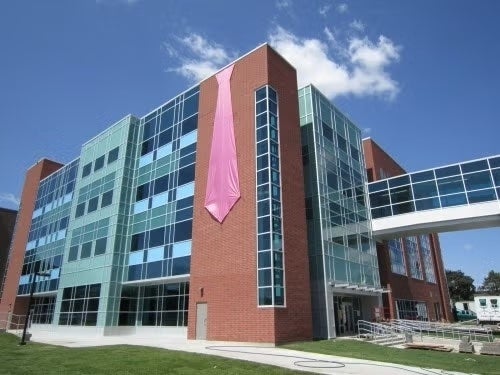
The brand-new M3 is welcomed to the Faculty of Math with its very own pink tie
Mathematics 4 (M4)
Today, workers are pouring concrete and welding steel on Mathematics 4. The five storey, 120,000 square foot building will feature an eco-friendly server room, and catalyze research into artificial intelligence, data analytics, security, and other vital issues we face today. Soon, it will join the other buildings as a familiar sight for students and faculty: reminders that here in the Faculty of Mathematics we don’t just imagine the future—we build it.
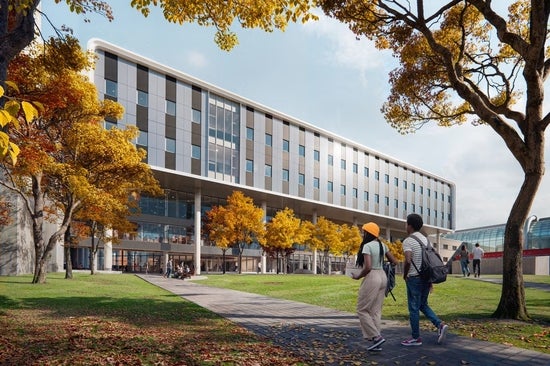
Artist's rendering of M4 as seen from the quad, with MC on left and DC on right
To learn more about Mathematics 4, visit the project website.