Students from the Faculties of Mathematics and Environment have been working together with real-world stakeholders to innovatively address problems facing Canadian communities. Participants in the Faculty of Environment’s Planning capstone course (PLAN 405) partnered with Math students in MTHEL 398 on semester-long projects that utilized their combined skills.
While students are still weeks away from finishing their projects, they have already built valuable relationships with each other and with external stakeholders, and learned how to take ideas from project proposal to reality.
Measuring Emergency Homelessness Response Policy in Canadian Cities: A Hybrid Human-Machine Learning Approach
Anna Chung (Planning), Linda Evans (Planning), Sameer Fettes (Computer Science), Kenya Miller (Planning), Paige Thompson (Planning)
Sameer Fettes first learned about the capstone course on LinkedIn, and decided to take it because he had deeply enjoyed doing interdisciplinary policy work at Environment and Climate Change Canada during a previous co-op term. His group’s project is focused on using machine learning to better understand a city’s homelessness policy, by analyzing a variety of documents including bylaws and local news stories. One of the goals of the project is to figure out whether it is possible to quantify the policy intensity of documents, to help researchers understand individual cities’ homelessness policies more quickly and in greater depth.
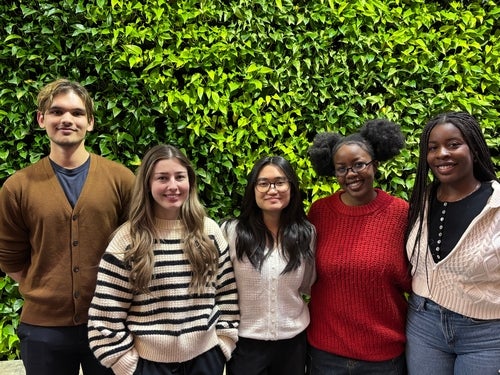
L-R: Sameer Fettes, Paige Thompson, Anna Chung, Linda Evans, Kenya Miller
“We’ve been working with the Future Cities Institute to do a qualitative comparison of Toronto, Vancouver, and Montreal, in terms of what specific issues they experience and how they’re addressing them,” Fettes explains. “In our early proof of concept, it took about thirty minutes to analyze all 2500 documents from an existing policy database that was provided to us.” They are working on creating a method that can be reproduced with other cities, and expanded to analyze policy issues other than homelessness as well.
“Interdisciplinary classes like this are great for Math students, because they give us more opportunities to understand fields that really matter beyond tech, finance, and software engineering,” he says. “I have really enjoyed being in a class that doesn’t just talk about how to build things, but also about what you should build, and why you should do it.”
Building Independent Grant-Writing Capacity in Nunavut: A Structured AI-Assisted Proposal Tool
Maddie Berman (Planning), Brandon Fowler (Computer Science), Nicholas Kerr (Planning), Josh Ponte (Planning)
“I chose this project not only because of its relevance to my previous work, but also because I myself am also Indigenous,” says Brandon Fowler, a Computer Science student. His group was tasked with creating a culturally sensitive AI-powered grant proposal writing tool in partnership with the Nunavut Economic Developers Association (NEDA). The tool allows users to answer basic information about their grant proposal, then work alongside an AI agent to further refine their requirements to eventually generate a draft proposal that they can further refine and edit alongside the AI agent. “This project is important because it helps give self-sufficiency and economic autonomy to the communities of Nunavut,” he says.
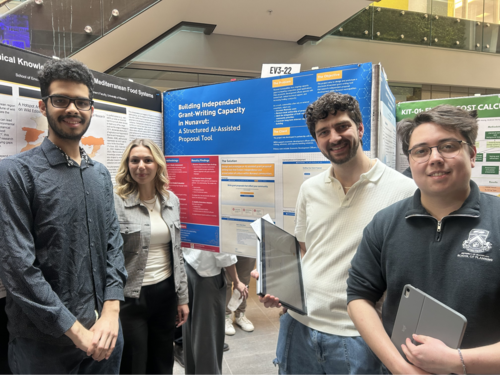
L-R: Brandon Fowler, Maddie Berman, Josh Ponte, Nicholas Kerr
The students split up the work according to their skill sets – Fowler did most of the coding and AI research, whereas his Planning colleagues handled problem analysis, presentations, and other contextual concerns. “As computer scientists, it can be easy to overlook the benefits of working closely with people in other professions. If we don't it's easy to lose the perspective of the very non-technical users our solutions are designed to serve,” he reflects. “This project has given me a new perspective on interdisciplinary work, and how different disciplines are inherently required to come together to make new and exciting creations.”
Building an Energy Calculator for Kitchener Utilities
Tharun Abraham Aju (Statistics and Actuarial Science), Michael Glazyrin (Planning), Chloe McNabb (Geography & Environmental Management), Hayden Milne (Planning), Grace Keren Wang (Statistics), Andrew Wong (Planning)
Tharun Abraham Aju’s group has been working with the City of Kitchener all semester to improve their public-facing energy calculator. “It’s currently a very basic website where you input how much natural gas you use for heating, and it outputs a dollar amount,” he explains. “The problem is that there are many types of households, building materials and ages, and machines used to heat and cool homes, and all of these change the heating cost.” Aju’s group has been working to update the calculator accordingly, as well as introducing assessment for sustainability as well as cost.
“It’s been cool working with Kitchener Utilities,” Aju says. “We had several meetings where they helped us identify the needs of the project.” While he has been handling much of the technical side of the project – “It’s very Excel oriented” – his teammates have focused on researching the impact of different technologies and building conditions on energy use. “The research has been challenging, because often the papers are more qualitative than quantitative, not focused on thermodynamics or math” Distilling that research into usable equations has been challenging.
“We are moving away from an age in which every computer science student becomes a software engineer, so it makes sense to have exposure to other domains,” he says. “I would love to see similar courses partnering with other faculties on other interdisciplinary projects.”