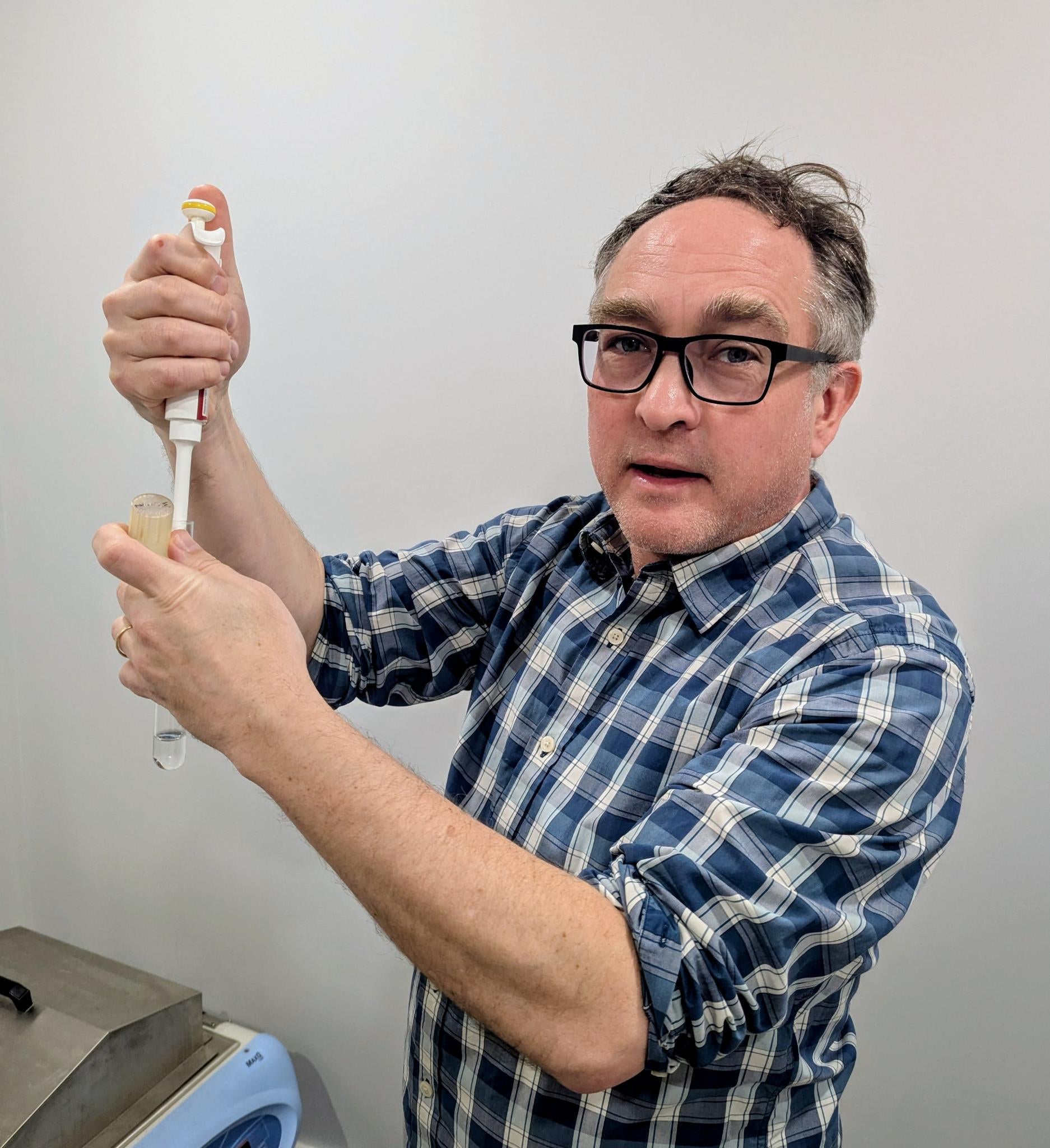
Congratulations to Dr. Matthew Scott, associate professor of Applied Mathematics and co-director of the Mathematical Biology Laboratory, on his co-receipt of a substantial grant ($1,350,000 US) from the Human Frontier Science Program.
“I am really grateful for the opportunity to work with this incredibly talented team on such an exciting project,” Scott says.
Scott’s project, “Living Batteries: Reconfiguring cell-wall deficient bacteria as synthetic mitochrondria,” is a collaboration with three international researchers: Dr. Meriem El Karoui (ENS Paris Saclay, France), Dr. Karl Morten (Oxford University, UK) and Dr. Madeleine Moule (The University of Edinburgh, UK).
“The hub of this collaboration is Dr. El Karoui,” Scott explains. “She saw data from Dr. Morten’s lab in Oxford showing bacteria alongside mitochondria inside the cells of patients suffering from chronic fatigue, and when I mentioned that we had a robust mathematical model of bacterial physiology that we wanted to extend to other kingdoms of life, she brought us all together on a project to use bacteria as synthetic mitochondria. To complete the team, we recruited a world-class cell infection specialist, Dr. Moule from Edinburgh.” The team’s goal is to engineer bacteria to act as synthetic mitochondria for individuals with chronic diseases. “We want to make living batteries that we can use to replace worn out mitochondria.”
The team is working collaboratively across borders, with each member contributing to the research from their home universities. One quarter of the research funding, approximately $337,500 USD total, will come to the University of Waterloo over the next three years.
"The Department of Applied Mathematics has unique research strengths in mathematical biology and medicine, combining mathematical and computational modelling with advanced wet-lab experimentation," says Dr. Hans De Sterck, chair of Applied Math. "This high-profile international grant will allow Prof. Scott and his collaborators to conduct innovative research across continents that pushes the boundaries of knowledge in mathematics and the life sciences."
The Human Frontier Science Program (HFSP) promotes “international collaboration in basic research focused on the elucidation of the sophisticated and complex mechanism of living organisms.” Founded in 1990, the HFSP is funded by participating governments, and designed to promote research collaboration across the world. The HFSP’s research grants emphasize “novel and interdisciplinary approaches that involve scientific exchanges across national and disciplinary boundaries.”
The HFSP, Scott explains, plays a unique role in funding basic science. As a supernational non-profit funded by two dozen governments around the world, “their mandate is a focus on high-risk, high reward projects. These are moonshot ideas, many of which obviously fail, but when they succeed they change the world. HFSP has been in operation for 36 years, and 28 awardees have gone on to win Nobel prizes. National funding agencies feel a responsibility to minimize the risk of public funds, but it is collaborative research like this that moves the windows of what is possible.”